

Flickr, Carlos Viñas
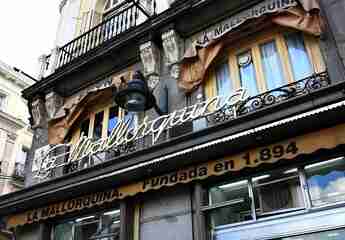
La Mallorquina Pastry Shop is a true paradise for those with a sweet tooth. Located in the heart of old Madrid on Puerta del Sol, it was founded in 1894 by Mallorca native Juan Ripoll.
On the first floor of the pastry shop, pastries, candies, chocolate, and other sweets are sold to take away. At the back of the hall there is a cafe where you can have coffee or tea at the counter. If you intend to relax while sitting at a table, it is better to go up to the second-floor tea room, where a waiter will serve you, although the prices for sweets will be somewhat higher.
It is hardly surprising that there are always many people here — the pastry shop is popular both with tourists and with local residents. And that is understandable, because the quality of the products has remained unchanged for many years, and the assortment is so large that even the pickiest sweet tooth will not be able to remain indifferent. Napolitanas buns with cream or chocolate, bagels, truffles, traditional sugar-free hard Alicante nougat, marzipan fruits, rolls, and cakes — and this is far from a complete list of what delights visitors at La Mallorquina Pastry Shop.
Shall I suggest a couple more dozen places worth visiting? ;) Download the Madrid audio guide in the Ever.Travel mobile app!

Flickr, copperblue2
The Ham Museum in Madrid differs somewhat from the traditional idea of a museum — there are no numerous exhibits kept behind glass here; this place is more like a gourmet shop where you can buy hundreds of kinds of ham from different corners of Spain. However, what sets the museum apart from an ordinary store is that its staff will gladly tell you about all the features of their products.
One of the Museo del Jamon stores is located on the capital's longest street — Calle de Alcala. Here you can buy sausage and cheese delicacies in regular and gift packaging, sample various kinds of ham, and even enjoy a hearty lunch in the cafe-restaurant attached to the museum.
The two main types of Spanish ham offered by the Ham Museum are jamon serrano and jamon iberico. The first is made from the meat of white pigs, the second from a special breed of black pigs that are fattened on cork oak acorns.
In addition, in this unusual museum you may be given a visual demonstration of the skill of slicing ham into very thin, almost transparent slices, because it is quite difficult to eat this product in any other form. And one interesting fact to finish with: did you know that Spain holds competitions for slicing the longest and thinnest ham!

Flickr, Peter Wrem Carlsen
San Miguel Market is truly the gastronomic heart of Madrid!
Previously, on its site stood the Church of Saint Michael, which burned down in 1790 together with Plaza Mayor, which is located not far from here. After the fire, it was decided not to rebuild the church, and a market was laid out on the empty site. At first, trade there was conducted directly under the open sky, until at the beginning of the 20th century architect Alfonso Dube y Diez erected airy steel structures in the style of that time. They say that his main source of inspiration was the Paris market Las Halles.
San Miguel is a meeting place for all Madrid gourmets. Here you will find paella, tortilla, tapas, oysters, caviar, jamon, and many other gastronomic delights of Spanish cuisine. It is important to know that all the products bought here are first offered for tasting! And there are also quite a few small restaurants literally with only a couple of tables where you can have a more substantial meal.
In addition, various events, concerts, and presentations are often held on the grounds of San Miguel Market. You can stop by for shopping or linger here with a glass of wine until very late in the evening — on weekdays the market is open until midnight, and on weekends it closes only at 2 a.m.

Flickr, nickhazlewood
This is a place where you can not only enjoy magnificent Spanish cuisine, but also immerse yourself in the atmosphere of the oldest restaurant in the world! Botin opened in 1725, and since then it has never closed for long, which even earned it a place in the Guinness Book of Records.
At one time, quite a few famous visitors could be found within Botin's walls. The Spanish painter Francisco Goya was often here, though not as a guest — in 1775 he worked in the restaurant as a dishwasher.
Ernest Hemingway loved to eat, drink, and create at Botin, and once, as the restaurant's current owners tell it, he even asked to be allowed to cook paella. Fortunately or unfortunately, Hemingway's impulse did not meet with the approval of the establishment's owners; however, they allowed the writer to mix his own martinis. Hemingway left mentions of this restaurant on the pages of his novel Fiesta.
One should also not forget that, besides everything else, Botin cooks superbly. The fried suckling pig and roast lamb are especially popular. As for prices: you will pay around 18 euros for a main course, and 40 for a three-course dinner.