Before we start, a quick note: this walk is also available in our mobile app - Travel Planner for iPhone and Android. Download it for this route, offline maps, GPS navigation, and help planning the rest of your Rome trip.
Updated for 2026: Trastevere is still one of Rome's best neighborhoods for a long walk, but evenings get crowded fast - go a little earlier for quieter streets and book dinner ahead if you have a place in mind.
Start at Largo di Torre Argentina, a short walk from the Pantheon. Then wander through the old Jewish Ghetto, cross Tiber Island into Trastevere, visit one of Rome's oldest churches, stop for a meal on Via della Lungaretta, and finish at the Sunday flea market.
Largo di Torre Argentina

Flickr, Shirley de Jong
The square takes its name from a tower built here in 1503. The open space you see today took shape in the early 20th century, after nearby buildings and the church of San Nicola dei Cesarini were cleared.
Excavations in the 1920s revealed a Republican-era sacred area below street level, with the remains of four temples now known simply as A, B, C, and D. In antiquity the site was ringed by major public buildings, including the Theatre of Pompey, the Baths of Agrippa, the Circus Flaminius, and the Porticus Minucia Frumentaria.
The nearby Theatre of Pompey also contained the Curia of Pompey, where the Senate met in the Republic's final years. Julius Caesar was assassinated here in 44 BCE. Archaeologists later identified a concrete marker that ancient sources link to the spot of the killing.
Thanks! Every time you book hotels on Booking.com through our site, you help us create another guide, another route, and another city page.
banner booking
Turtle Fountain

Flickr, seanfoneill
The Turtle Fountain was built between 1580 and 1588 in elegant late Renaissance style. Sculptor Taddeo Landini carried out Giacomo della Porta's design, and the nearby Mattei family financed the project. Like many Roman fountains of the period, it also served as a public water source.
The bronze turtles climbing toward the upper basin were added later, during a 17th-century restoration often linked to Bernini or Andrea Sacchi. Together with the dolphins, they are usually read as a symbol of the motto "make haste slowly."
Everything you need to know before your first trip to Rome - practical tips for independent travelers.
Portico of Octavia

Flickr, wfbakker2
The Portico of Octavia was rebuilt under Augustus on the site of the earlier Portico of Metellus and dedicated to his sister Octavia. It formed a grand colonnaded complex decorated with marble and a large collection of statues.
The complex was damaged by fire and later restored under Domitian. It enclosed the temples of Jupiter Stator and Juno Regina, along with a library and the Curia of Octavia.
By the Middle Ages, the portico and the nearby Theatre of Marcellus had been absorbed into shops and workshops, and the area became part of Rome's fish market.
Great Synagogue

Flickr, utopiandreaming
This is Rome's largest synagogue. The current building rose after Italian unification, when the old ghetto was dismantled and the city's Jewish community gained full civil rights. The cramped former synagogue was demolished, and plans began for a prominent new temple.
On April 13, 1986, Pope John Paul II made a historic visit here and prayed with Rome's chief rabbi, Elio Toaff. It was the first recorded papal visit to a synagogue and a major moment in Catholic-Jewish relations.
Tiber Island

Flickr, rudypollazzon
Tiber Island is the small boat-shaped island in the Tiber between the old Jewish Ghetto and Trastevere. According to legend, it rose from silt deposited here after the fall of the tyrant Tarquinius Superbus. In 293 BCE, during a plague, the Senate founded a sanctuary to Aesculapius, the god of healing, on the island. A sacred snake was said to have slithered from a boat onto shore, after which the island was reshaped like a ship with travertine embankments and an obelisk as its mast.
Santa Maria in Trastevere

Flickr, caribb
Santa Maria in Trastevere is a titular basilica and likely one of Rome's oldest churches dedicated to the Virgin Mary. Tradition places the first church here in the 3rd century under Pope Callixtus I; a larger basilica followed in the 4th century under Pope Julius I; and the core of today's church was built in the 12th century under Pope Innocent II.
Around 1140, the apse was decorated with a glittering mosaic of Christ and Mary, surrounded by apostles, saints, and Pope Innocent II holding a model of the church. Below it are scenes from Mary's life by Pietro Cavallini.
Inside, the nave is lined with ancient columns reused from classical buildings. The basilica holds an impressive mix of ancient, early Christian, and medieval art, and the facade is also adorned with a mosaic of the Virgin among saints.
Santa Cecilia in Trastevere

Flickr, chongchineu
Santa Cecilia in Trastevere is a medieval titular basilica dedicated to Saint Cecilia, the patron saint of music.
According to tradition, it stands on the site of Cecilia's house, and a church existed here by the 5th century.
The present basilica took shape in the 9th century and was later reworked in the Baroque period.
In front of the altar is Stefano Maderno's moving marble sculpture "The Martyrdom of Saint Cecilia" (1599-1600). The saint's relics were brought here from the Catacomb of Saint Callixtus.
The church also preserves fragments of Pietro Cavallini's fresco "The Last Judgment" (1293), while the ceiling shows "The Coronation of Saint Cecilia."

lettera43.it
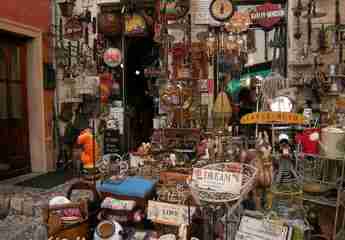
At Porta Portese, you'll find clothing, housewares, vintage odds and ends, and plenty of bargain-bin surprises. Quality varies wildly, of course, but low prices are part of the fun - and this is one of the few places in Rome where haggling still feels natural.
Do keep an eye on your belongings. The crowds are dense, so bring as little as possible and keep cash and documents somewhere secure.
You'll also see plenty of supposedly designer pieces. Some look convincing at first glance, but treat them as what they are: market knockoffs, not genuine luxury finds.
The Porta Portese market is easy to find - it stretches along Via Portuense and nearby streets. It runs only on Sunday mornings, so plan accordingly.
See also our other self-guided walks through the Eternal City:
- Guide to Rome
- First self-guided walk in Rome: Vatican and the Vatican Museums
- Second self-guided walk in Rome: Castel Sant'Angelo - Piazza Navona - Pantheon - Trevi Fountain
- Third self-guided walk in Rome: Colosseum - Roman Forums - Piazza Venezia - Trajan's Column - Imperial Forums
- Night walk through Rome