
Pařížská Street
Updated for 2026: Josefov is as atmospheric as ever, but it fills up quickly. Start early or come later in the day if you want a quieter walk and more breathing room inside the synagogues and cemetery.
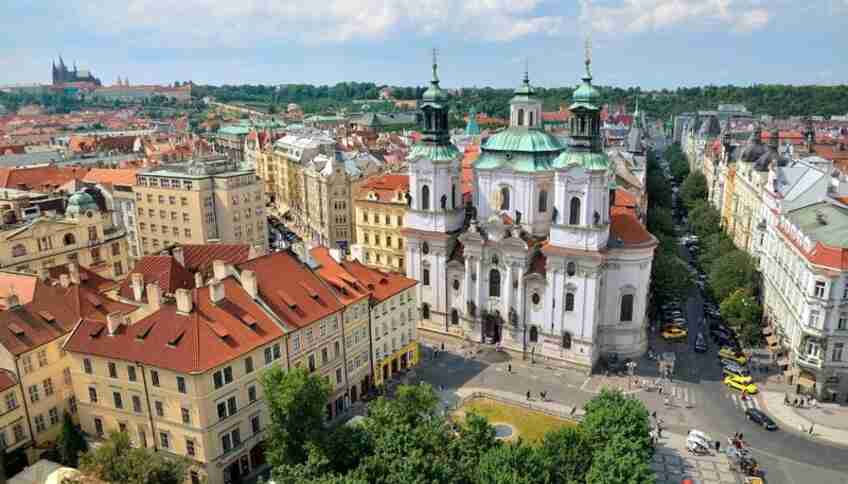
We will begin our self-guided walk from Old Town Square, walking along Pařížská Street, which begins by St. Nicholas Church. Today it is lined with luxury boutiques, but until the mid-19th century this street did not exist at all.
Before we set off, a quick reminder: this walk is part of our free mobile app – Travel Planner for iPhone and Android. Download it for offline maps, GPS, and help planning the rest of your Prague trip. So, let's go!
The quarter we invite you to explore is called "Josefov." It received this name at the end of the 18th century in honor of Emperor Joseph II, whose Edict of Tolerance granted Jews broader civil rights within the Habsburg Empire. Before that, this part of Prague was simply known as the Jewish Town, or ghetto.
By the way, the word "ghetto" is widely believed to have come from Venice. In the early 16th century, Jews there were confined to an island called Ghetto Nuovo, a place once associated with foundries. The name later spread far beyond Venice.
Venice is often described as the first city to impose this kind of separation: windows facing neighboring islands were said to be bricked up, and the gates were locked at night. Prague developed a little differently. What began as an ordinary community was only later cut off from the rest of the city.
Every time you book hotels on Booking.com through our site, you help us describe one more place, create one more route, and develop one more city. Thank you for that!
banner booking

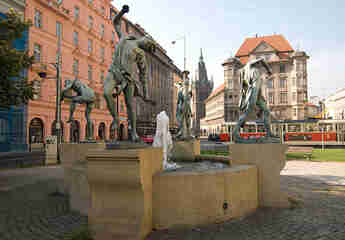
Pařížská Street begins at Old Town Square. Photo by François de Nodrest.
The first Jewish settlements appeared in Prague as early as the 10th century, on the left bank of the Vltava, where Malá Strana is today. Here, on the right bank, Jews appeared in the 12th century, probably after being pushed out of the older settlement. Back then, this district was not central Prague at all, but the edge of town.
What mattered was the location. A major trade route passed along Široká Street, linking western Europe with the east, and commerce here was lively. Many historians believe Jewish merchants were among the first representatives of this community to settle in Prague. Turn onto Široká Street from Pařížská Street, and you will reach the next stop on our walk – the Spanish Synagogue.
We also recorded a special audio walk through the Jewish quarter, where we tell the legends and darker stories tied to this place. It and other audio walks around Prague can be found in our free Ever.Travel mobile app for iPhone and Android.
Franz Kafka Monument
Near the entrance to the Spanish Synagogue stands a mystical, almost psychedelic monument to Franz Kafka. A small figure resembling the writer rides on the shoulders of an empty suit. It is hard to say exactly what sculptor Jaroslav Róna meant, but he captured Kafka's signature mood of anxious absurdity with remarkable precision.

By the way, the monument was installed relatively recently – in 2003. Photo by Frank Paul Silye.
This monument can be read in different ways. Some see a character from Kafka's fiction finally breaking free from a hopeless, frightening reality. Others see the opposite: a man still trapped inside an absurd and all-powerful system.
Read everything you need to know before a trip to Prague – a great place to start.
More self-guided walks in Prague
Spanish Synagogue
The place where the Spanish Synagogue stands today used to be called the "Old School." Historians believe Jewish merchants from Byzantium originally settled here. Whether because of their status or because their religious traditions differed from those of the rest of the quarter, the residents of this community seem to have remained somewhat separate.
On the site of the Spanish Synagogue, that very "Old School" still stood in the 19th century, but it had to be demolished because of its poor condition and an unsuccessful reconstruction. In 1868, the Moorish Revival building that we see today appeared here.

After visiting the museum, be sure to walk around the synagogue and look at its western facade. That is where the best view of the building opens up.
From the outside, the entrance to the Spanish Synagogue hides in a modest gray annex. Do not let that fool you: inside, you get a riot of color, gold, enamel, stucco, and intricate arabesques. On the second floor there is a museum exhibition dedicated to the age of enlightenment and Jewish emancipation.
Good to know: you can buy either individual tickets to the synagogues you want to visit during the walk or a single ticket for the entire Jewish quarter. The second option is usually better – it saves money and lets you see the district properly.
Old-New Synagogue
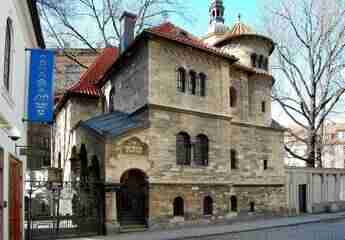
Next, we suggest that you walk to the Old-New Synagogue. It was built in the late 13th century and was then called the "New" or "Great" Synagogue. At that time this was perfectly true, and for many years the name fit. Later, as Prague grew and larger synagogues appeared, the old name became confusing, so "Old" was added. That is how the "Old-New" Synagogue came to be.
This building is unique in that its medieval exterior and interior have changed very little over the centuries. It is in this synagogue that, according to legend, Rabbi Loew's Golem was kept in the sealed attic. You will find the mystical story of the Golem's creation and the trouble that followed in our audio walk through the Jewish quarter by downloading the Ever.Travel mobile app for iPhone and Android.

The Old-New Synagogue is still active today
Jewish Town Hall
Next to the Old-New Synagogue stands the Jewish Town Hall – the former administrative center of the community. This building burned more than once, and the exterior we see today took on its Rococo appearance in the 18th century. A pair of clocks is installed on the facade of the town hall: one is ordinary, with Roman numerals, and the other is Hebrew. Notice how the Hebrew one seems to run backward. That is because Hebrew is read from right to left.

On the left – the entrance to the High Synagogue, on the right – the Jewish Town Hall
High Synagogue
Adjoining the town hall building is the magnificent High Synagogue, so named because the entrance to its prayer hall was on the second floor, and it could once be reached only through the town hall.
See also all the sights of Prague: Charles Bridge, Prague Castle, Golden Lane, the Dancing House...
Pinkas Synagogue
Next, we invite you to make a small detour. It is necessary because the entrance to the Old Jewish Cemetery, where we are heading, is possible only through the Pinkas Synagogue.
The building of this house of prayer was built in 1535 with funds from Aaron Horowitz. The place chosen for it was not ideal, as groundwater comes very close to the surface here. Since its construction, this synagogue has suffered several times from severe floods.

Today this building houses the Memorial to the Victims of the Holocaust
On the white walls of the synagogue, the names of Jews from Bohemia and Moravia who were killed during the Holocaust are handwritten. More than 77 thousand names, about a quarter of them children. On the second floor of the Pinkas Synagogue there is an exhibition of moving children's drawings by prisoners of the Terezin concentration camp. Most of them never grew up: of the 8 thousand children deported east at the very end of the war, only 242 survived.
Old Jewish Cemetery
You will come out into this cemetery by passing through the Memorial to the Victims of the Holocaust. There are two routes in the necropolis – winter and summer – and we think you will figure that out easily. Meanwhile, here are a few facts about this extraordinary place.

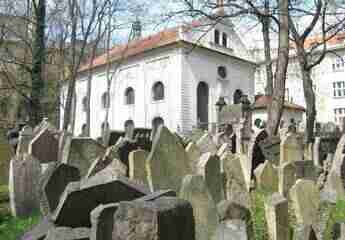
Originally, Prague's Jews were forbidden to bury their relatives outside the ghetto. They had to adapt and place newer graves above older ones. When the cemetery ran out of space, fresh soil was piled on top, people were buried there, and the earlier gravestones were moved higher. Over the years, the Jewish cemetery turned into a kind of layer cake strewn with gravestones. Historians believe that there are 12 burial layers here, containing around 40,000 burials.

This cemetery faithfully served the ghetto for nearly 300 years, until it was closed for burials in the 18th century. The most interesting graves preserved here to this day are those of Mordechai Maisel, one of the great benefactors of Prague's Jewish Town, and Rabbi Loew, the famous mystic and Kabbalist most closely associated with the Golem legend.

At the exit from the Old Jewish Cemetery, you will come across two important buildings. The heavy gray Romanesque-style structure is the Ceremonial Hall, and the white building is the Klausen Synagogue, which today houses an exhibition dedicated to Jewish traditions and customs from birth and circumcision to weddings and funerals.

Maisel Synagogue
Here our loop around the Old Jewish Cemetery closes, and we head to the Maisel Synagogue, named after Mordechai Maisel, one of the Jewish Town's wealthiest and most generous figures, who financed its construction.
The synagogue was erected on this site in 1590-1592 and was so beautiful that, according to contemporaries, Jews from across Bohemia and Moravia came to Prague to see this luxurious building. Completely unimaginable rumors circulated about its rich interior decoration. However, fires, which occurred quite often in the Prague ghetto, did not spare this beauty, and the synagogue has come down to our days in a form very different from its original grandeur.

Today the Maisel Synagogue is under the care of the Jewish Museum. It features a very interesting exhibition telling the history of Jewish life on Prague soil.
Not far from the Maisel Synagogue there is a little restaurant called "At the Golem". We recommend that you return here after the tour ends, because the food here is genuinely very good. You will easily find this place not only by the sign, but also by the figure of the Golem laid into the cobblestones at the entrance.

The restaurant has been operating here since 1967, and on its walls you will find many autographs of famous and well-heeled guests who have dined here over the years.

The Josefov quarter is located in the very heart of Old Prague. Staying here is genuinely interesting, and the city's main sights are just a short walk away. Still have not decided where to stay? We can suggest a hotel in Prague. Every time you book through our site, you give us the opportunity to continue creating new routes, describing new places, and expanding our database of cities. Thank you for that.
Rabbi Loew Monument
We have already mentioned Rabbi Loew while talking about the Old Jewish Cemetery. He was truly a significant and mystical figure who played an important role in the life of the Jewish quarter. On Mariánské Square you will see a monument to him and his little granddaughter hiding in the folds of the rabbi's robe. Believe it or not, according to legend this little girl played a part in the story of how death itself came hunting the great rabbi.
Intrigued? Download the Ever.Travel mobile app for iPhone or Android, and in Prague you will find an audio walk through the Jewish Quarter where we tell in detail about the Golem, Rabbi Loew, and the legend of how the Angel of Death was outwitted.
More walking routes and walks:
Tell your friends about what to see in the Jewish quarter "Josefov"