You can't visit Greenwich without seeing with your own eyes that very Greenwich Observatory, which sets the standard for Universal Time and marks the Prime Meridian.
In the past, all countries kept track of time and distances from their own meridians, but in the age of progress, when international trade became extremely important, it was decided to establish common standards for everyone. The measurements of the greatest maritime power at that time - Great Britain, whose observatory was founded back in 1675, were chosen as the reference point.
The Prime Meridian was marked with a brass strip running through the observatory courtyard. The cherished goal of any tourist in Greenwich is to take a photo standing with one foot in the Western Hemisphere and the other in the Eastern Hemisphere.
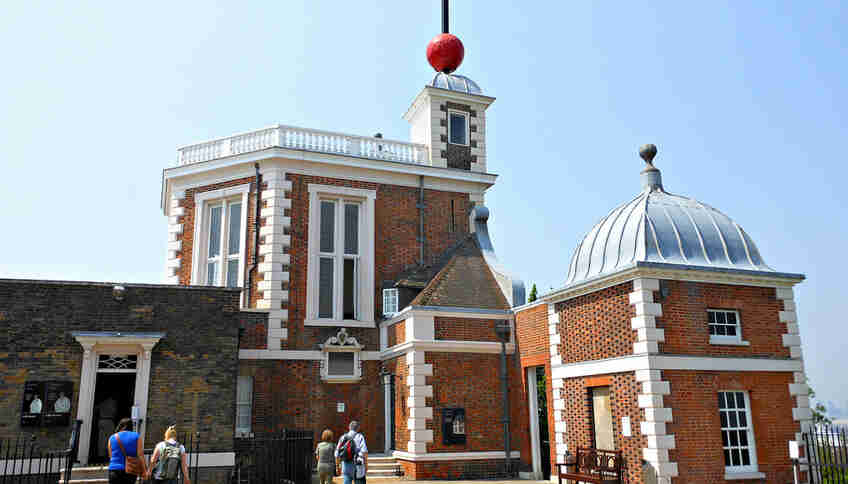
You can set your watch with perfect accuracy by synchronizing it with the "time ball." This red ball was installed on the spire on the roof of the building back in 1833, and since then it has dropped sharply to the base of the spire every day at exactly 13:00 in Greenwich.
The scientific and research departments of the Royal Observatory were moved farther away from London, because at first the development of the railway interfered with precise measurements, and later the scientists had to flee from the war and London's smog, which hindered observations.
Today, Greenwich Observatory has become a museum of navigation and astronomical instruments. Its collection will impress even those who are completely indifferent to technology and the exact sciences, because here there are a wide variety of clocks, chronometers, and telescopes, some of which are already many hundreds of years old.