
lense.mycharminggirl.com
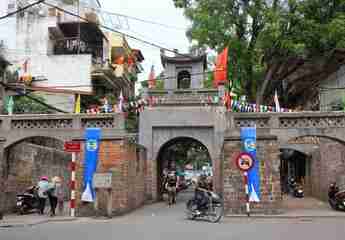
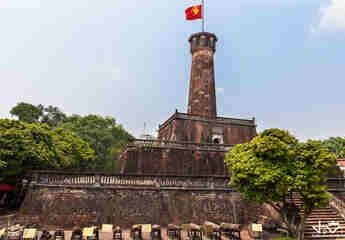
In the old city quarter, at the end of Hang Chieu Street, you will see an arch through which Vietnamese people on bicycles and scooters are constantly darting. This arch, crowned with a lookout tower with a gazebo resembling a pagoda, is Quan Chuong, or Hanoi's Old City Gate. It consists of one large arch three meters high and two small side arches for pedestrians.
This gate is the only one preserved from the 16 gates of the XVII-century city wall. It was built during the Late Le Dynasty, when the rulers decided to strengthen the city, founded back in the XIII century, with a fortress wall and watchtowers above the gates. Back then each of them bore the name of the village or area to which it opened, and Quan Chuong was called Dong Ha, after the neighboring village.
That was the case from the moment the gate was built in 1749 until 1873, when French troops destroyed all of the city's fortifications, including the gates. But at the one before you, a mandarin named Chuong made his stand - he and his soldiers held the gate to the last drop of blood and the last breath. In memory of such heroism, the French decided not to destroy the Dong Ha Gate. Later, the townspeople began calling it by the legendary mandarin's name - Quan Chuong.

Flickr, Codognanais - François CANTO
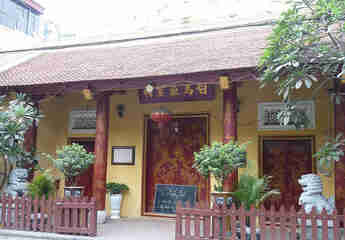
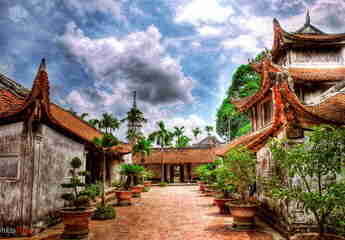
Centuries pass, dynasties of kings change, yet Bach Ma still stands, untouched by time and the elements. It is already more than a thousand years old! The temple is the oldest religious structure in Hanoi.
The story of Bach Ma's construction is quite interesting: it all began in the XI century, when Ly Thai To decided to found a new capital for his state. Back then it was not yet Hanoi, but Thang Long. But the builders' work was not going well at all: walls collapsed, roofs caved in... Then a white horse appeared before Ly Thai To and showed the place where the fortifications should be built. Following its guidance, the construction was moved to a new location, and everything immediately began to go smoothly. Since then, the white horse has been Hanoi's unofficial talisman. And Bach Ma Temple was built in gratitude; its name translates as 'Temple of the White Horse'.
Bach Ma looks very modest, yet elegant. This small structure is always filled with both tourists and local residents bringing offerings and donations.

tourinhanoi.com
The architecture of Hanoi at the beginning of the XX century is a kind of eclectic blend of traditional Vietnamese ethnic motifs and European style. But to fully understand how the Vietnamese lived at the beginning of the last century, it is worth visiting the so-called Ancient House, located in Hanoi's Old Quarter.
It occupies two buildings at once, connected by a shared courtyard and balcony. The ground floor, by tradition, is intended for work and trade. The bathrooms and kitchen are also located here. The second floor is set aside for private life; here you will see bedrooms, a living room, and a hall for ancestor worship.
The interior of the house is very cozy; the walls are painted a pleasant yellow. The wooden furniture is decorated with mother-of-pearl inlays traditional for Vietnam. Overall, the setting suggests that the people who lived in the house were not poor.

Flickr, lenguyen phamtran
The history of this street begins back in the XIII century, when the first houses started appearing on the site of drained swamps. At that time it was customary for members of the same craft guild to settle next to one another, and that is how Hanoi's oldest streets appeared: Paper, Fan, Shoe, Silk, and many others.
Almost all of them still exist to this day, and there you can still buy anything - from rice paper and painted fans to national costumes and lengths of real silk. In addition, prices in the Old Quarter will pleasantly surprise you; here they are much lower than in the city's markets and souvenir shops.
On Silk Street there are both private shops and state fabric stores, but, as you know, bargaining with private sellers is customary, so here you can buy a luxurious silk scarf for just 10 dollars.
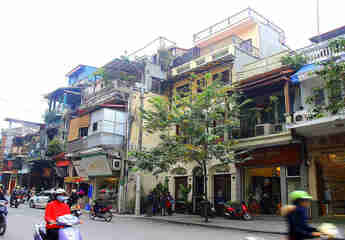
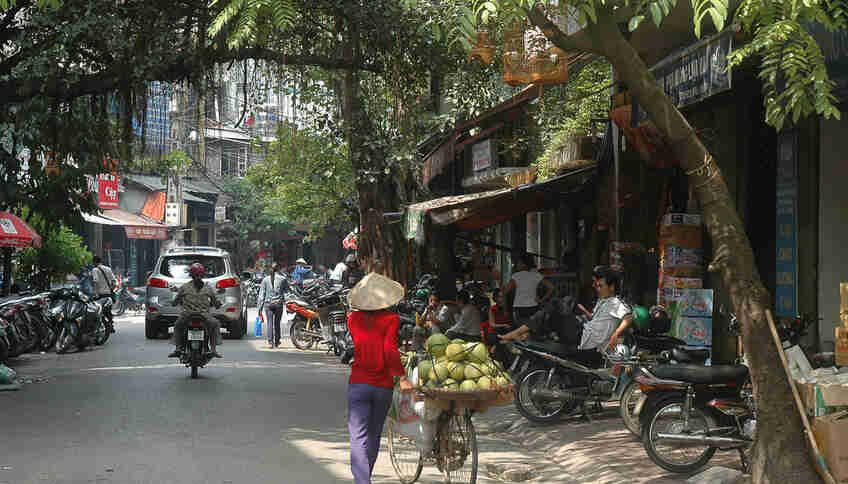
The streets of Hanoi's Old Quarter create a funny visual illusion: from the outside it seems that you are entering a tiny shop only a few meters wide, but when you open the door, you discover that the store is quite large, just absurdly stretched in length.
The explanation for this phenomenon lies in medieval Vietnamese laws: for several centuries, the city had a tax on the width of a facade. The more spacious the house and the wider the facade, the more you had to pay into the treasury. That is how crafty Vietnamese came up with the idea of building narrow houses, which are now called tunnel buildings. All the rooms and utility spaces in such buildings are arranged in a single line.
Besides, old houses are usually no higher than two stories - in the past it was forbidden to build a house taller than the ruler's palace.

Flickr, Mark Turner
In our view, Vietnamese people are not very religious. The overwhelming majority of the population follows the so-called 'cult of ancestors', which does not have the clear system and organization that we are used to as necessary attributes of any religion. It is more a set of moral traditions and rituals passed down from generation to generation.
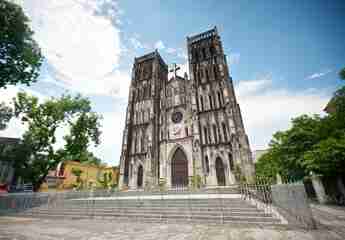
But Christians also live in Vietnam; they make up about 8% of the country's entire population, roughly 300000 people. And they have their own churches, one of the most outstanding of which is St. Joseph's Cathedral, built on the ruins of the Bao Thien tower by colonizers in 1886.
Externally, the temple is very similar to Notre-Dame de Paris; apparently the French decided not to be original and instead remain faithful to the classics. The gloomy Neo-Gothic style seems to transport us straight from Asia to Paris.
The interior decoration of the cathedral is quite bright; after all, the Asians' love of vivid color and liveliness made itself felt. Here you will see beautiful stained-glass windows, and on the back side of the church - unique bas-reliefs with biblical scenes.
In the cathedral courtyard there are comfortable benches where local residents, regardless of faith, relax, chat, and read newspapers.