Fisherman's Bastion

Flickr, Virgil photo colection
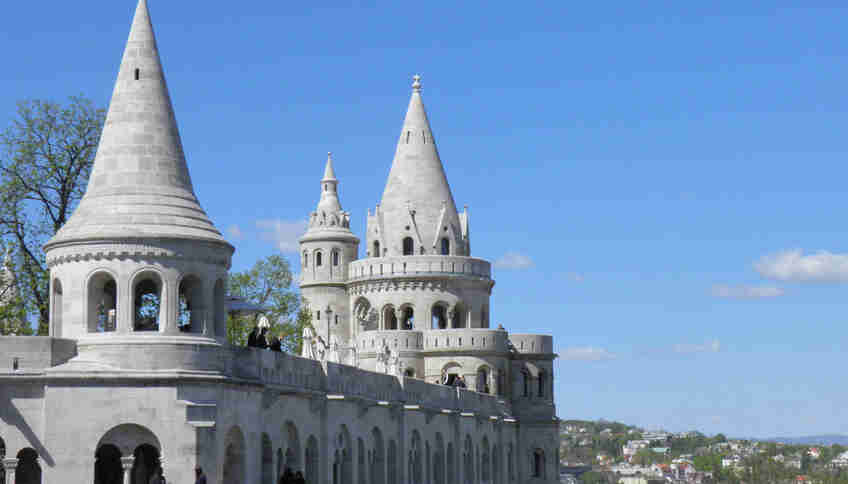
Fisherman's Bastion (Hungarian: Halászbástya) is an architectural structure on Castle Hill in Buda, one of the landmarks of the Hungarian capital. It consists of a square surrounded by a gallery 140 m long and 8 m wide with conical tented towers (6 small ones and one central one, symbolizing the seven tribes that founded the Hungarian state), arcades, and balustrades, from which a magnificent view of the Danube and Pest opens up. Fisherman's Bastion was built in 1899—1905 to the design of architect Frigyes Schulek and conceived as an architectural backdrop for Matthias Church. Despite its name, Fisherman's Bastion never had any defensive significance. Earlier, on the site of Fisherman's Bastion there was a square surrounded by a fortress wall where fish was traded. In the Middle Ages, Buda fishermen defended this section of the fortress wall in the event of a military threat, and Fisherman's Bastion became a monument to the brave guild of fishermen.
Monument to St. Stephen

Flickr, Macrobeus
Stephen I the Saint (Stephen the Great) (Hungarian: (Szent) I. István, Latin: Sanctus Stephanus[1] - Saint Stephen) (c. 970/975 — 15 August 1038) was Prince of Nitra (995—997), Grand Prince of the Hungarians (from 997), and the first king of the Kingdom of Hungary (from 1000/1001) from the Árpád dynasty. At birth he was given the name Vajk - Vayk[2] (from Turkic - 'hero' or 'leader'). The year of his birth is unknown, but some details of his biography make it possible to assert that he was born in 975 or a little later. Stephen was the only son of Grand Prince Géza and his wife Sarolt, who came from the noble line of the gyulas. Although both his parents were baptized, Stephen was the first devout Christian of the Árpád family. He married Gisela, daughter of Duke Henry II of Bavaria. After his father's death in 997, Stephen was forced to enter into a struggle for the throne with one of his relatives, Koppány, who was supported by a pagan retinue.
Church of St. Matthias

Flickr, chrisdphotography
Matthias Church (Hungarian: Mátyás-templom) is a Catholic church in Budapest, part of the Buda Castle complex. It was built in the lavish Late Gothic style in the second half of the 14th century and extensively reconstructed at the end of the 19th century. Matthias Church is located on Buda Hill between Trinity Square (Hungarian: Szentháromság tér) and Fisherman's Bastion. The main facade of the church faces west, onto Trinity Square. The church is built in a Gothic style rare for Budapest architecture; in plan it has an irregular rectangular shape with a projecting apse. In the central part of the main facade there is a gate above which is a Gothic rose window. In the south-western corner of the church stands an 80-meter bell tower; the bell tower of Matthias Church is the tallest structure of Buda Castle. On the north side the main facade is bounded by the tower of King Béla. Another entrance to the church is located in the portal of the church's south wall.
House of Hungarian Wines

Flickr, emzepe
House of Hungarian Wines (Hungarian: Magyar Borok Háza) is a museum in Budapest, located in Buda Castle on Trinity Square and dedicated to Hungarian winemaking. The exhibition presents more than 700 varieties of Hungarian wines from 22 wine-growing regions of Hungary. Visitors to the museum can taste more than 70 varieties of wine while viewing the exhibition. In Pest, on Rákóczi Street, the House of Hungarian Pálinka operates.

Flickr, Pete Shacky
These catacombs, also called the Buda Labyrinth, are located in the hill beneath Buda Castle. The total length of the underground passages open to tourists is 1200 m, and they descend to a depth of 16 m.
Presumably, this labyrinth appeared in the Middle Ages. Its main purpose was to lead out or shelter the residents of the fortress in the event of a siege. Legends, of course, say that in ancient times the passages stretched to Visegrád, 40 km from here, and residents could escape through them from the besieged city. But no real confirmation of this has yet been found.
Walking inside the catacombs is quite interesting, especially if you come here at night and ask the administration to turn off the lights. They will hand you an oil lantern, and you will be able to wander here imagining yourself as a cave dweller. On ordinary days, however, there are many tourists and noisy schoolchildren here.
There are several halls in the underground: the 'Rock Hall,' where you can see wall inscriptions and figures made of stone, a wine-tasting hall called 'Matthias's Wine Well,' and the Dining Hall, where you can have a snack.
It is also worth noting that the Buda catacombs have long since become a favorite place for various art-house exhibitions and similar events.

panoramio.com, Gábor Szalay
Under Buda Castle there is a network of underground passages, and most of them are of natural origin and stretch for many kilometers. Before the war, an underground complex was built here that served both as a bomb shelter and a hospital. It housed about a thousand people: the sick, the wounded, and all those who were left without shelter.
After World War II, the 'Cold War' began, and the hospital became a secret nuclear bunker. By the way, during the Hungarian uprising against Stalin (which people now stubbornly call a revolution) in 1956, thousands of soldiers died, but many were saved precisely thanks to this underground hospital.
Now there is a museum here. It was organized relatively recently, in 2002, when the site ceased to be secret. Tourists often come here to see this unique structure. For greater realism, instead of photographs and display boards, wax figures of soldiers and nurses are placed here. Looking at them, you can imagine how everything was organized, but nobody wants to stay here for long. And it is not only because of the gloomy feeling, but also because it is quite cold here — after all, the museum is underground. So do not forget to bring warm clothes with you, even if you are going to the underground hospital in summer.

Flickr, Sandra Király Pictures
A pleasant place for walks, one that beckons with its beautiful architecture, spreading trees, benches along the alley, fountains, and stunning views of Buda. Just do not confuse it with Buddha, the Indian deity. In Budapest, this is one of the parts of the city, and unlike Pest, it is hilly.
Setani Boulevard is also called the 'Árpád Tóth Promenade,' named after the Hungarian poet and translator. If you feel like showing off your intellect, know that he is the author of the collections 'Morning Serenade,' 'From Heart to Heart,' and 'On the Lazy Galley.'
On Setani Boulevard there is the Military History Museum, which contains a rich collection of weapons, awards, banners, and military uniforms from different years. Dear ladies, be prepared for the fact that you will lose your men here for a while, because in this museum they instantly turn into boys who never finished playing 'war.' Grenades, machine guns, rifles, pistols... where else can you see so many weapons at once? Even at the entrance to the museum, visitors are greeted by howitzers, mortars, and antique cannons.

owl.hu
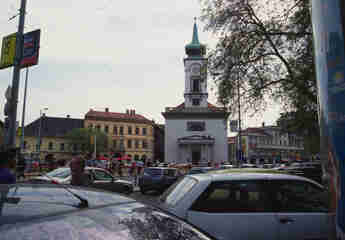
The tower of the Church of Mary Magdalene in Buda is all that remains of the church of the Buda guard built here in 1274. It is said that Hungarians came here to pray, since only Germans were allowed to enter the Church of St. Matthias.
In the seventeenth century, after the liberation of Hungarian lands from Turkish rule, during which the Church of Mary Magdalene had been turned into a mosque, monks of the Order of Saint Francis of Assisi rebuilt the church in the Baroque style.
Already in the 20th century, during the years of World War II, the church was badly damaged by shelling — almost only the foundation remained. In the 1950s, the leader of Hungary's Communist Party, Mátyás Rákosi, ordered the ruins to be demolished. It was only in 1989 that restoration of the tower of the Church of Mary Magdalene using the old Baroque structure could begin. The restoration was completed in 1997.