
Euphorbia pulcherrima or poinsettia
True Christmas in Barcelona, as in many other parts of Europe, begins with Euphorbia pulcherrima, or poinsettia - a bright red flower brought by the conquistadors from the tropical latitudes of Mexico. According to accounts, even the Aztecs used its roots to treat nursing mothers when their milk dried up.
Because the poinsettia blooms at Christmas, and its bracts form the shape of a star, it became popularly known as the «Star of Bethlehem» or «Christmas Star».
They tell a beautiful story about a poor Mexican girl who was so poor that she could not buy a gift for Jesus's birthday. Then an angel descending from heaven told her to gather weeds by the roadside and bring them to the church altar. That is what she did. By Christmas the ordinary leaves had turned crimson and begun to resemble a star in shape. This story took place in the 16th century, and by the 17th the flower had already been officially incorporated into Christmas traditions.

It is believed that this flower symbolizes the star that appeared over Bethlehem at the moment of Jesus's birth and helped the Magi find the way to the infant.

Christmas Nativity Scene
Originally, the word «vertep» meant a cave. Later, nativity scenes came to be called places where at Christmas symbolic mangers are arranged, in which, according to legend, Joseph and Mary took shelter, and where Jesus was destined to be born.
Probably, the creation of nativity scenes allowed ordinary people to convey and recall the plot of the Christmas story more vividly. Over time, the «nativity business» grew so much that besides Joseph and Mary with the infant, animals, Magi, children, angels, and even the rather dubious character of the «caganer», whom we will tell you about a little later, appeared in the cave.

At Barcelona's largest Christmas fair, in the square in front of the Cathedral of the Holy Cross and Saint Eulalia, you can buy yourself every possible character and even a signpost to Bethlehem.

As a rule, on Christmas Eve it is customary to stage theatrical scenes in the nativity display with the story of how King Herod, having learned of the prophecy that the King of the Jews was about to be born, ordered all infants under the age of two to be put to death. In such performances Herod is usually punished in the end for his villainy, and justice prevails.


Mistletoe
Another Christmas symbol is a sprig of mistletoe. This shrub grows on trees and is essentially considered semi-parasitic. However, among the Druids, mistletoe gathered from an oak possessed special mystical qualities, and in Scandinavian mythology an arrow made of mistletoe was the only way to kill the Celtic god Balder, son of Odin.


Caganer or «pooper»
When the tradition of placing a caganer, or in Russian a «pooper», in the nativity scene appeared is unclear, but by the end of the 17th century he had already become an indispensable character in the Christmas story. He is usually seated in the background of the scene, hidden behind some objects. He brings particular delight to children, who always try to find him in the nativity scene.
It is believed that the caganer brings good luck and prosperity to the home ;) By defecating, he fertilizes the soil, which means there will be a rich harvest next year!
There is another version of how the caganer appeared in the nativity scene - the belief that everyone, regardless of status, age, and holiness, is equal before God and defecates to exactly the same degree.

This character definitely has folk roots, since originally he was depicted as a peasant. But now, as a «pooper», you can even buy yourself a president or a famous footballer ;)


Caga Tió or «pooping log»
Who knows why the Catalans are so obsessed with pooping characters? There is a hypothesis that in this way the people wanted to show that even saints were living people too.
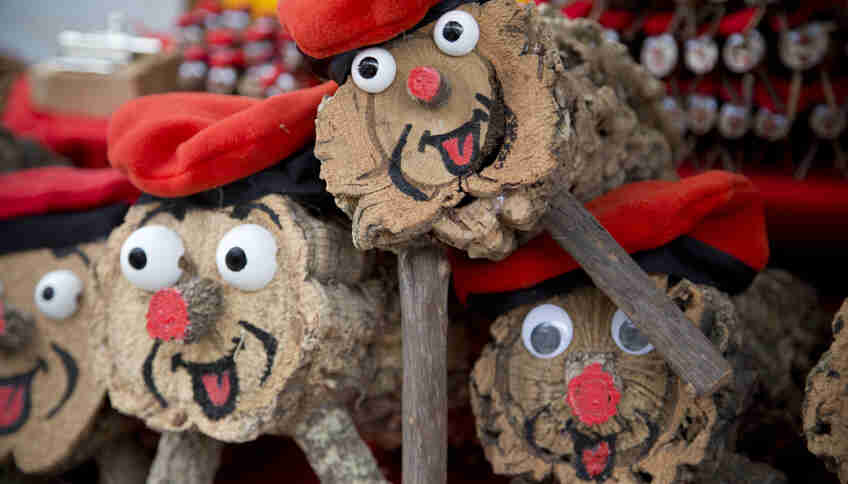
Nevertheless, a smiling and cheerful log, in a red Catalan hat, and even pooping sweets and gifts - what could be more fun and desirable for children?
There is a funny Christmas tradition: on the eve of the holiday, the log is singed at one end so that it can better... you won't believe it - poop gifts! Then the children sing a very down-to-earth little song for it, asking for treats while simultaneously beating the log with sticks. The words of the song deserve separate cultural attention and in my free translation sound like this:
«Poop, poop, log! Poop sweets, nuts and cheese! And if you won't poop - I'll beat you with a stick! Poop, poop, log!»
Artistic.
Then the children are sent to another room to pray that Caga Tió will bring even more gifts next year, while the parents meanwhile place treats and presents under the log. Truly, whatever people entertain themselves with, the main thing is that their children are happy ;)


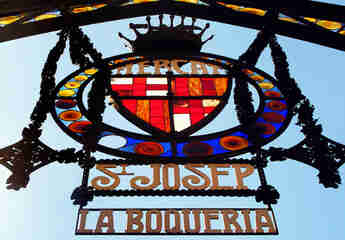
At the Boqueria market, the assortment on the eve of Christmas also changes to suit the festive table. Traditional hams acquire elegant packaging.


And in Barcelona's central squares, enormous Christmas nativity scenes are set up, and local kids in neat rows in funny red hats sing Christmas songs in exchange for sweets.

In short, you definitely won't be bored in Barcelona on the eve of Christmas! Share your holiday observations in the comments ;)