
art-banderoli.blogspot.ru
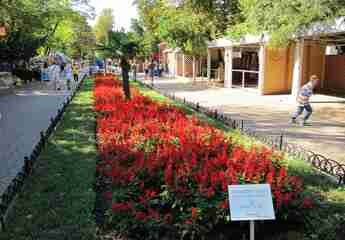
The impressive colonnade in front of Vorontsov Palace in Odessa was built in the Tuscan order style and originally surrounded the palace orangery, where tropical fruits and exotic flowers were grown.
This spot is the city's best viewpoint. They say that Count Mikhail Semyonovich Vorontsov, the governor-general of Odessa, admired these views over morning tea: from here it was easy to see which ships were entering the port and what cargo they were unloading.
According to legend, a couple of centuries ago there was an inn near the colonnade whose owner abetted the slave trade by plying visitors with drink and escorting them through a secret door in the foundation to the ships of Turkish slave traders.
Today, various entertainment events are held by the colonnade, concerts are organized, and light shows featuring famous DJs take place. This place is especially popular on September 2 - Odessa Day, when a chess tournament is held here along with a simultaneous exhibition on a number of boards equal to the city's age. The celebration ends with the cutting of a giant chess cake.
Vorontsov Palace

panoramio, Vad Ayrup
Vorontsov Palace is a palace complex that served as the residence of the governor-general of the Novorossiysk Territory, M. S. Vorontsov (later the Jungsmeister boys' gymnasium, the Society for the Acclimatization of Animals, and since 1936 the Palace of Pioneers), consisting of the main manor building, a belvedere colonnade, a manège, a service wing, and the Orlovsky building (the latter was destroyed in 1944). An architectural monument of republican significance, it was built in 1826—28. It is located in the city of Odessa on Primorsky Boulevard at 2a Vorontsovsky Lane.[1] The palace was built on the very northern edge of the seaside hill, on the site where the Turkish fortress of Hadzhibey once stood. “At the western end of the present Nikolaevsky Boulevard, where there was the insignificant little house of the landowner Kulikovsky, Count Vorontsov built his magnificent house,” wrote historian N. A. Murzakevich in the book Odessa Antiquity. Built to the design of architect F. K. Boffo in 1827 in the Empire style, the building became one of the most notable in Odessa for decades.
Primorsky Boulevard

newlogic.ua
Primorsky Boulevard (until 1919 — Nikolaevsky Boulevard, until 1945 — Feldman Boulevard[1]) is a boulevard in Odessa located on the edge of the city plateau, beginning at Duma Square and ending at Vorontsov Palace. The boulevard is one of the finest urban-planning ensembles of classicist architecture in Ukraine, successfully linking the city's central part with the sea and serving as the ceremonial facade on entering Odessa from the sea.[2] Pushkinskaya and Ekaterininskaya streets, as well as Vorontsovsky Lane, lead to the boulevard. Only one side of the boulevard is built up; on the other side there is a steep slope leading down to Odessa Port. The majestic Potemkin Stairs descend from the boulevard to the passenger terminal of Odessa Port. Primorsky Boulevard has been known as an archaeological site for two centuries. During the construction of houses at the beginning of the 19th century, workers began to come across ancient Greek burials and individual household items used by the ancient inhabitants of this territory.
Monument to de Richelieu

Flickr, twiga_swala
The monument to Duke de Richelieu in the city of Odessa (also known as the monument to the Duke, Richelieu, the duke, the bronze duke) is a full-length bronze monument dedicated to Armand Emmanuel du Plessis, Duke de Richelieu, unveiled in 1828. It was the first monument erected in the city of Odessa.[1] Duke de Richelieu took part in the storming of Izmail, and five years later settled in Russia for a long time. In 1803 Richelieu became city governor, and from 1805 to 1814 governor-general of Odessa. Odessites called him “our Duke” and considered him the founder of the city, although Odessa was already 8 years old by then. Thanks to the efforts of the new city governor, the city turned into a major trading port. When the Bourbons regained the throne, the Duke left for France, where he became prime minister in the government of Louis XVIII. He died on May 16, 1822 at the age of 56 in Paris from a cerebral hemorrhage.[2]
Potemkin Stairs

Flickr, Innusya
Potemkin Stairs are a boulevard staircase leading to the sea in Odessa. An architectural structure in the style of classicism, it is an architectural monument of the first half of the 19th century and one of the city's main landmarks. From the upper steps of the staircase, a broad panorama of the seaport, harbor, and Odessa Bay opens up. It was designed by architects F. K. Boffo, A. I. Melnikov, and K. I. Potier in 1835 and built in 1837—1841 by engineers J. Upton and G. S. Morozov. In the 19th and early 20th centuries it was called the Nikolaevsky Boulevard Stairs, the Giant Stairs, Richelieu Stairs, Vorontsov Stairs, and from 1919 to 1941 the Feldman Boulevard Stairs[1] or Primorsky Stairs, then Potemkin Stairs. At various times it was also called the Boulevard Stairs, Port Stairs, and Great Stairs. Conceived as a ceremonial entrance to the city from the sea, the staircase became the dominant feature of Odessa's architectural image and its symbol.
Golden Child

Flickr, Innusya
Golden Child is a bronze sculpture by sculptor Ernst Neizvestny installed at the Marine Terminal in the city of Odessa. Ernst Neizvestny conceived the sculptural composition “Golden Child” to mark the 200th anniversary of the city of Odessa. Back in 1944, as a Red Army soldier, the sculptor visited Odessa shortly after its liberation. He was struck by the devastation in the city, but also by the strength of spirit of the Odessites, who had endured two and a half years of occupation. This contrast stayed in the future sculptor's memory. The conceived composition departed from the author's traditional style — tragic, tense, and dynamic. The sculpture of the child is tender, soft, rounded, yet at the same time it already conveys the strength of a future giant[1][2]. About his ideas and their practical realization, the sculptor himself said the following[1][2]: Neizvestny's project was approved by the city authorities headed by Odessa mayor Eduard Gurvits. “I received an official commission and began to work.
Odessa Port

panoramio.com, Vad Ayrup
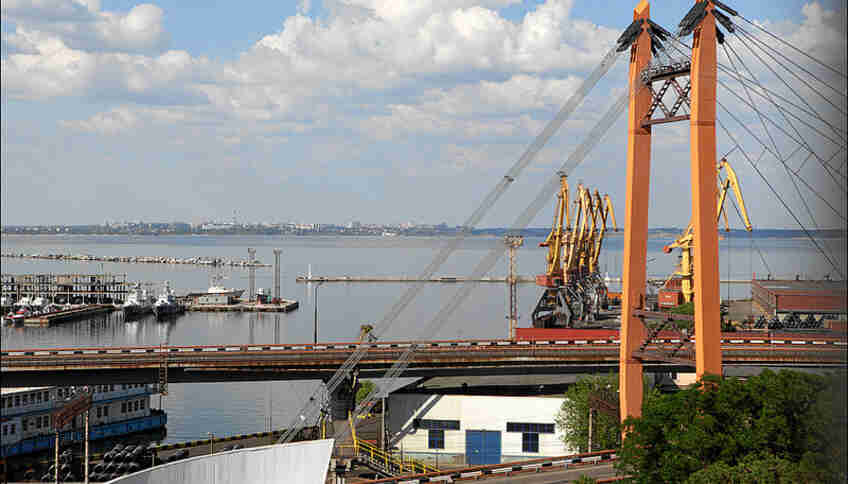
Odessa Sea Port is a major international trading port located on the northwestern coast of the Black Sea, in the southwestern part of Odessa Bay. It has one of the largest passenger terminals in Europe. It is recognized as Ukraine's base cruise port. The third-largest on the Black Sea by cargo turnover. The largest port in Ukraine by cargo turnover. Construction of the port began in 1794. By 1905 the port had largely acquired its modern outlines. In the Russian Empire it ranked second in cargo turnover after St. Petersburg. The greatest cargo turnover in independent Ukraine was in 2002 — 13.2 million tons of dry cargo and 20.4 of liquid cargo. It includes the Cabotage, Quarantine, Practical (also known as Watermelon), Coal (also known as Military), New, Oil, and other harbors. In the summer of 1793, Joseph De Ribas was appointed head of construction of the Hadzhibey fortress and the new port next to it.
Monument to a Sailor's Wife

Flickr, dgreenru
The Monument to a Sailor's Wife (“Sailor Girl”[1]) is a bronze sculptural composition installed in Odessa on the grounds of the Marine Terminal. The bronze sculptural composition was created by Honored Artist of Ukraine, sculptor A. P. Tokarev, who is the author of a whole series of small-form sculptural compositions adorning Odessa. It was ceremonially unveiled in 2002 during the City Day celebrations, which in Odessa are held on September 2. The sculptural composition depicts a graceful young woman firmly holding a child standing on the parapet. The figures in the composition are slightly larger than real people. Both mother and child gaze into the sea distance, awaiting the return of the ship on which the husband-father-sailor went to sea.

odessaguide.net
If after visiting the main sights of Odessa you still have some free time left, there is every reason to drop by the marine terminal. The atmosphere here is extremely authentic: liners, cargo ships, sea breeze… In addition, the open-air anchor museum is located here. Its exhibition is not far from the Potemkin Stairs, along which nearly all tourists stroll during their stay in Odessa.
Of course, the anchor display can hardly be called a museum. It occupies only a few square meters at the Marine Terminal. However, it is quite curious to study and examine them.
Matrosov anchor, grapnel anchor, three-, four-, and five-fluke anchors… In all, 16 rare exhibits. Near each of them are special plaques where you can read the history of these unusual but vitally necessary items for sailors. Here you can also trace the development of the anchor: how they were created at the beginning of their historical evolution, and what they look like today.