
Flickr, Paris by Mouth
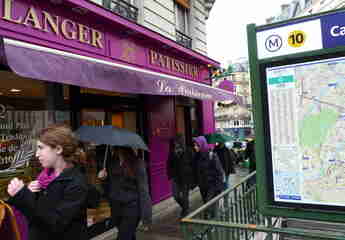
'La Parisienne' Bakery has specialized in croissants for many years. There are more than 20 varieties here, not necessarily sweet, but always fresh and incredibly delicious. Local regulars unanimously recommend trying Pain au chocolat – a croissant with pieces of chocolate inside.
All kinds of chouquettes and eclairs also deserve the highest praise. In addition, you can enjoy quiches Lorraine and mini tarts filled with fish, meat or vegetables here. In short, it is best to come to this kingdom of tastes and aromas on a relatively full stomach, otherwise there is a very high chance that you will want to buy almost the entire assortment of this bakery.
Finding 'La Parisienne' on the streets of Paris is not difficult at all. First, the aroma of fresh pastries is sure to attract you, and second, it is hard to miss the bright purple display window and sign of this bakery. In the mornings, small lines even form here, because there are always plenty of lovers of tasty, still-hot pastries in Paris. Humming the famous song about the 'crunch of a French roll,' you will not even notice how your feet themselves bring you to La Parisienne.
If your hotel is located near this bakery, we would bet anything that you will most likely have breakfast right here rather than in the hotel restaurant!
You can get a few more ready-made walking routes accompanied by people who know and love Paris well by downloading audio guides in the Ever.Travel mobile app.
Pantheon

Flickr, Charles Davis Smith
The Pantheon is an architectural and historical monument, an example of French classicism in the Latin Quarter of Paris's 5th arrondissement, France. Originally the Church of St. Genevieve, it later became the burial place of France's outstanding figures. The inscription at the entrance to the Pantheon reads: 'To great men, the grateful homeland' (Fr. AUX GRANDS HOMMES LA PATRIE RECONNAISSANTE). The pompous building in the style of mature classicism was built on the grounds of the Abbey of Saint Genevieve by the architect J. Soufflot, who took the Roman Pantheon as his model. Construction was carried out in fulfillment of a vow by King Louis XV, who promised that if he recovered from a serious illness he would build a new church at the abbey. The foundation was laid in 1758, and the building was completed by Soufflot's pupil in 1789. By the time the church was finished, the king had been overthrown, and the revolutionary government ordered the church to be turned into a mausoleum for great French figures.
Sorbonne

Flickr, -ARTUROMARTIN-
The Sorbonne is an architectural and historical monument, the center of the University of Paris in the capital of France; it is located in the Latin Quarter of Paris and is city property. The name Sorbonne comes from the theologian Robert de Sorbon, confessor to King Louis IX the Saint, who founded a theological college in the city in the 13th century — the Sorbonne College, which later became part of the University of Paris. By association, the term was transferred to the university itself and has remained attached to it to this day. The name 'Sorbonne University,' sometimes used in Russian-language mass media in relation to the Sorbonne, is semantically incorrect. The Baroque facade belongs to the Church of the Sorbonne — the Chapel of Saint Ursula of the Sorbonne; its construction was completed in 1642. Since the adoption of the law on the separation of religion and the state in 1905, the building has been adapted for official receptions and exhibitions.
Latin Quarter

Flickr, HubbleColor {Zolt}
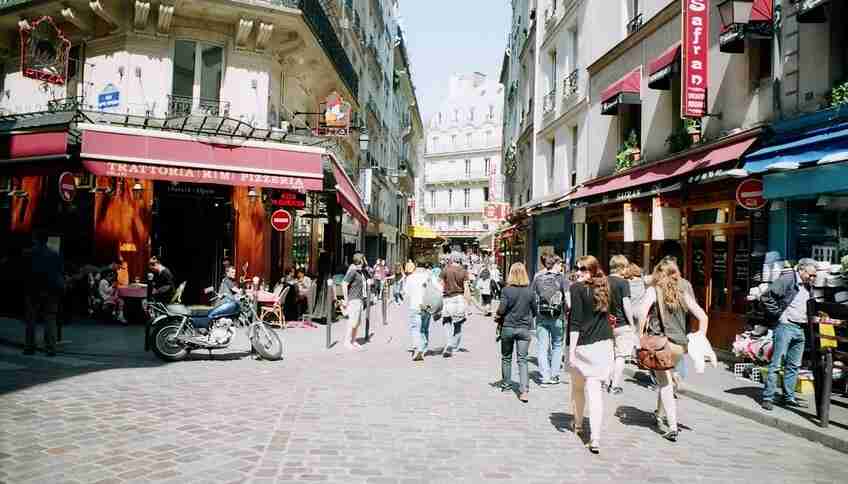
The Latin Quarter (Fr. Quartier latin) is a traditional student quarter in Paris's 5th and 6th arrondissements on the left bank of the Seine around Sorbonne University. The name comes from the Latin language, in which teaching at the Sorbonne was previously conducted. In this case, the word quarter denotes not one of the 80 Paris administrative quarters (Fr. quartiers administratifs), but an area with undefined boundaries situated on the slopes of St. Genevieve Hill. Today, the Latin Quarter includes not only the Sorbonne, but also several other institutions of higher education: the École Normale Supérieure, the Paris School of Mines (École des Mines de Paris), Paris II University, Pierre and Marie Curie University and others. The Latin Quarter is famous for its narrow old streets, bistros, bookshops and cozy cafes.
Luxembourg Garden

Flickr, HarshLight
The Luxembourg Garden (Jardin du Luxembourg) is a palace-and-park ensemble in the center of Paris, a famous city landmark. The former royal and now state palace park in Paris's Latin Quarter covers an area of 26 hectares. The Luxembourg Palace, where the Senate, the second chamber of the French Parliament, sits, is located in the park. The Luxembourg Garden is bordered on the north by the palace of the same name and the 'Little Palace' (Petit Palais), which is the official residence of the President of the Senate, as well as by the orangery and the Luxembourg Museum (Musée du Luxembourg), and on the east by the Paris School of Mines (Ecole des Mines). The garden can roughly be divided into two parts: around the palace are flowerbeds and terraces laid out back in the 17th century in strict geometric order and in the classical French style, while in the eastern and southeastern part a later park area in the English style emerged.
Les Deux Magots

Flickr, roboppy
Les Deux Magots is a famous cafe in the Saint-Germain-des-Pres quarter on Place Saint-Germain in Paris's 6th arrondissement. The cafe takes its name from the two figures of Chinese merchants located there. Magot (Fr. magot) is a grotesque statuette, a freak, an ugly figure. Originally, this was the name of a magazine published from 1812 onward, whose editorial office was located at the same address.
Café de Flore

Flickr, sanfamedia.com
Café de Flore is located at the corner of Boulevard Saint-Germain and Rue Saint-Benoît in Paris's 6th arrondissement. It is famous for always attracting an intellectual crowd. The cafe opened in 1887. The cafe got its name from a statue of the goddess Flora located on the other side of the boulevard. The interior of the cafe has scarcely changed since the Second World War. The walls and seats are clad in mahogany in the Art Deco manner. Like its perennial competitor, Les Deux Magots, it became a refuge for intellectual and creative circles, one of the symbols of Parisian bohemia. Guillaume Apollinaire's famous 'Paris Evenings' took place in the cafe. Later, ultra-right monarchists from Action française began gathering here. Then, on the contrary, Flore was favored by leftists who moved here from the neighboring Les Deux Magots because a more liberal atmosphere prevailed here. Regular patrons of the cafe included Jean-Paul Sartre, Simone de Beauvoir and André Breton.
Brasserie Lipp

Flickr, Yellow Scarf and a Suitcase
Lipp is a brasserie located in Paris's 6th arrondissement on Boulevard Saint-Germain. The annual Cazes Prize, named after one of the brasserie's former directors, is awarded here. On 27 October 1880, Leonard Lipp opened the brasserie on Boulevard Saint-Germain. Being an Alsatian, he left his homeland after it had been seized by Prussia. At various times, the brasserie was visited by Marcel Proust, André Gide and Antoine de Saint-Exupéry. In July 1920, Marcelin Cazes revived the undertaking begun by some poets, such as Paul Verlaine and Guillaume Apollinaire. In 1935 he founded a literary prize awarded annually to authors who had not been recognized by other awards.