Updated for 2026: Munich is easy to explore on foot and by public transport, but the old town stays busy year-round. Start early, reserve tower or museum visits when you can, and leave room for cafe stops, markets, and changing weather.
Karlsplatz

Flickr, peter_dahlmann
Do not be surprised if locals answer "Stachus" when you ask for Karlsplatz. Officially the square was named after Elector Karl Theodor, but Munich never really embraced that name. The nickname stuck instead, likely coming from an old beer hall dedicated to Saint Eustachius nearby.
One of the square's best-known landmarks is Karlstor, one of the surviving gates from Munich's old fortifications.
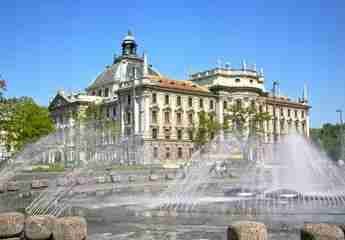
Across the way stands the Palace of Justice, a grand late-19th-century building that still houses important Bavarian courts today.
The fountain built here for the 1972 Olympics is another local favorite. On warm days children run straight through the jets, and in the evening the lights turn the water into a small show.
Karlstor

Flickr, RobbieLD
Karlstor is one of the three surviving gates from Munich's medieval second ring of walls. It marks the western edge of the old town, where Neuhauser Strasse begins and the long pedestrian route toward Marienplatz and Isartor gets underway. The gate dates from the late 13th and early 14th centuries and was first recorded as Neuhauser Tor before receiving its current name in 1791. Today the square in front of it is one of Munich's busiest transport hubs, with S-Bahn, U-Bahn, trams, and night services all converging at Stachus.
St. Michael's Church

Panoramio, Josef Drda
St. Michael's, the great Jesuit church on Neuhauser Strasse, was one of Bavaria's key Counter-Reformation churches. Construction began in 1583, but a tower collapse slowed the work and the church was not consecrated until 1597. Its facade is unusually dramatic, with a steep triangular gable and a figure of Christ above. Beneath the marble portal stands a bronze Archangel Michael, while statues of the church's patrons fill the niches. The building was badly damaged in World War II and later restored.
Frauenkirche
Flickr, stern.braun
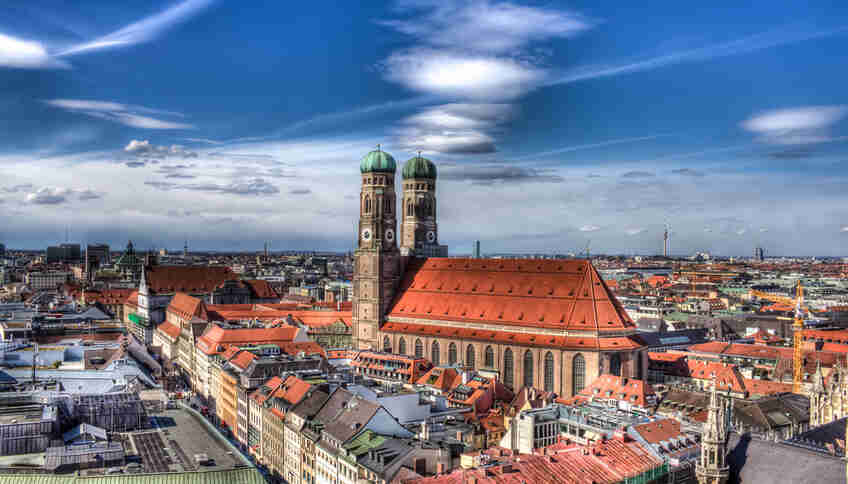
Frauenkirche, officially the Cathedral of Our Lady, is Munich's signature church and the seat of the Catholic Archdiocese of Munich and Freising. Construction in the Gothic style began in 1468 and was completed in 1525. Even though the cathedral is huge, the interior can feel surprisingly restrained because the tall rows of columns break up the space. Its twin domed towers rise to just under 100 meters, and Munich still protects skyline views that keep them dominant.
Marian Column

Flickr, mikkelz
At the center of Marienplatz stands the Marian Column, topped by a gilded figure of the Virgin Mary. Raised in the 17th century, it became one of the symbols of old Munich. At the base, four putti battle plague, war, famine, and heresy - a detail that is easy to miss if you only glance up at the statue.
Marienplatz

Flickr, pictob
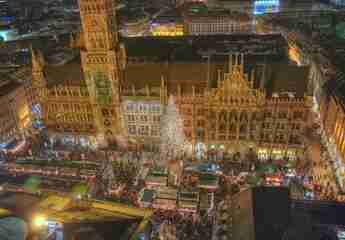
Marienplatz is the heart of central Munich, the focal point of the pedestrian zone, and one of the essential stops in the old town. The New Town Hall and the Old Town Hall frame the square, while Kaufingerstrasse begins nearby with its long run of shops. You are also a short walk from Viktualienmarkt, Frauenkirche, and several other major sights. Under the square is one of Munich's key transport interchanges, where S-Bahn and U-Bahn lines cross.
New Town Hall

Flickr, msc-ρңσtođєѕіgη
The New Town Hall fills the north side of Marienplatz and still houses Munich's mayor, city council, and much of the city administration. Built between 1867 and 1908 to designs by Georg von Hauberrisser, the Neo-Gothic complex stretches across the square with six inner courtyards and a tower about 85 meters high. The long facade is packed with dukes, Wittelsbach rulers, saints, and legendary figures. The tower is open to visitors and gives you one of the classic views across Munich's rooftops.
Old Town Hall

Flickr, lreed76
The Old Town Hall stands on the eastern side of Marienplatz and has been part of Munich's cityscape since the early 14th century. The great hall was built in the late 1300s, and the complex was rebuilt more than once after lightning damage, fire, and later redesigns, picking up Gothic, Renaissance, and Neo-Gothic elements along the way. The city council moved to the New Town Hall in 1874, but the old building remained one of the square's defining landmarks. It was badly damaged in World War II and later restored. The site also carries a darker association: on November 9, 1938, Joseph Goebbels delivered a speech here on the eve of Kristallnacht.
St. Peter's Church

wind-travels.com
St. Peter's Church, known locally as "Alter Peter," is the oldest parish church in Munich. A church has stood on this hill since the city's earliest days, and the present building reflects centuries of rebuilding, expansion, and stylistic change. In the 12th century the original Romanesque church was enlarged, and after later destruction a new church was consecrated in 1284. Over time the building picked up Gothic and then Rococo elements. It was badly damaged in World War II and painstakingly restored. If you climb the tower, you will get one of the best views in the old town.