Flickr, SpreadTheMagic
Leonardo was one of the most astonishing and incredibly gifted people the 15th century gave to humanity. It is hard to immediately recall other scholars who succeeded in such different sciences and fields of art. He is a vivid example of the "universal man," whom everyone knows as a great painter, architect, sculptor, inventor, writer, natural scientist, and even anatomist.
In addition, Leonardo da Vinci had the unusual ability to write texts in mirror script. He made all the entries in his notebooks with his left hand and from right to left. Moreover, some researchers of Leonardo's phenomenon claim that he could even write with both hands at the same time.
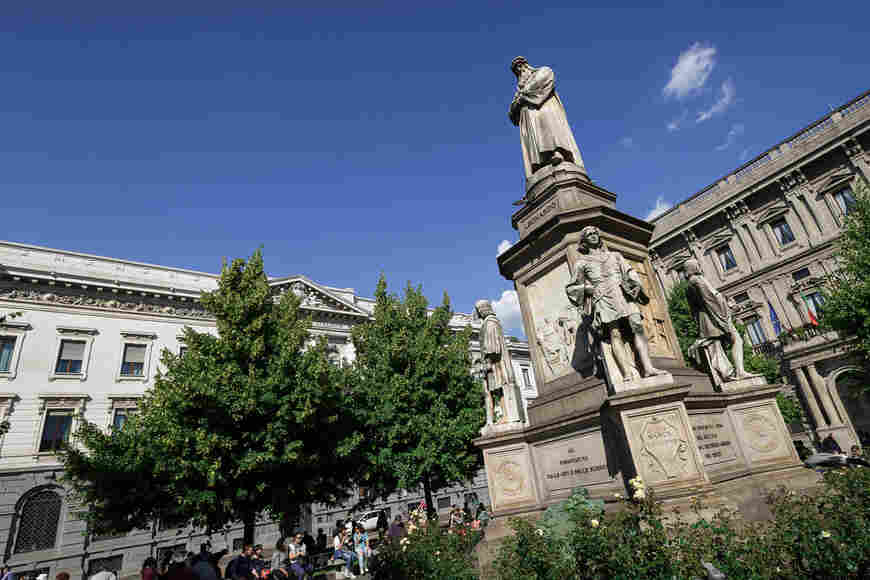
Like any outstanding scholar, Leonardo had pupils. The most famous of them are depicted together with the master on the monument in the center of La Scala Square in Milan. da Vinci himself stands on the pedestal, while at its base are statues of four of his pupils: Andrea Salai, Marco d'Oggiono, Giovanni Antonio Boltraffio, and Cesare da Sesto.
As a rule, the name Leonardo da Vinci is associated first and foremost with Florence, where he began his creative journey. However, the famous maestro spent many years in Milan. He even developed a project for an ideal city with specific parameters, a layout, and a sewer system. However, the Milanese duke Ludovico Sforza rejected his project. But his attempts to embellish and improve the city did not stop there.
To get better acquainted with the history of the famous scholar's life and work, Milan has several museums. In particular, there is a small collection in the inner courtyard of the church of Santa Maria delle Grazie, where his famous fresco "The Last Supper" is located, and the Leonardo da Vinci Museum of Science and Technology in Milan, where many inventions recreated from his drawings and notes are on display.
Santa Maria delle Grazie

Flickr, BBradley1024
Santa Maria delle Grazie (Italian: Chiesa e Convento Domenicano di Santa Maria delle Grazie) is the main church of the Dominican monastery in the western part of Milan. In the refectory of this church is one of the most famous frescoes in the world — Leonardo da Vinci's "The Last Supper".
It was built from 1469 according to the principles of Late Gothic under the direction of Guiniforte Solari. In 1490, Ludovico Sforza intended to place the mausoleum of the ducal House of Sforza here and entrusted the completion of the church to a master trained in the Renaissance style (it is believed that this was Bramante).
On August 15, 1943, the refectory was bombed by Anglo-American air forces, but Leonardo's fresco miraculously was not damaged. In 1980, the entire monastery complex was declared a World Heritage Site — the first in Italy.

awaytravel.ru
The Leonardo da Vinci Museum of Science and Technology is one of the most interesting and most visited in Italy. Thanks to the caring residents of Milan, it was founded in 1953, and today it is housed in the building of a former monastery of the Order of Saint Benedict.
The interactive laboratories of physics, chemistry, genetics, and robotics located on the museum grounds will captivate even those people who have always considered themselves far removed from the world of science. Here visitors are invited to make ink and "unpoppable" soap bubbles themselves, as well as look through a telescope and explore a submarine.
Of course, the collection of Leonardo da Vinci himself, which occupies an entire floor of the museum, is of particular value. The artist, inventor, sculptor, scientist, and greatest creator of the Renaissance left behind countless mysteries that more than one generation will still have to unravel. Thousands of pages of drawings, sketches, manuscripts, and wooden models carried through the centuries still make even the most hardened skeptics believe in the miracle of thought and technology today.
The Sculpture "Leonardo's Horse"

Flickr, Tony Bracjun
Leonardo's Horse is an unfinished sculpture by Leonardo da Vinci that existed only as a clay model. Beginning in the 1970s, two reproductions of this statue were created.
In 1482, Ludovico Sforza commissioned Leonardo to create the largest equestrian statue in the world, which was to become a monument to the duke's father, Francesco Sforza. The horse stood 24 feet = 7.3 meters tall. Ten years later, Leonardo had created only a clay model, which was destroyed by French soldiers in 1499.
In 1977, Charles Dent began reconstructing the sculpture, but the project turned out to be too costly both in time (15 years) and financing (a total of about 2.5 million dollars). In 1994, Dent died without ever seeing the completed statue. In September 1999, it was installed at the San Siro Hippodrome in Milan.
Another reconstruction, financed by billionaire Frederick Meijer, is currently located in the Meijer Gardens.