

Flickr, jasolo
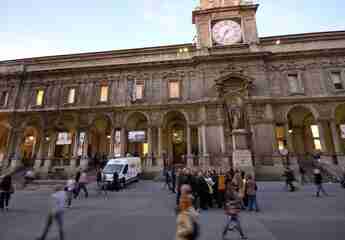
Piazza Mercanti was the city's main square throughout the Middle Ages. It began to take shape as early as the 13th century, and at that time it was much wider than it is now. Piazza Mercanti could be approached from six different sides. Each passage bore the name of the guild of craftsmen located there. Thus, the square could be reached, for example, via Armorers' Street or Goldsmiths' Street.
The modern arrangement of attractions on Piazza Mercanti can conventionally be divided by the points of the compass. On the west stands a Gothic building known as the "Casa dei Panigarola," built in the 15th century. On the north the town hall adjoins the square, erected in the 13th century and significantly reconstructed during Austrian rule in the 18th century. And the southern side of Piazza Mercanti is marked by a palace built in the Baroque style in 1645 by Carlo Buzzi.
And at the center of the square stands a 16th-century well adorned with two exquisite ancient columns.

Flickr, mmarco1954
For many years it was believed that the design of the Church of Santa Maria presso San Satiro belonged to the great Donato Bramante, one of the leading representatives of Renaissance architecture. The very same architect whose masterpiece is the famous St. Peter's Basilica in the Vatican. However, more recently this information has been disputed. Increasingly, the architect Giovanni Antonio Amadeo is being named as the author of the project, with Bramante credited only for certain details of the work on the church.
The Church of Saint Mary was built in the 15th century on the site of another famous building dedicated to Saint Satyrus. The interior of this church is renowned for a true stroke of genius by Bramante. It is known that the church's footprint did not allow the builders to erect a large altar, and then the famous creator, one of the first in world architecture, used a technique that is now quite widespread. Bramante painted (!) the altar section of the church and, using the effect of an optical illusion, made parishioners believe that the altar was real.
The Church of Santa Maria presso San Satiro is located in the very center of Milan, in a quiet courtyard, as if hidden between neighboring houses. As a rule, it is quiet here and there are rather few people. But those who are interested in Renaissance art always include this site in their plans for walks around the city. The Church of Santa Maria presso San Satiro is considered the foremost monument of the Renaissance not only in Milan, but in all of Northern Italy.
Ambrosian Library

wikimedia.org, Elekhh
The Ambrosian Library, Biblioteca Ambrosiana (Italian: Biblioteca Ambrosiana), is a library in Milan established by Cardinal and Archbishop Federico Borromeo. It was named after the Church Father Saint Ambrose of Milan, bishop and patron saint of Milan. It is the oldest public library in Italy. Construction began in 1603, and the library was opened to the public on December 8, 1609 (after the Bodleian Library, which opened in Oxford in 1602, it is the second public library in Europe). The oldest manuscripts were moved to Milan from the provincial monastery of Saint Columbanus. A printing house was opened at the library, and it also housed a school of classical languages. In addition, the library came to include the Academy and the Pinacoteca, established by the same Federico Borromeo.
Basilica di San Lorenzo Maggiore

Flickr, Mynth
The Basilica of Saint Lawrence (Basilica di San Lorenzo Maggiore; San Lorenzo Maggiore) is a Milanese church erected in memory of Saint Lawrence no later than the end of the 4th century, apparently while Ambrose of Milan was still alive. The upper part with the dome was rebuilt in the 16th century, but from the original church there remain the overall architectural concept, the ancient baptistery, and the 12th-century Romanesque bell tower. Several late antique mosaics have survived in the Chapel of St. Aquilinus. Around the basilica are monuments to Lazarus (1728) and Constantine the Great, as well as several ancient Roman columns that survived from the baths of Emperor Maximian (3rd century).

Flickr, Carlo Danese
As the chronicles of Milan relate, the medieval Porta Ticinese was built as early as the 12th century. In 1171, having survived an attack by barbarian troops led by the legendary Frederick Barbarossa with heavy losses, the authorities began thinking about reliable protection for the city against the actions of potential enemies. Soon a sturdy stone wall rose around Milan, and its main entrance was Porta Ticinese. In addition, there were 10 smaller gates, although they were built on a much less grand scale.
This information has survived to our day thanks to the Italian chronicler Bonvesin de la Riva, who created his historical treatise in 1288. However, it is now difficult to say with precision what the medieval gate he mentioned actually looked like. The fact is that over the course of the next eight centuries Milan did not particularly need this structure—enemies practically posed no threat to the city. Moreover, the massive gate hindered the free passage of people and carts. Therefore, fragments of the medieval monument and parts of the walls were often destroyed by the townspeople themselves.
The architect Camillo Boito reconstructed the approximate appearance of the gate in the second half of the 19th century; however, many critics conclude that he worked relying solely on his own idea of Porta Ticinese…

Flickr, B Plessi
The Church of Santa Maria presso San Celso was built in the 15th century on the site of another church, where the sarcophagus containing the relics of Saint Celsus had previously been kept.
The building of the new church was erected specifically to house the sacred icon of the Mother of God. Initially, the authors of the project were the famous Italian architects Gian Giacomo Dolcebuono and Giovanni Battagio. However, later the outward appearance of the church was refined by the efforts of other masters. Among them was Giovanni Antonio Amadeo, who was also involved in the construction of the no less famous Church of Santa Maria presso San Satiro. It was he who built the complex octagonal dome in this building, which was adorned with statues by Agostino de Fondulis.
A few years later, a nave was added to the Church of Santa Maria presso San Celso, and later a square portico created in the style of classicism was added as well.
As for the interior of the church, first of all it is worth noting the gallery of works by artists from Venice and Lombardy, as well as paintings from the Renaissance and Baroque periods. These include such well-known canvases as "The Baptism of Christ" by Gaudenzio Ferrari and "The Conversion of Saint Paul" by Moretto.
Basilica di Sant'Eustorgio

Flickr, Libero.Pensiero
The Basilica di Sant'Eustorgio, the Basilica of Saint Eustorgius (Italian: Basilica di Sant'Eustorgio), is a Catholic church in Milan and an architectural monument. The Romanesque church was built in the 11th-12th centuries (later heavily rebuilt), and in the 14th-15th centuries numerous Renaissance chapels were added to the basilica. Over the centuries, the basilica was a place of pilgrimage to the relics kept here, which were believed to belong to the Three Kings who brought gifts to the newborn Jesus. Probably the first church on this site was built in the 4th century. It was named in honor of Saint Eustorgius, Bishop of Milan (343-349), who, according to tradition, transferred the relics of the Three Kings from Constantinople to Milan. In 1764, a Christian burial was discovered beneath the basilica containing coins of Emperor Constans (ruled in 337-350), the son of Constantine the Great[1]. In the 11th century the church was completely rebuilt in the Romanesque style.
Basilica of Saint Ambrose

Flickr, MartaPanizza
The Ambrosian Basilica (Basilica di Sant’Ambrogio, Sant'Ambrogio) is a basilica built in 379-386 by Saint Ambrose of Milan on the site of the burial of early Christian martyrs in Milan. Before the canonization of Saint Ambrose it was called the "Basilica of the Martyrs" (Basilica Martyrum). It acquired its current Lombard-Romanesque appearance in 1099. On the right side of the facade is the austere "bell tower of the monks" (9th century), and on the left the taller, more elegant "bell tower of the canons" (1144, completed in 1889). The church houses the relics of Saint Ambrose and the relics of the martyrs Gervasius and Protasius found by him on this site. The remains of Emperor Louis II are also buried in the basilica. The main apse mosaic depicting the Pantocrator dates to the 13th century.