Updated for 2026: Sultanahmet remains one of Istanbul's busiest historic districts, so start early if you can, expect crowds around the major sights, and wear comfortable shoes for the stone paving.
Obelisk of Constantine

Flickr, markus.richter
The Obelisk of Constantine, also known as the Walled Obelisk, has stood on the Hippodrome since Byzantine times. Emperor Constantine VII restored it in the 10th century and covered it with gilded bronze plaques celebrating imperial victories, topped by a sphere. That rich outer casing disappeared after the Crusaders sacked Constantinople in 1204, leaving the bare stone core you see today. Later accounts say Ottoman-era youths even climbed it to show off their courage.
This guide is only a quick introduction. If you want the fuller story, you can download the Istanbul audio guide in the Ever.Travel mobile app.
Serpent Column

Flickr, Joe Lamm
The Serpent Column (Tur. Yılanlı Sütun) is one of the oldest monuments in Sultanahmet. It is the surviving shaft of a bronze victory tripod made from weapons captured after the Greek victory over Persia at Plataea in 479 BC. The monument originally stood at Delphi before Constantine moved it to his new capital, Constantinople. It was once topped by three serpent heads; only fragments survive today, and one of those heads is in the Istanbul Archaeological Museums.
Egyptian Obelisk

Flickr, One1stanbul
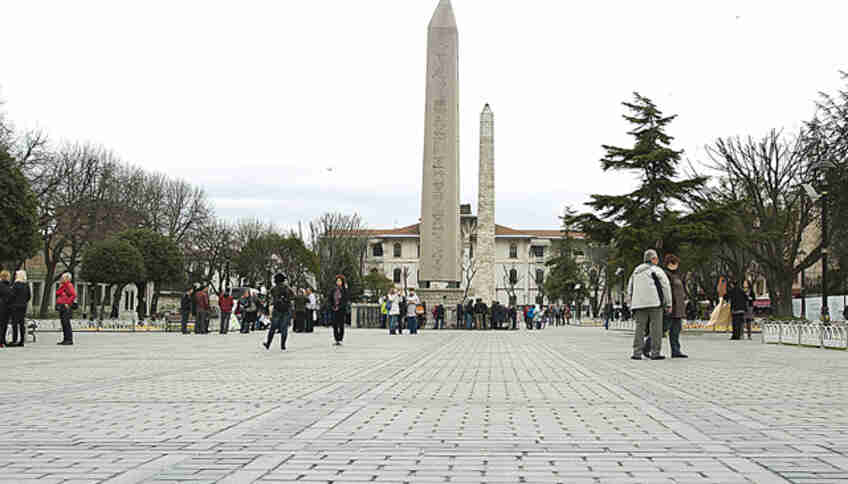
The Obelisk of Theodosius, often called the Egyptian Obelisk (Tur. Dikilitaş), is the best-preserved ancient obelisk brought to Constantinople. Carved from pink granite under Pharaoh Thutmose III, it was erected on the central spine of the Hippodrome by Emperor Theodosius I in AD 390. Hieroglyphs still run up all four sides, and near the top you can make out the pharaoh in the presence of the god Amun-Re. Its elegant proportions are part of what makes this stretch of Sultanahmet so memorable.
Hippodrome

Flickr, Margot Wolfs
Sultanahmet Square (Tur. Sultanahmet Meydanı), including the old Hippodrome area known as At Meydanı, is one of Istanbul's best-known public spaces. Here, between Hagia Sophia and the Blue Mosque, layers of Roman, Byzantine, Ottoman, and modern Istanbul sit almost on top of one another. The surviving columns and obelisks still trace the old racecourse, while the German Fountain adds a later imperial flourish.
The ancient Hippodrome began under Septimius Severus in the early 3rd century, when the city was still Byzantium. Constantine later expanded it as he remade the city into Constantinople. At its height, this vast arena was roughly 450 meters long, 120 meters wide, and capable of holding around 100,000 spectators for chariot races, ceremonies, and political theater.
German Fountain

Flickr, fatih oktay foxfo
The German Fountain (Tur. Alman Çeşmesi) is a historic fountain on Sultanahmet Square and one of the area's most recognizable landmarks. It was presented to the Ottoman Empire to commemorate Kaiser Wilhelm II's 1898 visit to Istanbul. Built in Germany, shipped here in pieces, and assembled on site, it finally opened in 1901. The green dome, golden mosaics, and octagonal plan make it easy to spot even in a busy square.