Galata Bridge
Updated for 2026: Galata remains one of Istanbul's best neighborhoods for a walk - busier, more polished, and more packed with cafes than ever. Go early or near sunset for the best atmosphere, and expect queues at the tower and steady foot traffic around the bridge.

Flickr, the-kid-in-me
Galata Bridge (Turkish: Galata Köprüsü, English: Galata Bridge) spans the Golden Horn in Istanbul, beside the New Mosque. The modern bridge has two levels: a lower deck with restaurants and a promenade, and an upper deck for cars and the tram. It is roughly half a kilometer long and 42 meters wide, with a movable central section. Crossings over the Golden Horn go back centuries. A much earlier bridge is mentioned in the time of Emperor Justinian, and during the Ottoman siege of Constantinople in 1453 troops crossed the inlet on a pontoon bridge made from linked ships. In 1502-1503, under Sultan Bayezid II, even Leonardo da Vinci proposed an astonishingly ambitious design for a bridge here.
There are plenty more great sights in Beyoglu. Want more ideas? Explore our Istanbul audio guide.

Flickr, YaS-MaNiA
Galata was once home to the Camondos, a wealthy Sephardic Jewish banking family that had fled persecution in Europe. With their palaces and townhouses, this part of the city took on a distinctly European feel - part Florence, part Venice, part Rome. The family became major patrons of Istanbul and were often called the "Rothschilds of the East".
In the 19th century, the family commissioned these elegant stairs to make the steep route between the lower and upper streets easier - especially for relatives heading to school or the bank. It was a generous gift to the city, but also a very practical one.
The staircase's sweeping, fan-shaped curves are not just beautiful. They also help soften a fall, making the descent safer if someone slips.
Galata Tower

Flickr, Michał Sacharewicz
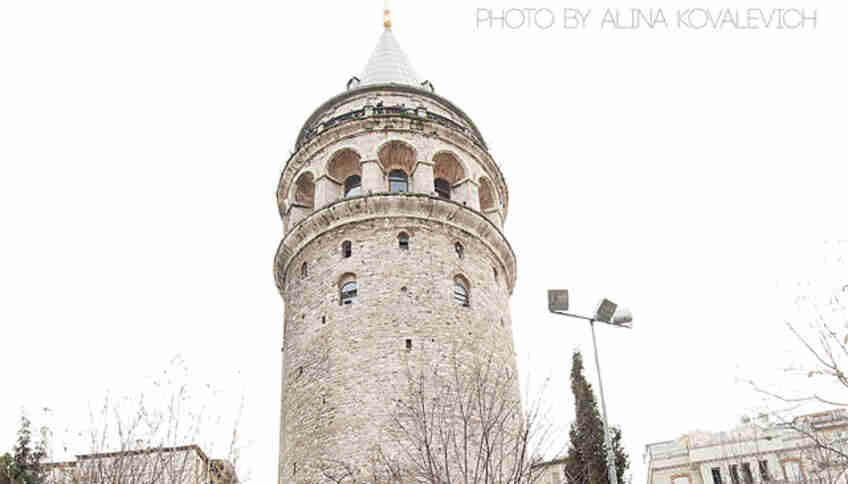
Galata Tower (Turkish: Galata Kulesi, Greek: Πύργος του Γαλατά) stands on a high ridge on Istanbul's European side and is visible from much of the historic center. Rising roughly 67 meters, it remains one of the city's best-known landmarks. Earlier fortifications stood in this area, but the tower we see today was built in 1348-1349 by the Genoese as part of the walls around their Galata colony. Small fragments of those defenses still survive nearby. Under the Ottomans, the tower was altered over time and served different roles, including as a lookout and an observatory, before becoming the iconic viewpoint travelers know today.