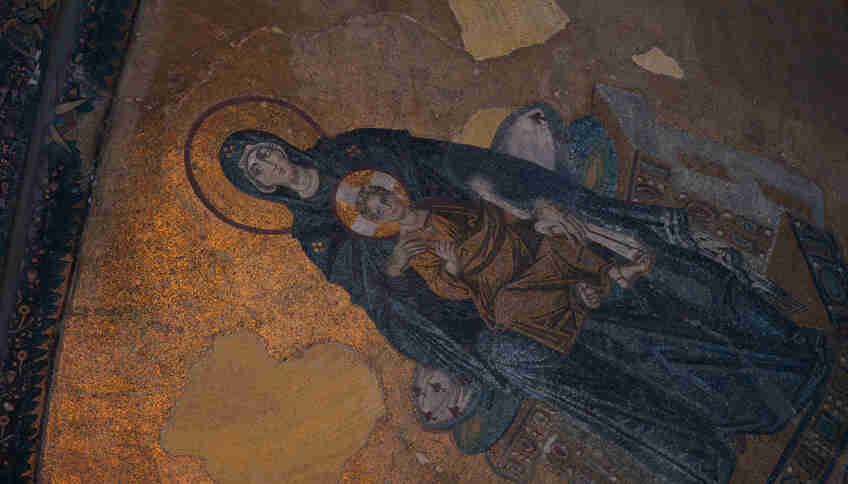
The main attraction of the northern gallery of Hagia Sophia is a mosaic depicting Emperor Alexander, who ruled at the beginning of the 10th century. Historians date it to 912, and it was discovered only during restoration work carried out in 1958.
It is believed that this mosaic is a portrait of the emperor made during his lifetime and depicts him during the Easter service. On either side of Alexander's figure are medallions bearing his name and monograms, deciphered as “Lord, help your servant, the Orthodox and faithful emperor.”
On the arches adjoining the portrait, fragments of mosaics dating back to the period of Justinian I have survived. If you look closely, you will notice that the modern fresco decoration of Hagia Sophia completely copies the design of the Justinian mosaics. This is a very curious fact! Thanks to the discovery of this detail, we understand that Muslim craftsmen covered the Byzantine mosaics with plaster, but painted the walls above them with the very same pattern, omitting only the images of crosses and other Christian symbols.