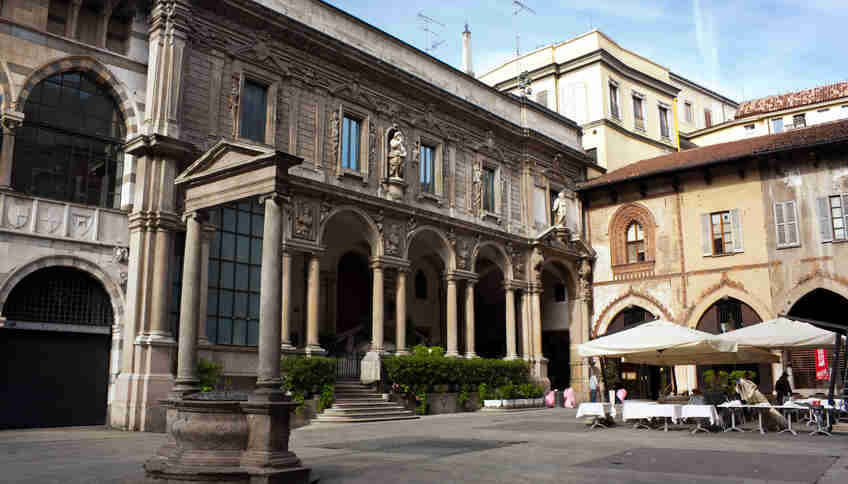
Throughout the Middle Ages, Mercanti was the city's main square. It began to take shape as early as the 13th century, and at that time it was much wider than it is now. Piazza Mercanti could be approached from six different sides. Each passage bore the name of the craftsmen's guild located on it. Thus, the square could be reached, for example, via Armorers' Street or Jewelers' Street.
The current arrangement of the sights on Piazza Mercanti can conventionally be divided by the cardinal directions. To the west stands a Gothic-style building known as "Dom Panigarola" and built in the 15th century. From the north, the square is adjoined by the town hall building, erected in the 13th century and significantly reconstructed during the period of Austrian rule in the 18th century. And the southern side of Piazza Mercanti is distinguished by the Palace, built in the Baroque style in 1645 by Carlo Buzzi.
And the center of the square is marked by a 16th-century well decorated with two exquisite ancient columns.