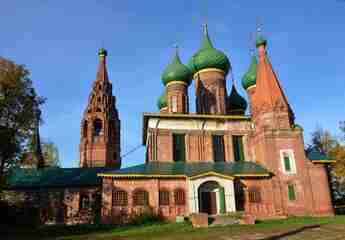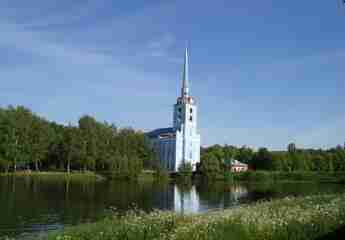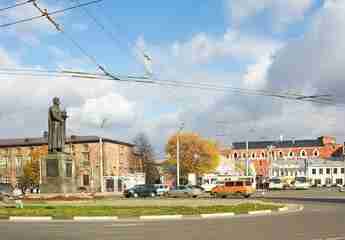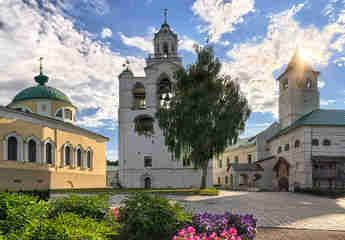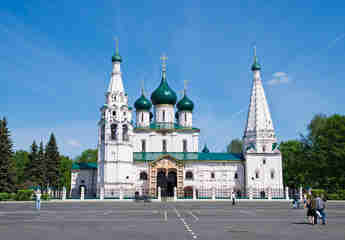
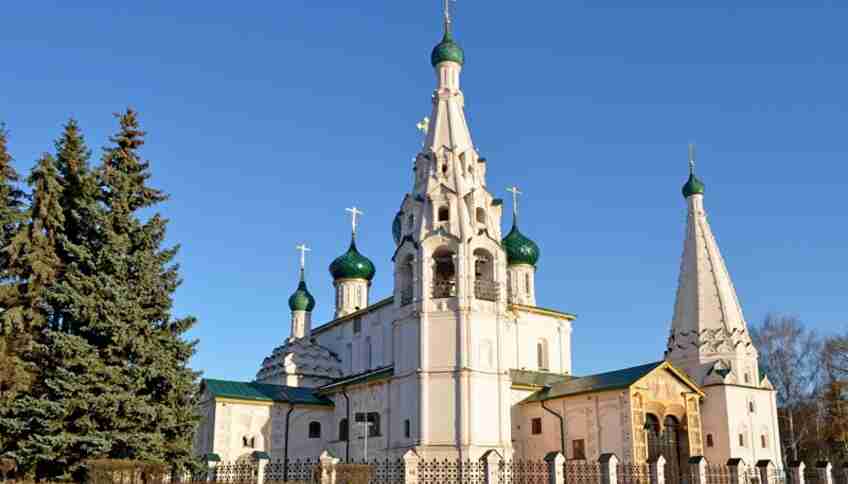
Almost the entire center of Yaroslavl consists of old buildings, ancient churches, and squares. But cultural historians commonly use the term “historic center” to refer to the very first settlements, fortified settlements, or fortresses. In Yaroslavl, this is considered to be Rubleny Gorod, which was located between the modern-day Sobinova and Respublikanskaya streets.
Rubleny Gorod had the shape of a triangle, the “point” of which was formed by the confluence of two rivers — the Volga and the Kotorosl. Its perimeter was about 1 km, so this rather small town could easily be explored on foot. Unfortunately, the buildings of Rubleny Gorod have not survived to the present day.
Fortunately, Yaroslavl was not among the cities where factories and plants were built right in the center. This made it possible to preserve the historic part in the form it had after the urban planning reform of Catherine II. At that time, the city acquired a clear layout with straight streets radiating from Ilyinskaya Square and ending in towers.
At the beginning of the 19th century, architect Pankov added several more beautiful buildings to the city architecture, such as Gostiny Dvor, the Spiritual Consistory, and the Matveyevskys estate.
In 2005, the historic center of Yaroslavl was added to the UNESCO World Heritage List.