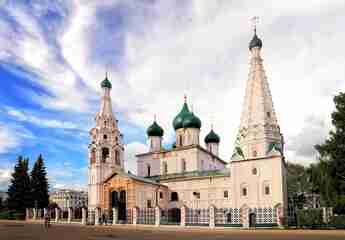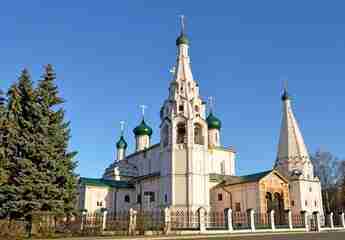
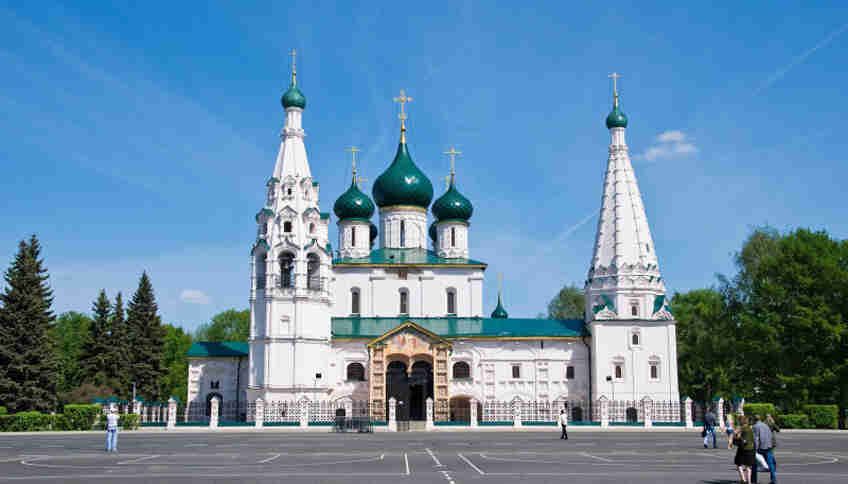
In the center of Sovetskaya Square in Yaroslavl stands an outstanding 17th-century architectural monument – the Church of Elijah the Prophet. It is a very beautiful white-stone church with green domes and gleaming golden crosses. It was built in 1650 on the site of two wooden churches.
Funds for it were provided by the local merchant brothers Skripin, following the tradition established by Nadey Sveteshnikov. Originally, the church stood in the courtyard of their family estate, and 9 representatives of the Skripin dynasty were buried near it.
When construction was completed, Patriarch Joseph, as a special token of gratitude, gave the founding merchants a fragment of Christ's robe, which had previously been kept in the Moscow Kremlin. In honor of this event, the Rizopolozhensky chapel was added to the church.
The church's murals were painted in 1680. In just three months, a team of 15 masters adorned the walls with magnificent frescoes. Many of them, incidentally, depict everyday scenes. The carved iconostasis is renowned for its ancient icons, and on the pediment of the western porch you can see the composition “Crucifixion”.
In the 1920s and 1930s, they wanted to demolish the church and erect a monument to the fighters of the revolution in its place. The organization of militant atheists actively collected city residents' signatures for this. But staff from Glavnauka and the Yaroslavl Museum defended the “white-stone beauty”.
It was then turned into an anti-religious museum, with a Foucault pendulum suspended beneath the dome. Then the war began and the museum was abandoned. Restoration of the church began only in 1955.
Funds for it were provided by the local merchant brothers Skripin, following the tradition established by Nadey Sveteshnikov. Originally, it stood in the courtyard of their family estate, and nine representatives of the Skripin dynasty were buried near this church.
When construction was completed, Patriarch Joseph, as a special token of gratitude, gave the founding merchants a fragment of Christ's robe (which had previously been kept in the Moscow Kremlin). In honor of this event, the Rizopolozhensky chapel was added to the church.
The church's murals were painted in 1680. In just three months, a team of 15 masters adorned the walls with magnificent frescoes. Many of them, incidentally, depict everyday scenes. The carved iconostasis is renowned for its ancient icons, and on the pediment of the western porch you can see the composition “Crucifixion”.
In the 1920s and 1930s, they wanted to demolish the church and erect a monument to the fighters of the revolution in its place. The organization of militant atheists actively collected city residents' signatures for this. But staff from Glavnauka and the Yaroslavl Museum defended the “white-stone beauty”.
It was then turned into an anti-religious museum, with a Foucault pendulum suspended beneath the dome. Then the war began, and the museum was abandoned. Restoration of the church began only in 1955.