What should you see in Yaroslavl? The best place to answer that question is on the interactive attractions map. Dozens of interesting places are already marked there – you simply need to choose the ones you would like to visit. Create a custom walking route or use one of the ready-made guides.
Our tour of Yaroslavl begins at a place that matters not only to local residents, but to Russians across the country...

livejournal.com, svetliya4ek
Every resident of Russia has seen this chapel – and that is no exaggeration, because it appears on the 1,000-ruble banknote. Bet you just reached for your wallet?
The Chapel of Our Lady of Kazan was built in Yaroslavl in 1997, when the whole country was celebrating the 385th anniversary of Moscow's liberation from foreign invaders.
In 1612, Yaroslavl became the capital of the state for several months, because this is where the volunteer militia from Nizhny Novgorod, led by Minin and Pozharsky, arrived. Their headquarters were based in the Spaso-Preobrazhensky Monastery.
After gathering their strength and increasing their forces, they marched from Yaroslavl to Moscow on July 27, 1612. Nearly four centuries after the capital was liberated, the Chapel of Our Lady of Kazan was raised by the gates of that very Spaso-Preobrazhensky Monastery.
Its silhouette looks a little like a rocket, a bell hangs inside, and one side is designed as a colorful stained-glass image of the Kazan icon of the Mother of God. The project was created by architect Grigory Daynov.
Inside the chapel there is a memorial plaque with words of gratitude from descendants to the people's militia. So in essence, this structure is not only a chapel, but also a monument to historic events.
Keep in mind that you can not only read or print this Yaroslavl guide, but also download it to your smartphone. All you need to do is download the free Ever.Travel app. Walking with a mobile guide is so much more convenient than carrying traditional books or printouts from the internet!

Flickr, Yvon from Ottawa
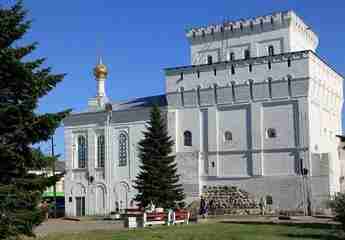
The Chapel of Our Lady of Kazan stands beside Yaroslavl's largest men's monastery and one of the 16 largest monasteries in Russia – the Spaso-Preobrazhensky Monastery. It is also one of the country's oldest and most beautiful historical and religious landmarks. It is famous as the place where one of the oldest monuments of Russian literature, The Tale of Igor's Campaign, was discovered.
The first mentions of the monastery date back to 1186, so it is generally considered to have been founded in the 12th century. At that time all of its buildings were wooden, while the stone structures you see today appeared after the fire of 1501.
In 1516, the Cathedral of the Transfiguration of the Savior was built here. The frescoes decorating its walls are now the oldest surviving monument of 16th-century mural painting. Only two such examples from the time of Ivan the Terrible have survived in Russia – here and in the Assumption Monastery of Sviyazhsk in Tatarstan. Even more remarkably, 17 icons from that era are still preserved in the cathedral.
At the end of the 18th century, by decree of Catherine II, all monasteries – including the Spaso-Preobrazhensky Monastery in Yaroslavl – were abolished. It then became the residence of the archbishops, and after Soviet rule arrived, the monastery was closed completely.
After the war, the churches and monks' cells were used as educational institutions and a military office. Since the 1950s, the Yaroslavl State Historical, Architectural and Art Museum-Reserve has operated here. That is exactly where we invite you to take a walk.
We are intentionally not going into detail about how to get from one sight to the next. They are all close to each other. Besides, in the Ever.Travel mobile app you will find a map with the full walking route marked on it. So don't worry about getting lost or missing something interesting :)
Belfry with the Church of the Pechersk Icon of the Mother of God

Yandex.Photos, Yulenochekk
The highest point of the Spaso-Preobrazhensky Monastery in Yaroslavl is this old 32-meter belfry, whose construction began back in the 16th century. Originally it had two tiers – a bell tower with green tiled tented roofs above, and a church below.
Over the centuries, the structure changed several times. At the end of the 17th century, the Alexander Nevsky chapel was added to the southern side of the belfry, and two more side chapels – dedicated to Nil Stolobensky and the Holy Forefathers – appeared much later, at the end of the 19th century. The tented tops crowning the belfry were dismantled in 1808-1809, and another tier in the form of a three-span arcade was added. By 1824, the bell tower had taken on its final appearance, designed by Yaroslavl architect Pyotr Pankov: a rotunda gazebo resting on eight columns beneath a round dome.
The church was consecrated in honor of the miraculous Pechersk Icon of the Mother of God in 1860. But during the White Guard uprising of 1918, the belfry was badly damaged. Restoration work in the 1920s and 1950s returned it to its original appearance. Church bells rang here again in 1991, when antique bells were raised to the top. Some of them date all the way back to the 16th century!
By the way, the top of the belfry offers a wonderful view of Yaroslavl's historic center.
What to See in Yaroslavl? City Guides:

Yandex.Photos, baranov.michael.2011
The Church of the Yaroslavl Miracle Workers stands beside the Cathedral of the Transfiguration of the Savior. It was built between 1827 and 1831 to a design by architect P.Ya. Pankov. Earlier, this site was occupied by the Entry into Jerusalem Church – a small church contemporary with the main cathedral. The relics of the Yaroslavl miracle workers – Prince Fyodor and his sons Konstantin and David – were found in its lower level in 1463. The fire of 1501 badly damaged the church, but it stood for more than another century until it was rebuilt, and in 1617-1619 a new Church of the Entry of the Lord into Jerusalem appeared here.
Built in the first half of the 19th century, the Church of the Yaroslavl Miracle Workers is eclectic in style. Classicism can be seen in the western facade, where a triangular pediment is supported by several Ionic columns. Above it rises a dome with a small cupola. The eastern facade, by contrast, follows the tradition of ancient Russian architecture, with an altar section formed by three semicircular apses.
This church brings together several artistic traditions from different eras, making it a truly unique and memorable architectural landmark.
And the next stop absolutely belongs on any answer to the question, 'What should you see in Yaroslavl?'

sobory.ru, Mikhail Chuprin
The Cathedral of the Transfiguration of the Savior is considered the oldest church in Yaroslavl. This three-domed, golden-topped cathedral was built on the site of an earlier sanctuary that had stood here even before the Mongol invasion.
The present cathedral was built in 1515. No one knows for certain who the architect was, but the building clearly reflects Italian architecture blended with the traditions of Russian church design. Historians believe it may have been built by an Italian – more specifically, Venetian – architect invited by Prince Konstantin.
The three towers of the cathedral are gilded and crowned with delicate openwork crosses, their outlines echoed by the rounded gables beneath them and the semicircular apses of the lower level.
The Cathedral of the Transfiguration of the Savior was beloved by Tsar Ivan the Terrible. Numerous charters granted to the church by the tsar confirm this, as do accounts of his frequent visits to the monastery. Historians and archaeologists also believe that the cathedral's ancient frescoes, which date from the same period as Ivan's reign, were created with the monarch's blessing and financial support. Most of these frescoes have survived to the present day and are carefully restored and protected from damage.
This is where our walk through the Spaso-Preobrazhensky Monastery ends – now let's head out to Epiphany Square.

Panoramio, GES-RU
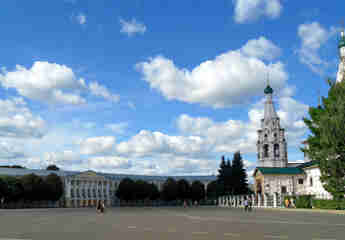
This old red-brick church is a true ornament of one of Yaroslavl's central squares. It was built in the 17th century on the site of an earlier wooden church.
Here, two architectural styles – Moscow and Yaroslavl – were combined for the first time. The result is a richly decorated church with two rows of kokoshniks beneath the roof, an ornament unique among Yaroslavl churches.
Construction of the stone church began in 1684 thanks to the efforts of merchant Alexei Zubchaninov. Inside, it turned out remarkably light and spacious: unlike many other churches, it had no internal pillars or supports.
The wall frescoes also date back to the 17th century. They were painted by a team of leading masters of the time – Dmitry Plekhanov and Fyodor Ignatyev. It is even said that Guriy Nikitin himself took part in the work; his frescoes also decorate the Novospassky Monastery in Moscow, the Church of Elijah the Prophet in Yaroslavl, and many other beautiful churches across Russia.
Today, Epiphany Church in Yaroslavl is listed as a cultural heritage site of the Russian Federation. Its image was also used on commemorative postage stamps issued for the city's 1,000th anniversary.

Panoramio, VLADNES
One of the city's oldest squares, known since the 12th century, only regained the name Epiphany Square quite recently – in 1992. Under Soviet rule it was called Podbelsky Square, and before that it was Rozhdestvenskaya Square.
That is because in the 14th century there was a convent here called the Nativity Monastery. It was burned down during the Polish siege of the city in 1609. Later, the Church of the Nativity of the Mother of God was built on the site. You will not see it today either – it was demolished in 1930 because it was considered an obstacle to traffic.
Over time, Epiphany Square truly grew into Yaroslavl's largest transport hub. Around a dozen buses and trolleybuses depart from here, and many of the city's streets begin here as well.
Fortunately, the historic value of the area was preserved as well. Around the square you will see several old buildings, including the former house of the Chepakhin merchants (No. 2), the clergy department house (No. 6), the so-called House of Friendship (No. 8), Epiphany Church, the diocesan administration, and the Spaso-Preobrazhensky Monastery.
By the way, this area is home to most of Yaroslavl's hotels. It is a very convenient place to stay – almost all the main sights are within walking distance. For the best prices and accommodation options, Booking.com is a good place to look.

new-team.org, GoldenMan28
Yes, this is the very monument everyone in Russia has seen on the 1,000-ruble banknote. It stands on Epiphany Square in the center of Yaroslavl.
Sculptor Oleg Komov portrayed him at full height, with a sword in his right hand symbolizing the prince as defender, and a model of the future city in his left. The model is meant to represent a fortress, but locals somehow compare it to a cake. That is why the monument has earned the nickname 'The Uncle with the Cake.'
'The Uncle with the Cake' faces Moscow and greets everyone arriving from the capital. Every Saturday, wedding car convoys line up around it – newlyweds consider it a must to visit the monument to Yaroslavl's founding father.
The monument was installed fairly recently – in the 1990s. Before that, for a long time the city had no monument to Yaroslav the Wise at all. Or rather, it did, but a very long time ago – back in the 19th century.
That earlier monument took the form of a pyramid and stood in the ravine where, according to legend, Yaroslav fought a bear. Emperor Nicholas I considered it unworthy of the site's historical importance and ordered it dismantled.
The legend of that duel is reflected in the modern monument to Yaroslav the Wise. One of the bas-reliefs on the pedestal shows the coat of arms of Yaroslavl – a bear holding a battle axe.
Another relief shows the prince working on a manuscript. As is well known, Yaroslav was deeply involved in educational and cultural work. During his reign, great resources were spent on copying and translating books into Old Russian and Church Slavonic.

Yandex.Photos, sokoloff.vitalick2011
Several streets radiate out from Epiphany Square in central Yaroslavl, including Pervomayskaya Street, where you will find a striking architectural landmark from the early 19th century – Gostiny Dvor.
There used to be an earthen rampart here, but it was filled in at the end of the 18th century. Since this was the very center of the city and the road from the capital led here, brisk trade naturally sprang up. It developed chaotically, with makeshift market stalls going up everywhere, leaving the area looking rather untidy.
In 1813, the city council ordered the construction of Gostiny Dvor so trade could be carried out in a more orderly way. The architect appointed to the project was Pyotr Pankov – a gifted self-taught talent without formal training. Scholars still debate whether he could have carried out such a project on his own, or whether he was helped by the Italian architect Carlo Rossi, who was working in a neighboring province at the time – Gostiny Dvor looks remarkably like the work of the famous Italian master.
The construction of Gostiny Dvor lasted five years. In the end, three separate structures were built: the southern wing, the northern wing, and a rotunda between them. Some historians believe there was once a fourth building standing behind the rotunda.
This architectural ensemble occupied an entire block filled with trading arcades. But 13 years later, a major fire struck the city, and that very fourth building disappeared as a result.
The northern wing grew worn with time and was rebuilt by 1911. The southern wing had to be dismantled completely – very little remained of it after the White Guard uprising in 1918. Today, the State Bank building from the early 20th century stands on its site.

cestyapamatky.cz
Keep walking along Pervomayskaya Street and you will soon reach the next stop on our route.
Although this paired architectural ensemble of federal and regional heritage sites is often treated as a single sight of Yaroslavl, the histories of its two parts differ quite a bit.
Vlasyevskaya Tower is much older than Znamenskaya Church. In the days of the Earthen Town there were five towers here, but only two have survived. Vlasyevskaya was built of brick in the mid-17th century on the site of a burned wooden tower. It served as one of the city gates, and the road from here led to Uglich. In Peter the Great's time, a tax was even collected here. For what, do you think? For wearing a beard and looking untidy!
Later, a wooden chapel was attached to the tower. In the 18th century it was replaced with a stone one, and in 1861 it was converted into a church. Later still, one of the walls was decorated with the image of the Sign icon, and that is how the church came to be called Znamenskaya.
Gradually, both the tower and the church were hemmed in by neighboring buildings, so today you will find the Yunost people's film studio, a building of Yaroslavl State University's economics faculty, and a bank beside them. The tower itself now houses computer labs and university television. Quite an unusual symbiosis!
Interesting fact: when Yaroslavl began building a water supply system at the end of the 19th century, it needed a water tower. Vlasyevskaya Tower took on that role, and a huge tank was installed at the top, holding 15,000 buckets of water. That was enough to supply 500 homes.
Meanwhile, we have now reached Volkov Square – and here is why it bears that name...

Flickr, Nick Grabowski
In Vasilyevsky Square in front of the theater stands a monument not just to an actor, but to the founder of the acting profession in Russia – Fyodor Grigoryevich Volkov. He was the one who assembled the country's first theater troupe and staged the first comedies in the stone barn of his own house.
Before long, word of the 'Yaroslavl comedians' reached Empress Elizabeth Petrovna herself. Thanks to her patronage, Volkov and his troupe soon began performing at court. In 1756, the establishment of the Russian Theatre was officially announced, laying the foundation for Russia's Imperial Theatres.
Given Fyodor Volkov's remarkable achievements, the sculptor chose to portray him standing at full height on a pedestal, proudly looking toward his greatest creation – the Russian Academic Drama Theatre. His arms are crossed over his chest, which makes the pose feel a little theatrical, but in this case it could not be more fitting. His stage costume only adds to the effect.
The monument was unveiled in August 1973, although the competition to design it had been announced back in 1900. Incidentally, the theater museum still keeps the sketches submitted to the jury at that time. History took a different course, and the famous actor's memory was honored only many years later.

Flickr, peterrbarker
This is the oldest theater in Russia. In autumn 2014, it will open its 265th season. More than two and a half centuries have passed since young Fyodor Volkov, together with his brothers and friends, began staging the first 'Yaroslavl comedies' in his father's barn. Over time, the city got a dedicated building for the theater.
The current building is actually the third home of the theater. It was built in 1911 to a design by architect N.A. Spirin. It is not tall, but it is very beautiful, done in a neoclassical style and decorated with columns and bas-reliefs. On the portico rises a snow-white sculptural group of three figures: Apollo with two muses – Melpomene and Thalia.
The classical theme continues inside the theater as well. For example, near the staircase leading from the first floor to the second stand two sculptures in ancient Greek style, and in the auditorium you can admire a magnificent frieze on the theme of 'The Triumph of Dionysus.'
Today, the theater's playbills feature leading Russian and European directors. Two major festivals are held here every year: the International Volkov Festival, one of the five largest in Russia, and the youth festival 'The Future of Theatrical Russia.'
From Volkov Square, continue along Pervomayskaya Street and, checking the map in the Ever.Travel mobile app, you will easily make your way to the next Yaroslavl landmark.

fotki.yandex.ru, baranov.michael.2011
This monastery is tied to a very interesting legend. In the 16th century, a man from Tutayev – then the town of Romanov-Borisoglebsk – was near Kazan on business. We know his name was Gerasim, and that he had an injured hand.
One day, Gerasim dreamed that the Blessed Virgin Mary appeared to him. She told him he would be healed if he went to a certain shop, bought an icon there, took it to Romanov, and built a church in its honor. Gerasim found the shop and bought the icon. The moment he took the image with his injured right hand, he was miraculously healed. In gratitude, he brought the icon to Romanov-Borisoglebsk, just as the Virgin had asked. This happened in 1588. The icon remained there for 21 years and was said to work many miracles.
In May 1609, Romanov was besieged by the Poles. To protect and preserve the icon, Lieutenant Yakov Lyubsky took it to Yaroslavl. Local residents knew of its miraculous power and believed it later helped the city withstand a 24-day siege. In gratitude, they built a wooden church in honor of the icon and added cells around it to house nuns from a monastery that had burned down.
Construction of the stone Cathedral of the Kazan Mother of God began in 1649. It was rebuilt, dismantled, and reconstructed several times. In Soviet times the monastery was abolished, and the cathedral was turned into an archive. Services resumed there only in 2001.
Today it is one of Yaroslavl's most revered churches. It houses the relics of Saint Agafangel (Preobrazhensky). As for the fate of the legendary icon itself, sadly it remains unknown: a copy now hangs in the cathedral.

livejournal.com, ondryushka
Yaroslavl's Red Square is adorned by a structure you simply cannot miss. It is the Fire Tower, which recently celebrated its 100th anniversary. It stands more than 30 meters tall – almost the height of a nine-story building. It was built in 1911 to a design by the city's chief architect, Grigory Sarenko.
There used to be a wooden tower here, but wood and the weather are not the best of friends, so in time it had to be replaced with stone. For many years the tower faithfully served the city – it was the tallest building in Yaroslavl, and firefighters were on duty here around the clock to spot suspicious smoke or flames in time.
Interestingly, the tower once also served as the city's largest thermometer: when the outdoor temperature dropped below –25°C, a flag was raised at the top in the morning to show that classes in the gymnasiums were cancelled for the day.
From 1974 onward, fire watch shifts were abolished because telephone communication proved to be a more effective alarm system. Today, the building houses the Main Directorate of EMERCOM for the Yaroslavl Region and a federal fire protection unit.
The height of this structure makes it especially appealing to photographers, who can get some wonderful shots of the city right from the historic center.
Next, we turn toward the Volga and walk through a small park to another city monument.

2rf.ru
On the bank of the Volga – the river Nikolai Nekrasov loved and celebrated in his writing – now stands his monument. The writer once lived in this city, spent his school years here, and had his own estate near Yaroslavl where he stayed in summer.
The monument to Nikolai Nekrasov was unveiled in 1958, although fundraising campaigns had repeatedly been announced before that in hopes of honoring the hometown poet. Each time, however, the money collected was not enough, so the monument appeared in Yaroslavl only 80 years after the poet's death.
The sculptor portrayed the writer at full height, gazing thoughtfully into the distance – toward his beloved Volga. The pedestal bears the words, 'I dedicated my lyre to my people,' and nearby bas-reliefs depict scenes from his best-known works: Little Peasant Boy, Orina, Soldier's Mother, and Who Can Be Happy and Free in Russia?
In 2021, the 200th anniversary of Nikolai Nekrasov's birth will be celebrated. The authorities in Yaroslavl began preparing for the date in advance: plans included preserving the cultural sites already connected to the writer's name and creating new ones, such as the museum and tourism complex 'Nekrasov's Left Bank.' Locals also came up with the idea of establishing a Nekrasov Boulevard.
At this point, we will turn right and continue walking along the riverbank.

Yandex.Photos, lis.svetlana2011
This is probably the most beautiful and best-kept embankment you will find in any Volga city!
The first attempts to protect the Yaroslavl riverbank from constant erosion began in the mid-18th century, when monks gathered stones and laid them along the shore. At that time, however, they managed to reinforce only a small stretch near the bishop's house.
Large-scale reinforcement and improvement came in the early 19th century, when Emperor Alexander I arrived in the city on an official visit. Seeing the poor condition of the riverbank, he ordered the necessary funds to be allocated. After that, the slopes were leveled and lined with rubble stone and moss. An extraordinary number of ships and barges had to be mobilized: every merchant vessel arriving in Yaroslavl was required to bring four cubic meters of rubble stone free of charge.
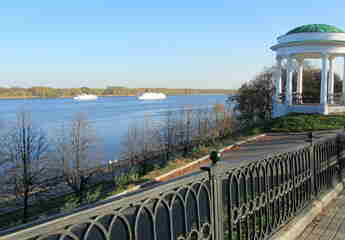
Under Nicholas I, the wooden fences were replaced with cast-iron railings, linden alleys were planted, pedestrian descents to the water were created, and round gazebos were built. One of those gazebos has survived to this day. It has become a symbol of the Volga Embankment, and no memorable photo here feels complete without it.

liveinternet.com, m-a-kuzmin
Built on the bank of the Volga, the Church of the Nativity of Christ shaped Yaroslavl's skyline for several centuries and blended organically into the city's overall architectural ensemble. It was built between 1635 and 1644 with the funds of wealthy merchants Guriy and Akindin Nazaryev, although the church they founded was completed by their sons – Ivan, Andrei, and Mikhail Guryev. The benefactors' names are preserved in an inscription still visible high on the main structure.
This four-pillar church with five domes, galleries, and side chapels cost the merchant family an enormous sum. But money was clearly not the main concern. An additional Kazan chapel was added to the original design, doubling the size of the western gallery. The bell tower stands out especially in the complex, topped by a delicate openwork tented roof.
The interior paintings of the Church of the Nativity of Christ were added in the 1680s. They were created by a team of masters led by Dmitry Semyonov, who was also known for his frescoes in the Church of Elijah the Prophet.

Yandex.Photos, olg95409143
This private museum, run by a wonderfully colorful owner-magician, holds some very original exhibits: antique clocks, musical instruments, irons, bells, a porcelain collection, and even gold-ground icons. Children who can hardly imagine any iron besides a modern electric one are genuinely amazed by old devices with bellows, coal compartments, and cast-iron inserts. Adults, meanwhile, hold their breath as they listen to the sounds of a real barrel organ, gramophone, and harmonium.
And we almost forgot the best part: in this museum, all the exhibits are not only rare, antique, and authentic – they still work. The guides happily demonstrate this. The young women play unusual instruments and even the bells with remarkable skill.
In the clock hall, you can see floor clocks, wall clocks, mantel clocks, travel clocks, and many other examples. They are all in working order too, but wound to different times so that a melodic chime accompanies visitors throughout the tour.
The museum also holds unique audio recordings and vinyl records. Perhaps someone will be amused by heartfelt relics such as 'Comrade Stalin's Speech' or 'Ilyich's Favorite Songs.' In total, the collection includes more than 10,000 records – can you imagine that?
By the way, Russian-style wedding ceremonies are often held here for newlyweds. One of the halls also regularly hosts concerts with guest performers from Moscow, St. Petersburg, and other cities in Russia and beyond.

Yandex.Photos, slawik.miasnikov
This snow-white beauty appeared on the bank of the Volga more than 170 years ago. It was built on the site of a 'Chinese pavilion' – a small chinoiserie-style gazebo that was extremely fashionable in Russia in the second half of the 18th century. Variations on Chinese tea houses were usually placed in scenic spots so people could admire nature and reflect in peace.
In time, the pavilion grew worn down, and in the 1840s a rotunda gazebo in classical style was built in its place. It became the first structure of its kind in Yaroslavl. Three more gazebos were later built in its image, but this one is valued far above the others. No wonder – it is a contemporary of Nekrasov himself.
In 1905, however, Yaroslavl nearly lost this romantic landmark. The city authorities decided that restoring it would be too expensive, and that demolition would be more practical. But outraged residents staged a mass protest and managed to save the gazebo.
Today it is one of the main symbols of Yaroslavl. Newlyweds come here, tourists take photos beside it, and couples arrange to meet nearby. Many people even call it the 'gazebo of love.' How many romantic meetings and heartbreaks it has witnessed, perhaps only the Volga knows.

sobory.ru, Ilya Beskhlebny
Walking along the Volga Embankment, be sure to turn into Narodny Lane – here, surrounded by ordinary residential buildings, stands the ancient Church of Nikola Nadein. It is considered the first stone church built in the city's trading settlement.
Construction began as early as 1620, just after the Time of Troubles had ended and some order had returned to Russia. The church was named in honor of Saint Nicholas the Wonderworker, whose icon was once said to have washed ashore here on the Volga, and also in memory of its worldly benefactor, Nadeya Sveteshnikov.
He was one of the wealthiest merchants in Russia, and he did more than just build a church – he started a whole tradition of financing churches with private wealth. Rich dynasties practically competed with each other, building churches one grander than the next. It was considered the finest sign of prosperity.
Originally, the Church of Nikola Nadein had five domes, but in 1836 the side cupolas were removed, leaving a single central dome. A bell tower was added nearby, crowned with a beautiful eight-sided tented roof.
The most interesting treasures are inside the church. First of all, there are the old wall paintings covering nearly every surface. In some places you can still see frescoes created in the 17th century by teams of masters from Yaroslavl and Kostroma. The church's main highlight, however, is its Baroque iconostasis, which is said to have been executed from drawings by Fyodor Volkov – the very man who founded Russian theater.

Flickr, ChihPing
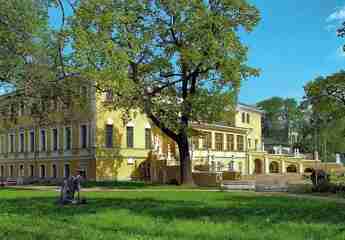
Across from the Church of Nikola Nadein stands the Yaroslavl State Art Museum. It is located on the grounds of the former governor's house, built in the early 19th century.
Every Russian emperor from Alexander I onward once visited this historic building. It also served as the official residence of 17 governors of Yaroslavl.
By the way, not long ago the entrance to a secret passage was discovered. It once ran underground from the building's main entrance to a grotto gazebo on the lower embankment. Whether anyone ever managed to use it, and under what circumstances, is something we suggest you try to find out on the spot.
The art museum holds more than 70,000 exhibits – not only paintings and graphic art, but also decorative and applied arts, numerous sculptures, and valuable coins. Works by outstanding artists such as Repin, Levitsky, Bryullov, and other masters are also on display here. The museum often hosts temporary exhibitions devoted to artists of global stature, such as Salvador Dali.

yourenta.ru
The lovely garden beside the home of Yaroslavl's governors was laid out at the same time as the palace itself – in the first half of the 19th century. This place remembers every Russian tsar of its era, from Alexander I to Nicholas II. Today, anyone can enjoy its aristocratic old-world atmosphere combined with contemporary culture. The house and garden are part of the Yaroslavl Art Museum, which restored the grounds in 1994.
Governor's Garden is neat and beautifully maintained, with straight paths and carefully shaped lawns. It also features many sculptures made of bronze, ceramic, marble, and granite. This open-air exhibition is called 'Sculpture in the Open Air' and includes works by leading masters from Moscow and St. Petersburg.

livejournal.com, svetliya4ek
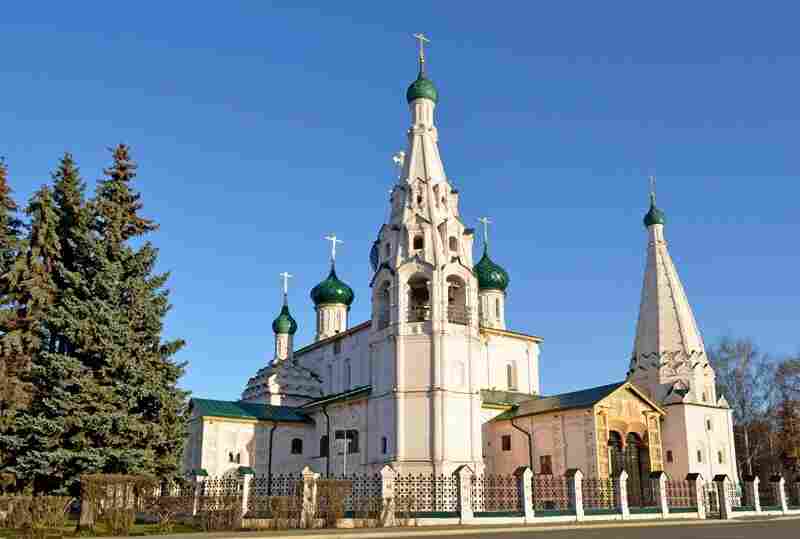
Just beyond Governor's Garden lies Sovetskaya Square, at the center of which stands a remarkable 17th-century architectural monument – the Church of Elijah the Prophet. It is a beautiful white-stone church with green domes and gleaming golden crosses. It was built in 1650 on the site of two wooden churches.
Funds for its construction were provided by the local merchant brothers Skripin, following the tradition started by Nadeya Sveteshnikov. Originally, the church stood on the grounds of their family estate, and nine members of the Skripin dynasty were buried nearby.
When construction was finished, Patriarch Joseph gave the founding merchants a fragment of Christ's robe, previously kept in the Moscow Kremlin, as a special sign of gratitude. In honor of this event, a Chapel of the Deposition of the Robe was added to the church.
The church was painted in 1680. In just three months, a team of 15 masters covered its walls with stunning frescoes, many of which depict everyday life. The carved iconostasis is famous for its antique icons, and on the pediment of the western porch you can see a composition of the Crucifixion.
In the 1920s and 1930s, there were plans to demolish the church and put up a monument to the fighters of the revolution in its place. The League of Militant Atheists actively collected signatures from residents in support of the idea. But staff from Glavnauka and the Yaroslavl museum managed to defend this white-stone beauty.
It was then turned into an anti-religious museum, with a Foucault pendulum hung beneath the dome. Then the war began, and the museum was abandoned. Restoration of the church started only in 1955.

Yandex.Photos, j-tertichny
Until 1918, this square was called Ilyinskaya Square – after the Church of Elijah the Prophet, which was built here more than three and a half centuries ago and served as the area's architectural centerpiece.
The decision to rename the square Sovetskaya was connected to the fact that the executive committee of the Soviet of Workers' and Peasants' Deputies was located here. In 1919, there were plans to erect a monument to Lenin in the center and rename the square once again – this time to Lenin Square. But that plan never came to life.
Today's Sovetskaya Square is surrounded by low three-story buildings. Two of them – to the left and right of the Church of Elijah the Prophet – are former government offices, as administrative buildings were once called. They look almost identical, except for the triangular pediment on the right-hand building. One now houses the Yaroslavl Regional Duma, while the other is occupied by various social organizations.
Between these two wings once stood the governor's palace. It was very beautiful, with elegant statues rising above its roof. Together, the buildings formed a magnificent architectural ensemble.
When Paul I came to power, the palace was destroyed, and an empty lot remained on the site for a long time. Later, an unremarkable police administration building was constructed there, but it too was demolished in Soviet times.
The regional party committee needed a new building, so drawings of the governor's palace were found in the archives in hopes of rebuilding it in the city center and restoring the unity of the ensemble. The idea was supported in the capital, but the local authorities changed everything at the last moment. In the end, a building considered modern for its time was constructed instead – now home to the Administration of the Yaroslavl Region.
Yandex.Photos, -Svetlana-
Almost all of central Yaroslavl consists of old buildings, ancient churches, and squares. But in cultural history, the term 'historic center' is usually reserved for the earliest settlement, hillfort, or fortress. In Yaroslavl, that place is considered to be Rubleny Gorod, once located between today's Sobinova and Respublikanskaya streets.
Rubleny Gorod had the shape of a triangle, with its pointed tip formed by the meeting place of the Volga and Kotorosl rivers. Its perimeter was about one kilometer, so this small town could be easily explored on foot. Unfortunately, none of the buildings of Rubleny Gorod have survived to this day.
Fortunately, Yaroslavl was not one of the cities where factories and plants were built right in the center. That allowed the historic part to survive in the form it took after Catherine II's urban planning reform. The city then received a clear layout with straight streets radiating from Ilyinskaya Square and ending at towers.
At the beginning of the 19th century, architect Pankov enriched the city's architecture with several more beautiful buildings, including Gostiny Dvor, the Spiritual Consistory, and the Matveyev estate.
In 2005, the historic center of Yaroslavl was added to the UNESCO World Heritage List.

livejournal.com, neringa_iris
On Chelyuskintsev Square, near Sovetskaya Square, stands an ancient men's monastery. Its history begins in 1616, after Russia was liberated from Polish invaders.
A few years earlier, a severe epidemic had struck the city, and local residents, together with soldiers, prayed for healing in a small chapel that once stood on this spot. Soon the plague ended, and in gratitude the townspeople began building wooden churches in honor of the icon of the Savior Not Made by Hands, before which they had prayed, and Saints Cyril and Athanasius of Alexandria. The latter were chosen deliberately: in Orthodoxy they were revered as defenders of Christianity against heresy, and the Catholic faith of the Polish invaders was considered heresy at the time.
At the end of the 17th century, stone churches, monastery buildings, and monks' cells began to rise on the site of the wooden churches. They have survived to this day, although in Soviet times the Kirillo-Afanasievsky Monastery, like many religious buildings, was used for very different purposes – the administration of a furniture factory was located here.
Only in 2005 was the monastery returned to the Church. Five years later, it had been partially restored and services resumed. At the beginning of 2011, the icon of the Savior Not Made by Hands, which had been kept there before the revolution, was returned to the monastery.

livejournal.com, dmrog
Across from the Kirillo-Afanasievsky Monastery stretches a lovely park with linden alleys and tidy paths. At its center stands the famous Demidov Pillar – a monument to Pavel Demidov, founder of Yaroslavl's first institution of higher education.
The current pillar is a recreation of the monument destroyed after the revolution. Originally, it was a 12-meter bronze column standing on a granite pedestal and topped with a celestial sphere and a double-headed eagle.
The money for it was raised, as the saying goes, by the whole community through voluntary donations from townspeople. Once the necessary sum had been collected, the monument was solemnly unveiled in March 1829. But nearly 100 years later, revolutionaries began actively stripping away any symbols of autocracy that reminded them of imperial Russia.
First they removed the double-headed eagle and the celestial sphere, and then they decided to dismantle the monument entirely and use it for the needs of industrialization. As it turned out, the bronze column was hollow and filled with sand for stability, so it brought them little real value.
In 2004, the Museum of the History of Yaroslavl initiated the restoration of the monument on its original site. City authorities supported the proposal and allocated more than 20 million rubles from the budget. By December 2005, the tallest monument in Yaroslavl – the Demidov Pillar – once again stood in the city center. It looks much like the original, though the column is now made of ultra-strong concrete.
To see the next sight, we need to turn back toward the embankment – it is definitely worth it :)

Yandex.Photos, mr.Vlad
As we know, Andrei Bolkonsky is a literary character – a hero of Tolstoy's epic novel War and Peace. Could he really have had an actual house? Or is this simply a namesake? These questions are asked not only by visiting tourists, but also by local historians, journalists, and researchers.
According to a favorite city legend, Leo Tolstoy modeled Prince Andrei after a real person – Lieutenant General Nikolai Tuchkov of the Russian army, who died in Yaroslavl in a hospital for officers.
Digging through the archives, local researchers discovered that during the war a hospital had indeed been located in this house on the Volga Embankment. That is why it first came to be called 'Tuchkov House' – even though he never lived here – and later 'Bolkonsky House.'
But whose mansion was it really? Judging by the architecture, it is clearly an 18th-century family estate built in the spirit of provincial classicism. Archival research has shown that the house was built by collegiate assessor Anna Zezevitova, who owned it until 1821. Later, a military hospital really was located here, but whether the prototype of Andrei Bolkonsky was ever connected to it remains a mystery.
After the war, various organizations occupied the building, and it gradually fell into decline. Only in the early 2000s, after it passed into private hands, did restoration begin. Today, the mansion shines with renewed grandeur and draws the attention of countless tourists.

Yandex.Photos, Gomper
Right on the bank of the Volga stands a tower that in the 17th century served as the water entrance to the city. It was long part of the fortifications built around Rubleny Gorod. There were once 19 such towers, but only two survive today – the Volga Tower and Znamenskaya Tower.
By the way, the Volga Tower stood at the very corner of the 'triangle' – Rubleny Gorod itself had the shape of a triangle, with the Medveditsky Ravine forming its base. From here there was a good view of the river and the nearby shore. That proved especially useful in 1609, when the city endured a 24-day siege by the Poles.
Originally, the Volga Tower had a shooting gallery and a wooden tented roof with a watchtower, but this burned down in 1711, and a century later the shooting gallery was dismantled as well. In the 1840s, the tower was built higher and turned into a military arsenal. From then on, it was known as the Arsenal Tower.
Toward the end of the 19th century, a tavern was opened inside the Volga Tower. No one overcomplicated the name – they simply called it 'The Tower.' Judging by all signs, it was a success, since today there is still a cafe here.
Today, strolling peacefully along the Volga Embankment, it is hard to imagine that this place once buzzed with life and brisk trade around the tower. Merchant vessels – including foreign ships and barges – arrived in Yaroslavl daily, and all their goods entered the city through the Volga Gate.
And once again we 'dive' back into the city. Sorry for leading you in zigzags now and then, but Yaroslavl's historic center is so full of sights that it would be a shame to miss even one of the more notable ones. The distances are short here, so enjoy the walk :) The route map in the Ever.Travel mobile app will help you stay on track.

Yandex.Photos, pavel.paladiev
The wooden Church of the Transfiguration of the Savior in Gorod is first mentioned in chronicles of the 15th century. It burned down in the great fire of 1658, and a stone church was built in its place. Externally, it resembles the Church of John Chrysostom in Korovniki, since it was modeled after it. In 1693, the walls of the church were covered with frescoes in less than a month.
Over time, the church was expanded and rebuilt, with new side chapels added and icon paintings renewed. Sad times began in 1918. First it was badly damaged during the White Guard uprising, though parishioners quickly raised money for restoration. After 1926, however, the parish was closed and the church was handed over to the local history museum.
For a long time, the building was used as storage space, and only in the early 1990s did gradual restoration begin: cracks were sealed, facades refreshed, and gilded crosses placed back atop the domes. In July 2003, the Church of the Transfiguration of the Savior in Gorod was returned to the Yaroslavl diocese.

SOBORY.RU, Ilya Beskhlebny
Not far from the Church of the Savior in Gorod stands another white-stone beauty – the Church of Nikola Rubleny. It is the only church on the territory of the Yaroslavl Kremlin to have survived from the 17th century, which makes it especially valuable.
The church's name has two parts: 'Nikola' in honor of Saint Nicholas the Wonderworker, the patron saint of travelers, and 'Rubleny' after the historic center of Yaroslavl. It is said to have once stood over a gate, meaning visitors entered Rubleny Gorod through it.
The stone church was built in 1695; before that, the church here was wooden. We no longer know exactly what the earlier building looked like, but its stone incarnation is considered exceptionally successful. The five onion domes are crowned with gleaming crosses, while the tented bell tower seems to rise like a prayer toward the sky.
From the outside, the church walls are almost unadorned, and the windows sit deep in their niches. Yet the overall architectural composition is so harmonious and expressive that the Church of Nikola Rubleny is considered one of the most interesting churches in Yaroslavl.

Flickr, nikita.baranov.982
Now we have reached the most interesting place of all – the spot where Yaroslavl was born. From a geographical point of view, the site for the fortress was chosen perfectly: it resembles a triangle, with its pointed tip protected by natural water barriers and its base formed by a deep ravine that likely also held water.
In effect, this was a kind of island that was not easy to approach – which is precisely why Yaroslav the Wise chose it for his future city. According to legend, a pagan sanctuary once stood here.
To put an end forever to what was seen as a pagan shrine, the grand prince built six Orthodox churches on his island. The main one was the Assumption Cathedral, recently rebuilt. The others, except for the Church of Nikola Rubleny, were destroyed over time.
In the middle of the 17th century, Rubleny Gorod was enclosed by wooden fortifications that included two gate towers and ten blind towers. The Volga Tower, which served as the river entrance, has survived to this day.
Within the ancient town stood not only churches, but also the voivode's house – princely chambers – and wooden dwellings for the prince's retinue and ordinary residents. All the structures, including the churches, towers, and fortress walls, were hewn from wood, which is how Rubleny Gorod got its name. Beyond it began the Earthen settlement, where people also lived.
After the 'great fire' of 1658, all the wooden buildings burned down. Some were rebuilt, but the walls themselves were not restored. By then, artillery capable of firing cannonballs through any barrier had made such defenses unnecessary.

fotki.yandex.ru, baranov.michael.2011
The Metropolitan Chambers – the ceremonial residence of the metropolitan – were built at the end of the 17th century on the site of the voivode's house. The bishop himself lived on the second floor, while the servants' rooms were on the ground level.
According to archival documents, Empress Catherine II stayed in this house twice in the 1760s. Later it was the residence of Governor-General Alexei Melgunov, whom she appointed as Yaroslavl's governor.
In the 18th and 19th centuries, the Metropolitan Chambers were rebuilt several times: the fence was removed, facade decorations were stripped away, the stone porch was dismantled, and a third floor was added.
The building was badly damaged during the revolutionary years, but restoration according to the original design began already in the 1920s. In this way, the Metropolitan Chambers regained their former appearance.
In 1977, an icon painting exhibition organized by the Yaroslavl Art Museum opened here. Today, the building houses an entire department of that collection devoted to Old Russian art. It is absolutely worth visiting, as it offers a unique chance to see 600 years of icon painting created by generations of Yaroslavl masters.

Yandex.Photos, baska-ira
The 'pearl' of the Yaroslavl Kremlin – and indeed of the entire ancient Rostov-Yaroslavl diocese – is the Assumption Cathedral. It was the city's first stone church, built at the beginning of the 13th century. Before that, most churches here were wooden – right up until the fire of 1658.
The interior of the church was once very rich: the walls were decorated with stone carving, the floor was laid with majolica, and the doors featured gilded copper ornaments. At the very beginning of the 16th century, however, a fire broke out in the cathedral and its vaults collapsed.
But as the saying goes, every cloud has a silver lining: while clearing the ruins, workers discovered the remains of Yaroslavl princes buried here in the 13th century – Vasily and Konstantin Vsevolodovich. The latter, incidentally, was the founder of this church. It was by his order that construction of the Assumption Cathedral began in 1215.
In 1516, a rebuilt church on the same site was consecrated. During the Time of Troubles, it was in the Assumption Cathedral that Dmitry Pozharsky received the metropolitan's blessing for the campaign to liberate Moscow.
The following centuries were not kind to the church either: it was rebuilt, restored, turned into a labor exchange, and even used as a grain storehouse. Then in 1937 the cathedral was blown up. A city park was later created on the empty site.
With the arrival of the 2000s, it was decided to rebuild the Assumption Cathedral. In 2010, Patriarch Kirill consecrated the completed church. It differs dramatically from its predecessor and is much larger, but people still keep the memory of this place alive and continue to come here with love and prayer.

Yandex.Photos, misina
This sculptural composition of three angels – who, according to the biblical story, came to Abraham to announce the miraculous birth of his son – was installed on the Strelka in front of the Assumption Cathedral in 1995.
The authors of 'Trinity' were sculptor Mukhin and architect Bobovich. It is said that Mukhin originally made the composition for Japan, but for some reason the monument never left for the Land of the Rising Sun. The sculptor then offered it to the Yaroslavl city administration, and they agreed to keep it in his hometown.
After the solemn unveiling, however, the local press erupted in angry criticism, and the public, to put it mildly, did not appreciate the creators' efforts. People began calling the angels 'humanoids' because of the strange shape of their heads.
Over time, locals developed a wedding tradition of tossing coins into the bowl set before the angels. A direct hit is considered a sure sign of luck.
Unsurprisingly, this sparks a wave of indignation among the clergy, who call it sacrilege and a pagan ritual. Still, no special measures were ever taken – the matter was simply left to the conscience of the townspeople themselves.

Flickr, Artyom Dyakiv
For Yaroslavl's 1,000th anniversary, the beautiful Strelka Park was restored on the city's famous sandy spit.
In truth, this is not quite a park in the usual sense – there are no groves, wooded areas, or lakes here. But it does not need them, because the waters of the Volga and the Kotorosl splash against the Strelka from both sides. Together with a professional irrigation system, they help the greenery thrive even in sandy soil.
The whole park is planted with lawns and flower beds, and comfortable paths and benches have been added for visitors. There are trees here too, but they are still young, so you should not count on much shade just yet.
The central part of Strelka Park is occupied by a large musical fountain. On the site of an old spring, a 20-meter stele was installed, surrounded by figures symbolizing different stages of Yaroslavl's history: Prince Yaroslav the Wise, the city's founder, along with a priest, a chronicler, warriors, and a woman with a child.
The park is always lively. People in Yaroslavl love this place and often come here to relax and spend time with friends. It is beautiful in winter too – skiers glide along the snowy paths, and children cheerfully tumble in the snow.
This is where our walk through Yaroslavl's historic center comes to an end. We hope we have fully answered the question, 'What should you see in Yaroslavl?' :) Still, there is much more to discover in the city – take a look at the attractions map. It will help you build your own walking routes. Never tried that before? See our tips – it is easy and very convenient!