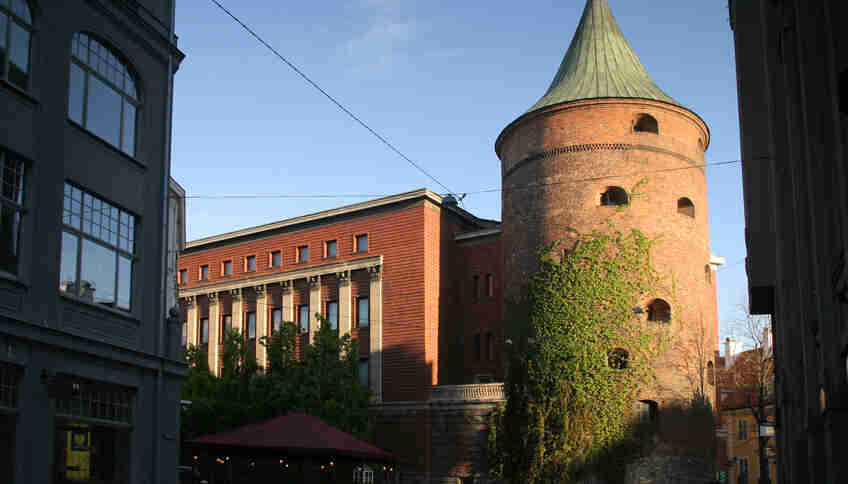
Riga's medieval fortress was once surrounded by 28 towers. The only one that has survived is the Powder Tower, built at the beginning of the 14th century. Back then it was still called the Sand Tower, as it defended the city's main entrance from the side of the Great Sandy Road (modern-day Smilsu Street).
During the Swedish-Polish War, gunpowder was stored in the tower, and that is how it got its new name. The Swedish army seriously damaged the fortress structure, and in 1650 it had to be restored. As a result, the tower's height exceeded 25 meters, and the thickness of its walls reached 2.5 meters.
After that, the building withstood all subsequent assaults on Riga, including the capture of the Latvian capital in 1710 by the troops of Peter I, in memory of whom nine cast-iron cannonballs are still "kept" in the tower's walls.
For almost two centuries the tower stood empty and deteriorated, and at the end of the 19th century it was leased to private individuals, who restored the interior spaces and organized a beer hall, as well as fencing and dance halls.
Since the 1920s, the Powder Tower has housed a military museum, which during the Soviet era was transformed into the Museum of the Revolution. Nowadays the building once again belongs to the Latvian War Museum, whose exhibitions introduce visitors to the country's military and political history in the 20th century.