Buda Castle Funicular

Flickr, Marcus Wong from Geelong
Updated for 2026: Buda Castle is as popular as ever, so expect lines at the funicular and plenty of company around the palace complex in peak season. Go early or later in the day for softer light and a calmer walk along the terraces.
Budapest's funicular is more than a ride up from Clark Ádám Square to Buda Castle - it's a historic attraction in its own right. The cars are split into three stepped compartments, and the interiors still echo the late 19th century, when the line first opened. It began operating in 1870 and originally ran on steam power.
The line was badly damaged during World War II and remained out of service for decades before being rebuilt and reopened.
Each carriage has a name. One is called Gellért, after nearby Gellért Hill; the other is Margit, a nod to Margaret Island and Saint Margaret of Hungary.
For most visitors, the funicular is less about convenience and more about the experience. You can walk up to the castle, but the vintage cars make the climb far more enjoyable - especially on a rainy day or when the wind picks up. The short ascent still feels wonderfully dramatic.
Sándor Palace

Flickr, Neal1960
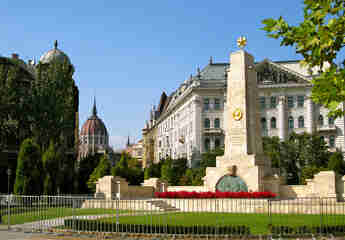
Sándor Palace (Hung. Sándor-palota) stands beside Buda Castle and is one of the most elegant Neoclassical buildings in the district. Completed in 1806 for Count Vince Sándor, it is associated with architect Mihály Pollack. From 1919 until World War II it served as the working residence of Hungarian prime ministers, then was badly damaged in the war and painstakingly restored. Since 2003 it has been the official residence of Hungary's president. Look for the bas-reliefs on the facade, the memorial plaque to Pál Teleki on the eastern wall, and interiors known for chandeliers, tapestries, and paintings by Károly Lotz.
The Turul

Flickr, rowan.parkinson
Turul (Hung. Turul) is a legendary bird in Hungarian mythology, usually imagined as a powerful falcon. Over time it became one of Hungary's best-known national symbols, appearing in origin stories, memorials, and public sculpture. The great Turul beside Buda Castle is especially striking: wings spread wide, a sword in its claws, and the city falling away below.
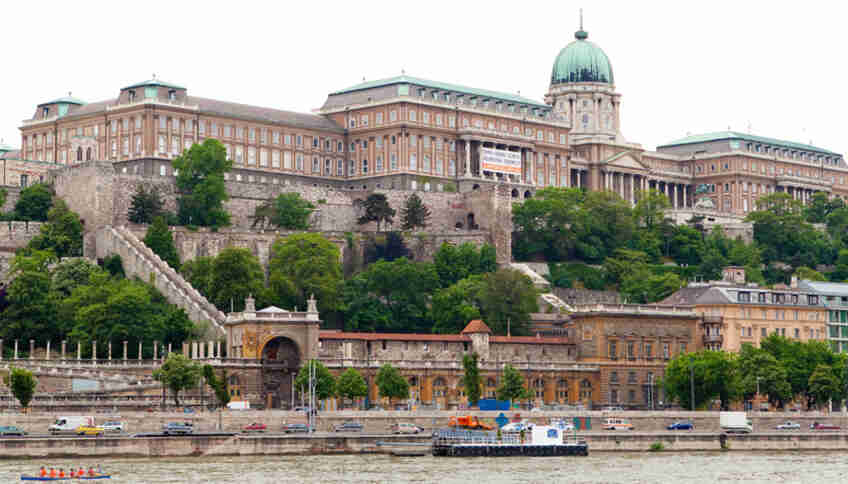
Buda Castle

Flickr, FinsUp0531
Buda Castle (Hung. Budai Vár) is the historic castle complex of the Hungarian kings and one of Budapest's defining landmarks. You can reach it by the Budavári Sikló funicular or on foot through the Castle District. The site forms part of Budapest's UNESCO World Heritage area, and its history stretches back to the 13th century, when King Béla IV began building a royal residence here after the Mongol invasion. Expanded under Sigismund and reshaped many times since, the complex you see today is the result of centuries of war, rebuilding, and reinvention.
Hungarian National Gallery

Flickr, Stockton Andrew
The Hungarian National Gallery (Hung. Magyar Nemzeti Galéria) is one of the country's leading art museums, with Hungarian works spanning the Middle Ages to the modern period. Housed inside the Royal Palace, it brings together medieval altarpieces, sculpture, 19th-century painting, and later art under one roof. Founded in 1957, the gallery grew from museum holdings, city collections, and private donations, and today it fills several wings of the palace.
National Széchényi Library

Flickr, thausj
The National Széchényi Library (Hung. Országos Széchényi Könyvtár) is Hungary's national library and one of the country's most important scholarly institutions. Its collections preserve the printed and written memory of Hungary, including the famous Corvina manuscripts associated with King Matthias. The library was founded in 1802, when Count Ferenc Széchényi donated the first core of the collection, and it still bears his name.
Budapest History Museum

Flickr, neurock
The Budapest History Museum (Hung. Budapesti Történeti Múzeum) occupies the southeastern wing of the Royal Palace and follows the story of the city from Roman times to the modern age. Alongside artworks, ceramics, textiles, photographs, and everyday objects, visitors can see Gothic and Renaissance remains uncovered during archaeological excavations. It's one of the most rewarding stops in the complex if you want to understand how many different Budapests are layered into this hill.