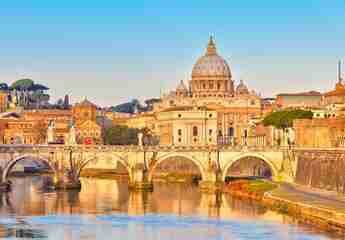

This crossing over the Tiber was built at the same time as Emperor Hadrian's mausoleum in 134-139 and was formerly called Hadrian's Bridge or Aelius Bridge — after the ruler's second name. After the tomb was renamed Castel Sant'Angelo, the bridge changed its name as well. And later, in the XVII century, statues of the apostles Peter and Paul and 10 more sculptures depicting angels appeared on it. So if one of the “experts” suddenly starts authoritatively claiming that the bridge was named because of the angels on it, you can safely say the opposite: the figures appeared on it one and a half thousand years later.
If you look more closely at the angels, you will notice that each of them is holding a certain object in their hands. All of these are attributes of the execution of Jesus Christ: the crown of thorns, the scourging column, the cross, the rods, the mocking placard, a sponge with vinegar instead of water, the spear, the nails, Christ's burial shroud... These sculptures were created by the sculptor Lorenzo Bernini together with his students. It is believed that two of them — the angel with the crown and the angel with the “INRI” plaque — were created by the master himself, while the others were the work of his followers.
Helping you plan a trip to Rome — Travel planner and guide for iPhone or Android. Hundreds of attractions, ready-made walking routes, the ability to create your own routes, an offline map, and GPS. Everything you need for a great trip.
On the side of the bridge opposite the castle, two chapels were installed. They were built in memory of the tragic events of 1450. Back then, thousands of pilgrims gathered on the crossing, hurrying to St. Peter's Basilica for the feast day. As the crowd was passing, the balustrades of the bridge gave way and collapsed into the Tiber together with the people. Many drowned, but even more died in the panicking crowd that rushed away from the bridge. Since then, the street leading to Piazza Navona has been called “Via Panico”.
Thank you! Every time you book hotels on Booking.com through our site, you help us describe one more place, create one more route, or develop one more city. Thank you for that!
banner booking
Routes and guides to Rome:
- Guide to Rome
- What to see in Rome in one day
- First self-guided route in Rome: Vatican and the Vatican Museums
- Second self-guided route in Rome: Castel Sant'Angelo – Piazza Navona - Pantheon - Trevi Fountain
- Third self-guided route in Rome: Colosseum — Roman Forums — Piazza Venezia — Trajan's Column — Imperial Forums
- Fourth self-guided route in Rome: Trastevere district
- Night walk through Rome