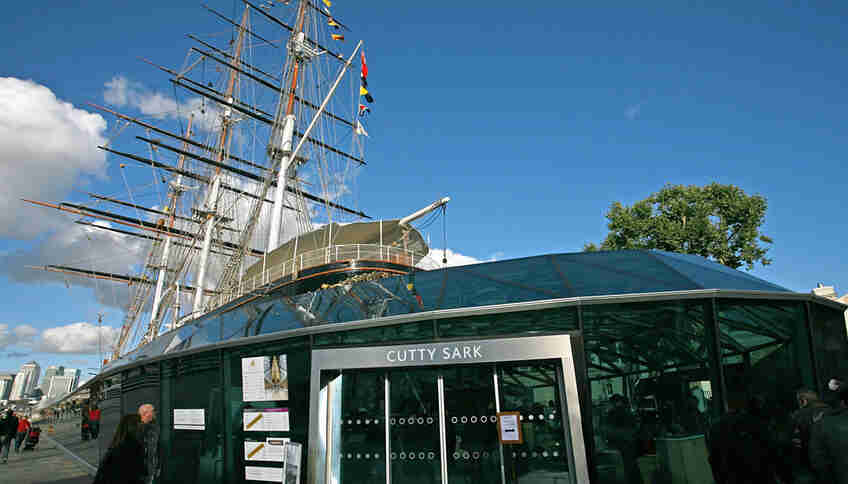
The legendary tea clipper Cutty Sark is a symbol of the time when the British Empire was the greatest maritime power. Light sailing clippers raced across the waves to China and back, competing to see who would be the first to deliver the fresh tea harvest to the royal table and the finest homes of London.
Cutty Sark is one of two sailing clippers that have survived in their original form to this day. The ship now stands in dry dock in Greenwich, and anyone can inspect it from keel to masts, admire its perfect lines and complex rigging, and also visit the museum of the history of seafaring and the vessel itself.
The unusual story of Cutty Sark began back in its creation in 1869. Captain John Willis commissioned the fastest ship in the world and wanted to give it an unusual name, with a touch of the devil about it. The option "Sea Witch" met with objections from the extremely superstitious sailors. Then Willis took a different path and named the ship after the heroine of Burns's poem, who danced at a witches' sabbath in a short, erotic shirt ("cutty sark" translated from Scots means "short shirt"). According to the plot of the poem, when the witch saw a drunkard spying on the sabbath, she chased after him, but managed only to tear off the tail of his horse. Thus, the figurehead of this unusual vessel was made in the form of a half-naked witch holding a horse's tail in her hand.
Cutty Sark delivered cargo to England until 1922; after that, the ship was used as a training vessel. In 1957 the Queen herself opened a museum on board, and in 2007, after restoration, it was reopened, also with the participation of Her Majesty.