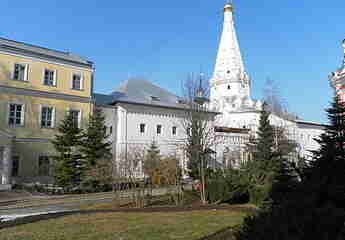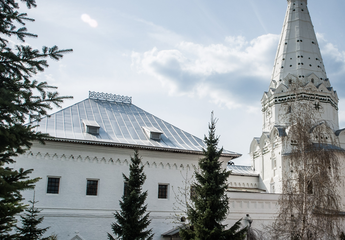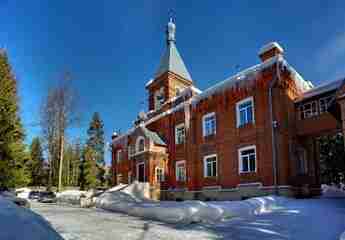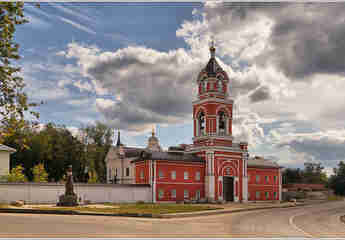

The Holy Gates are the beginning of the path to the Trinity Lavra of St. Sergius, the main entrance where monks greet especially honored guests and the hierarch, the Patriarch of Moscow and All Rus'.
The tall building with a broad dome and onion cupola on an elegant drum resembles a church far more in its outlines than a passage onto the grounds. The Holy Gates acquired their present majestic appearance in 1855, and before that they were rebuilt several times.
Originally these gates passed through the Red Tower in the Lavra's fortress walls, which was built in the 16th century. It was 14 meters high, consisted of four floors, and was equipped with 58 loopholes. Its main purpose was to protect the monastery from enemy attacks.
The 19th century was much calmer than the previous centuries of the Time of Troubles and wars, and defensive fortifications gave way to architectural refinement. In 1807, Metropolitan Platon decided that it was unseemly for such a great and holy monastery not to have beautiful gates, since the Lavra, located near Moscow, was often visited by members of the royal family and their entourage. Thus the Holy Gates appeared—a decorative annex with half-columns, white-stone cornices, and an icon of St. Sergius above the gateway.
In 1855, the Red Tower was completely rebuilt, changing both the facade of the Holy Gates and the building itself. A spherical roof crowned with a dome and cross raised the tower above the wall. The interior rooms were painted with frescoes depicting scenes from the life of St. Sergius.