
Rome is one of those cities you never really finish. It is packed with architecture, art, stories, great food, and layer upon layer of history everywhere you turn. But if it is your first visit, it is easy to get overwhelmed and miss the essentials. That is why we put together several classic walks and a few less obvious ones, each showing a different side of the city. You will find the full list at the end of this article or on our page of Rome guides.
On this walk, we start in the Celio district and make our way from the Colosseum past the Arch of Constantine and the Roman Forum to Piazza Venezia, then on to Trajan's Column and the Imperial Forums. Give yourself most of a day if you can - this is the heart of ancient Rome, and it deserves unhurried time.
Updated for 2026: This route is still a great way to see ancient Rome, but the area around the Colosseum and Forum is busier than ever. Start early, book major sights ahead when you can, carry water in warm weather, and expect security checks at the busiest entrances.
Before we start, a quick reminder: this walking route is also available in our free mobile app - Travel Planner for iPhone and Android. Download it for this route, offline maps, GPS, and handy tools for planning your time in Rome. Now, let's go!
We recommend starting early and taking the metro to Colosseo station, right by the Colosseum. Even at 8 a.m. the square can already be crowded. If you plan to go inside, check the current ticket rules in advance - entry systems change, and waits build quickly.
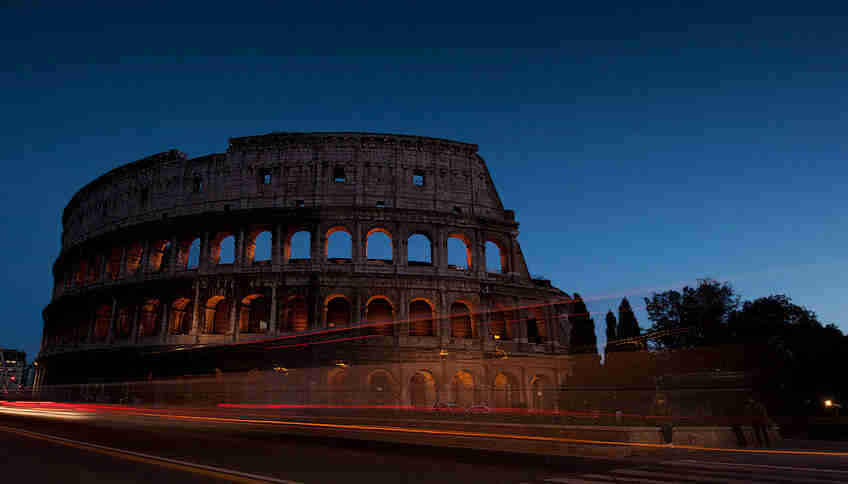
Tip for photographers: The Colosseum looks best from a centered, slightly elevated angle rather than from far below. You do not need a dramatic high point - just a small rise along the Forum side is enough to keep the proportions clean and make the crowds less distracting.

Photo: Alina Kovalevich
The world-famous amphitheater was built on land once occupied by Nero's vast Domus Aurea. Construction began under Emperor Vespasian around AD 72, it was inaugurated by his son Titus, and completed under Domitian.
After gladiatorial games ended, the Colosseum gradually fell into ruin. In the Middle Ages, much of its stone was taken for houses and churches. In the 18th century, Pope Benedict XIV consecrated it as a place associated with early Christian martyrdom, a move that helped save it from further destruction.
A nice bit of film trivia: although "Gladiator" is set in Rome, some of its arena scenes were filmed far from the city, including at the amphitheater of El Jem in Tunisia.
Every time you book hotels on Booking.com through our site, you help us research one more place, create one more route, and keep this project going. Thank you!
Booking banner
Arch of Emperor Constantine
Constantine was not deeply connected with Rome, yet one of the city's most famous triumphal monuments bears his name. After his victory over Maxentius at the Battle of the Milvian Bridge in AD 312 - a battle later linked to his famous vision of the cross - the Senate erected this arch in his honor. Look closely and you will see that many of its reliefs were reused from earlier imperial monuments, with some faces reworked to resemble Constantine.

Photo: Alina Kovalevich
The main entrance arrangements change from time to time, but many visitors approach the Roman Forum from Via dei Fori Imperiali. For years there has often been a street artist here sketching the Colosseum in graffiti style. Whether you buy anything or not is up to you, but it is fun to stop and watch.
On the way in, notice the maps mounted along the wall beside the street. They show the Roman state at different moments in history, tracing the story from a small settlement traditionally linked to Romulus to a vast empire.
In the earliest days, the low ground between the Quirinal, Viminal, Palatine, and Capitoline hills was marshy. Over time it became a meeting and trading space outside the oldest settlement, then evolved into the economic and political heart of Republican Rome. Under the emperors, especially from Augustus onward, the Forum became the public center of the city, where religion, commerce, and power all converged.
After Christianity became dominant and the ancient civic order faded, the Forum declined. Grand buildings collapsed, their stone was reused elsewhere, and by the Middle Ages the area had become what Romans called the Campo Vaccino - a pasture dotted with broken columns and half-buried ruins.
If you prefer stories to straight facts, try our audio walk through the Colosseum and the Roman Forum. In it we talk about early Christianity, Emperor Constantine, and recreate the atmosphere of the Forum in the 1st century AD. You can find these audio guides in our mobile application - Ever.Travel travel planner for iPhone and Android.
Capitoline Hill
The long, fascinating walk through the Roman Forum ends on Capitoline Hill, with Piazza Venezia only about 300 meters farther on. As you come out, do not miss the famous Capitoline Wolf, one of Rome's best-known symbols. Plenty of visitors walk past without realizing what they are looking at, so it is worth slowing down here.

Photo: Alina Kovalevich
At the center of the square stands a copy of the equestrian statue of Marcus Aurelius. The ancient original survived in part because for centuries it was believed to depict Constantine, the first Christian emperor, and was therefore spared. Today the original is kept in the Capitoline Museums.
Piazza del Campidoglio, or Campidoglio, was one of Rome's earliest deliberately designed civic spaces. Michelangelo reimagined it in 1538, planning the famous star-shaped pavement to widen the square visually and give it a sense of ceremony. The paving you see today was laid much later, following his design.
You will also find two milestone columns from the Appian Way and the paired statues of the Dioscuri, Castor and Pollux.

Important: Before the second half of the walk, take a proper break for lunch or at least a coffee. There are plenty of trattorias below, and next up are Piazza Venezia, the Vittorio Emanuele II monument, and the Imperial Forums.
See more walking routes in Rome:
- Rome guides
- First self-guided route through Rome: Vatican and the Vatican Museums
- Second self-guided route through Rome: Castel Sant'Angelo - Piazza Navona - Pantheon - Trevi Fountain
- Third self-guided route through Rome: Colosseum - Roman Forum - Piazza Venezia - Trajan's Column - Imperial Forums
- Fourth self-guided route through Rome: Trastevere district
- Night walk through Rome
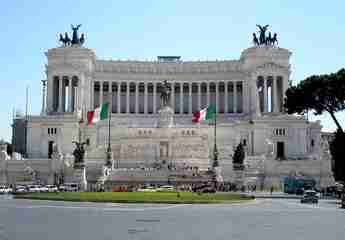
Monument to Vittorio Emanuele II and Piazza Venezia
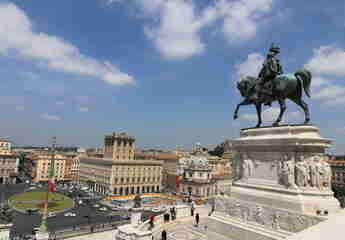
Locals sometimes jokingly call this enormous white monument a "typewriter" because of its layered shape. Officially it is the Vittoriano, built in honor of Vittorio Emanuele II, the first king of unified Italy, which explains its grand scale and symbolism.
From the terraces you get an excellent panoramic view over Piazza Venezia and toward Trajan's Column, our next stop.

Photo: Alina Kovalevich
Trajan's Column and the Imperial Forums
As soon as you descend from the Vittorio Emanuele II monument, head toward the Forum of Trajan, which is easy to spot thanks to the tall column wrapped in scenes from Trajan's Dacian campaigns. It was originally crowned with a statue of the emperor; today it is topped by Saint Peter.
Immediately behind the column you can see the remains of Trajan's Forum and the impressive complex known as Trajan's Market. The area is framed by the churches of Santa Maria di Loreto and the Most Holy Name of Mary. From here the chain of imperial fora continues with the Forum of Augustus, the Forum of Nerva, and the Forum of Peace, also known as the Forum of Vespasian.


Upper viewpoint near the Colosseum
Another 500 meters or so, and you are back at the Colosseum. That is Rome: hours of walking, yet everything still feels wonderfully close together. From here, climb to the higher viewpoint for a cleaner, wider look at the amphitheater and fewer people in the frame.

Photo: Alina Kovalevich
A little tip: By the time you return to the Colosseum, the light may be softening or slipping into blue hour, which is perfect for photos. The amphitheater glows warmly after dark and looks especially dramatic against the evening sky. If you want sharper shots, bring something stable to rest your camera or phone on - photographers know you improvise with whatever is nearby.
That wraps up our walk through ancient Rome. Do not forget to download our free mobile application Travel Planner for iPhone and Android. This route, offline maps, GPS, and other tools will help you plan your time in Rome.
Happy travels!
More walking routes in Rome: