
Yandex.Fotki, koka132200
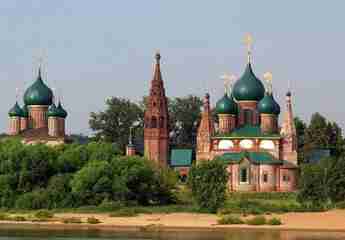
This historic district of Yaroslavl took shape back in the XIII century. The gentle banks of the Volga proved convenient for grazing and breeding cows, which is how the area got its name. In addition to dairy and meat production, fishing was practiced here for a long time. In 1584 this territory was annexed to Yaroslavl.
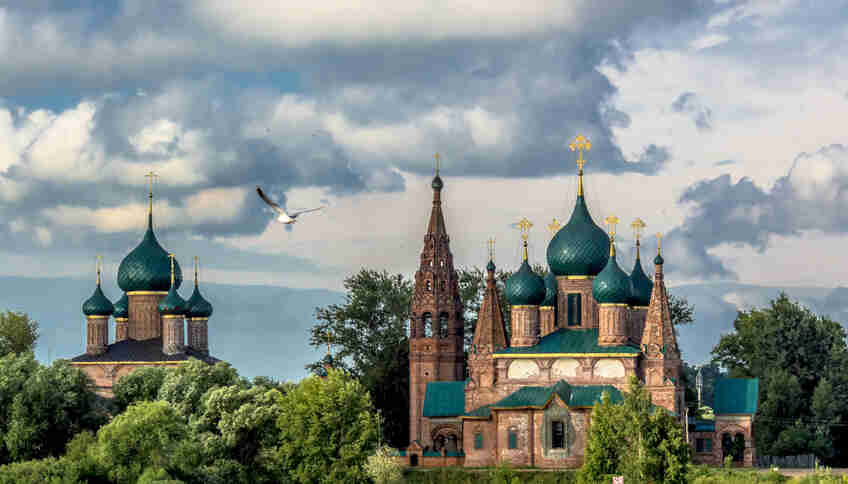
Today Korovnitskaya Sloboda is famous for its magnificent architectural ensemble, consisting of the Church of John Chrysostom and the Church of the Vladimir Icon of the Mother of God. Both churches are rightly considered excellent examples of Russian architecture, and each is unique in its own way.
The Church of John Chrysostom was built in 1649-1654. The red-brick church, generally untypical for Russia, was built mainly with funds from the wealthy local Nezhdanovsky family. Thanks to the colorful tile friezes and hewn-brick ornaments, the church looks very festive. Light enters the interior through 12 large windows. The five-tier iconostasis of the XVIII century, decorated with Baroque carving, deserves special attention. The church contains many old icons and wall paintings.
In 1669, next to it was built the Church of the Vladimir Mother of God, intended for services in the winter season. Like the neighboring church, it is crowned with a striking five-dome composition. In 1680, a graceful slender bell tower was erected between the churches.
Since 1992, reconstruction and restoration of the churches damaged in Soviet times has been underway. At present they belong to the Yaroslavl-Kostroma Diocese of the Russian Orthodox Old Believer Church.
Fyodorovskaya Church

livejournal.com, neringa_iris
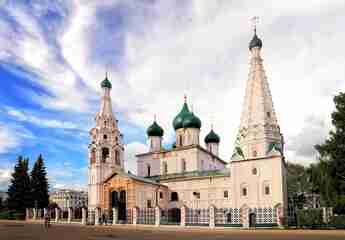
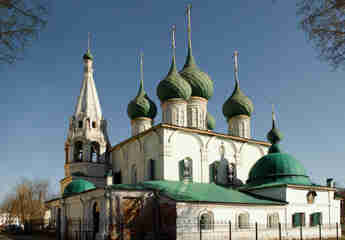
The Church of the Fyodorov Icon of the Mother of God is a four-pier, five-domed parish church on the right bank of the Kotorosl in Yaroslavl (the Karabulino district, formerly Tolchkovskaya Sloboda), built in 1682-87 and from 1987 until the consecration of the new Assumption Cathedral (2010) served as the cathedral of the Yaroslavl-Rostov Metropolis (now diocese). The parish ensemble also includes the winter church of Nikola Penskogo with a bell tower and the modern baptistery church of Equal-to-the-Apostles Vladimir (1999). The parish is surrounded by a Soviet-era fence, and several bishops are buried near the church. The church gave its name to two streets crossing the Zakotorosl side of the city — Bolshaya Fyodorovskaya (in Soviet times it bore the name of the militant atheist Emelyan Yaroslavsky) and Malaya Fyodorovskaya (now Malaya Proletarskaya).
Church of John the Baptist in Tolchkovo

livejournal.com, neringa_iris
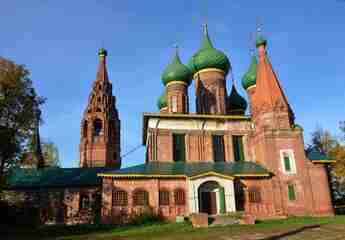
The Church of John the Baptist in Tolchkovo is one of the most famous monuments of Yaroslavl architecture. It is a cultural heritage site (a monument of history and culture) of federal significance.It was built from 1671 to 1687 in Tolchkovskaya Sloboda, on the right bank of the Kotorosl. The 45-meter bell tower was built later, in 1690. The wall paintings were created in 1694—1695 by an artel of Yaroslavl painters led by Dmitry Plekhanov and Fyodor Ignatyev.Tilework was used in the decoration of the walls. The church's fifteen domes are divided into three groups.It is depicted on the reverse side of the Bank of Russia 1000-ruble banknote of the 1997 issue.In 1895 it was visited by the artist Mikhail Vasilyevich Nesterov .

fotki.yandex.ru, Gonshchik
Before you is the only example of Petrine Baroque architecture in Yaroslavl. The style, which appeared in the time of Peter I and shaped the look of St. Petersburg, was a rarity for provincial cities.
The Church of Peter and Paul was built on the model of the famous Peter and Paul Cathedral in St. Petersburg. This grand church was erected in 1742 with money from the Zatrapeznov brothers, owners of the Yaroslavl Big Manufactory. The location of this church is quite unusual — it stood in the middle of an industrial complex and was surrounded by production buildings and barracks for workers, and in the ponds at the foot of the church linen used to be bleached.
The Church of Peter and Paul was the center not only of the district's spiritual life, but also of its social life; a parish school, hospital, and board of trustees operated on its grounds.
In Soviet times a Young Pioneer club with a cinema was housed in the church, but now it has been returned to the Russian Orthodox Church and restored. Services are once again held here.
The Church of Peter and Paul is surrounded by the beautiful Petropavlovsky Park. Its azure-white walls and the tall spire of the bell tower are reflected in the waters of the park's lakes, creating a soothing landscape.
Petropavlovsky Park

Yandex.Fotki, kvk-foto
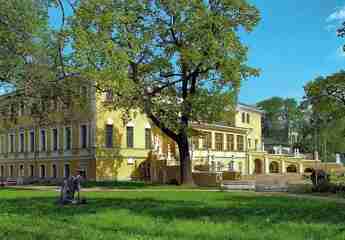
Petropavlovsky Park is one of the oldest parks in Yaroslavl and is located in the Krasnoperekopsky district on the former territory of the Yaroslavl Big Manufactory.At the end of the 1720s and the beginning of the 1730s, the Zatrapeznov merchants created the largest combined manufactory in Russia. The manufactory consisted of two complexes: the first textile complex was located at the source of the Kavardakovsky stream, the second paper complex was at the mouth of the stream .During the construction of the manufactory, dams were made along the course of the Kavardakovsky stream to power water mills, and this created a cascade of ponds . There were 5 ponds in total. The first pond was called the 'dirty' one; laundry was rinsed and washed in it, and people bathed there. The second pond was the 'clean' one and was used only for 'clean' needs. The third and fourth ponds were the central part of the park ensemble; fish were caught there for the 'master's table'. The fifth pond directly adjoined the factory owner's house .In 1722—1731 a regular garden was laid out .
Church of John the Faster, Archangel Gabriel and Andrew of Crete

Yandex.Fotki, Sergey Khodotov
The beautiful yellow church, resembling both a palace and a Catholic church at once, is located not far from the Krasny Perekop factory. This location of the church is no accident, because it was built with funds from the workers of the Partnership of the Yaroslavl Big Manufactory.
The development of industry attracted more and more people to the city, and by the end of the XIX century there was already a need for a large church. The completion of its construction coincided with the 50th anniversary of the factory, so the church was dedicated to the patron saints of the enterprise, the namesakes of the founders of the manufactory — Ivan, Andrei and Gavriil.
This three-altar church has three altars in honor of John the Faster, Archangel Gabriel and Andrew of Crete, but townspeople more often call it by a shortened name — the Church of Andrew of Crete.
The appearance of the church is a mixture of Art Nouveau and Gothic elements. The tall arches around the windows and the two tiers of arcades on the 40-meter bell tower are decorated with ceramic tiles with floral patterns. The exterior walls of the church are adorned with beautifully preserved frescoes and mosaics of glazed tiles in pastel shades.
In Soviet times the church did not function; its premises first housed workshops of the electromechanical plant, then a children's sports school. In 2010 the church returned to the ownership of the Russian Orthodox Church, and restoration work is now being carried out there. Over the decades of using the church for purposes other than its intended one, the interior decoration was almost completely destroyed.
Krasny Perekop Factory

Yandex.Fotki, Nataliy-Sharova
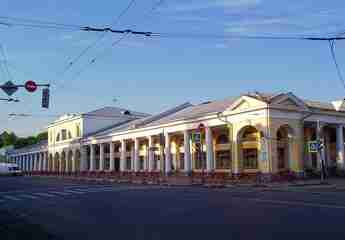
OJSC Yaroslavl Technical Fabrics Combine Krasny Perekop (before the Revolution — Yaroslavl Big Manufactory, YaBM) is a textile industry enterprise in Yaroslavl, the oldest enterprise in the city and the oldest enterprise in the industry in the country.Yaroslavl Linen Manufactory was founded on the southwestern edge of the city beyond the Kotorosl River on 28 June (9 July) 1722 by the merchant of the Gostinaya Hundred Ivan Maksimovich Zatrapeznov, marking the beginning of the spread of linen manufacturing in Russia. The state granted the manufactory land free of charge and allowed it to invite craftsmen for production work both from Russia and from abroad and, with their consent, assign them to the factory permanently.In 1731 an Imperial decree followed: 'to render the Zatrapeznovs every assistance and neither inflict offenses nor taxes upon them, and also, as far as possible, protect them from others under threat of the wrath of Her Imperial Majesty'.