Keep in mind that after reading this, you do not need to print the guide at all. In our Ever.Travel mobile app for iPhone and Android, you will find it in a far more convenient mobile format. Create a trip to Vladimir, download the route "What to See in Vladimir in 1 Day" to your smartphone, and head out into the city fully prepared :) Offline maps, GPS, and other ready-made routes are completely free. Along with photos, detailed descriptions, and the addresses of every sight, the app also includes an offline map showing the route of this city walk. That is exactly why we will not be adding directions like "turn right here" or "go left after that" below – it is easy to understand where each stop is by looking at the map. So, let's begin!

Panoramio, Arick N
Nikitskaya Church in Vladimir is a magnificent example of 18th-century Baroque architecture. The site had long been considered sacred: from the 12th century it was home first to the Kozmodemyansky Monastery, and later, from the 17th century, to a parish church dedicated to John the Baptist and Saints Cosmas and Damian. Nikitskaya Church itself was built in 1762-1765 with financial support from local merchant Semyon Lazarev.
From the outside, the church impresses with both its monumentality and the lightness of its design. Its three levels are crowned by two elegant spired towers, one of which houses the bell tower.
The interiors were once decorated in lavish Baroque style, with richly carved iconostases. Sadly, none of that luxurious decor survived the Soviet era. In the 1970s, parts of the Vladimir Scientific Restoration Workshop were housed inside Nikitskaya Church, and the interiors were gradually altered to meet the institution's needs.
It is also worth noting that Nikitskaya Church has a twin. In Dmitrov, an almost identical church – the Trinity-Tikhvin Church – was built in 1794-1801.
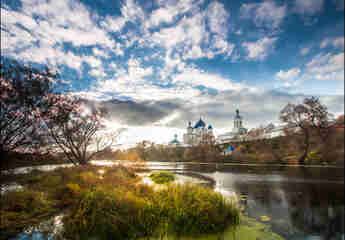
In truth, Vladimir is best visited not for one day, but for at least two. That way you can explore the city's sights at a relaxed pace and also make sure to take a trip to Bogolyubovo, home to the famous Church of the Intercession on the Nerl.

poputi.su, Denis Konkov
On Nikitskaya Street, you will spot an interesting building that blends Art Nouveau and Classicist architecture. This is the Realschule, built in Vladimir in 1908 to a design by the famous architect P. A. Vinogradov. The facade is adorned with two sculptures by A. A. Aladyin depicting two Russian scientists – D. I. Mendeleev and A. G. Stoletov. The tidy three-story building is topped with two semicircular pediments above the entrances.
Originally, students came here for specialized secondary education with a focus on natural sciences and mathematics, preparing them for technical colleges and universities. After the October Revolution, the building housed several different institutions: a women's seminary, the Practical Institute of Public Education, a teachers' institute, and during World War II, a military hospital.
Today, the building belongs to Vladimir State University for the Humanities, with its education and philology faculties based here.
By the way, if you are coming to Vladimir for a weekend rather than just one day, Booking.com is a good place to look for a hotel for the night. We have hardly seen a more convenient way to compare prices, services, and reviews.

Flickr, EgorSP
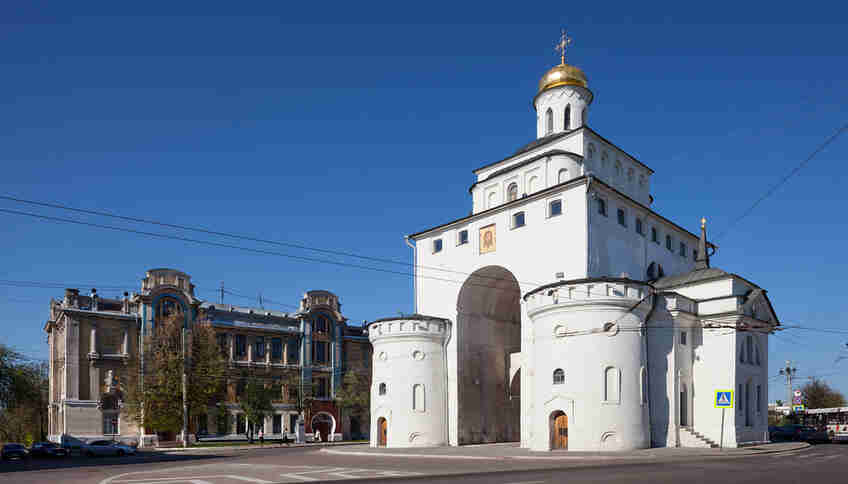
This is probably the single most essential stop on any "What to See in Vladimir in 1 Day" itinerary. Dating back to the 12th century, the Golden Gate is an outstanding example of Old Russian architecture and witnessed many key moments in the city's history.
Even though the gate has not survived intact, it still impresses with its majestic and harmonious design. Its massive doors were once covered in gilded copper that shone brightly in the sun, which is how the gate got its name. In the 13th century, during the Mongol invasion, those copper plates were lost, and their fate remains unknown.
Originally, the Golden Gate served a defensive purpose as part of the city's fortifications. It was also used as a kind of triumphal arch through which the princes of Vladimir-Suzdal entered the city, especially Andrei Bogolyubsky, during whose reign it was built.
Over the centuries, the appearance of the gate changed many times because of fires, wars, and internal conflicts. Today, the gate church houses a museum exhibition where you can see a large diorama depicting Vladimir's defense against Batu Khan's forces in 1238, along with many other exhibits including military gear, armor, and weapons from different eras.

pmvd.info
Locals in Vladimir often call Trinity Church the Red Church because it is built of red brick. Its construction was timed to mark the 300th anniversary of the House of Romanov and was completed in 1916.
The church's architectural style is best described as pseudo-Russian, combining elements of Old Russian architecture with Byzantine design. The brickwork is laid in an original cross pattern, while the tall domes and bell tower give the rather massive structure a more graceful silhouette.
Unfortunately, the church's interior decoration has not survived. The last service was held here in 1928. During the Soviet period, the church was used for practical purposes, and there was even talk of demolishing it.
Since 1974, the building has belonged to the Vladimir-Suzdal Museum-Reserve, which has displayed collections of crystal, lacquer miniatures, embroidery, and other folk crafts here. The museum is still open today, and you can visit to admire the work of Russian masters past and present.

livejournal.com, vladimirdar
The Museum of Crystal and Lacquer Miniatures has been part of the Vladimir-Suzdal Museum-Reserve since 1974. After the famous Trinity Church was restored in 1971-1973, exhibition halls were created inside it to introduce visitors to traditional artistic crafts. The Vladimir region has long been rich in talent, so these displays are absolutely worth your time.
The delicate lacquer painting on display is stunning in its craftsmanship. You can immediately see how much work and inspiration went into these pieces.
The lacquer miniature exhibition is on the second floor, while the first floor is devoted to crystal. The objects on display were created by master artisans from the town of Gus-Khrustalny. You could spend ages admiring their refined work – it feels as though nothing is impossible for them. You will see tableware, souvenirs, and decorative objects, all enhanced by beautifully chosen lighting that plays across the crystal surfaces. The exhibition covers the full history of the Gus Crystal Factory, from the mid-18th century to the present day.

Panoramio, V ' Ayrup
Vladimir's theater has a long and vivid history. Founded in 1848, it welcomed some of the brightest stars of Russian stage art. Over the years, such theatrical greats as Lensky, Fedotova, Pravdin, and other famous pre-revolutionary actors performed here.
Thanks to the wife of local noble leader Ogarev, the city gained its own troupe made up of graduates from the country's best theater schools. Before long, the Vladimir theater was touring across Russia, including the capital.
In 1934, it was named after Lunacharsky, and its repertoire shifted from classic productions of Chekhov and Dostoevsky to revolutionary plays about Red Army soldiers and proletarians. During World War II, performances were suspended because most of the actors went to the front.
The postwar revival of Vladimir Drama Theater gave Russia the great actor Yevgeny Yevstigneyev, who began his rise to fame on this very stage.
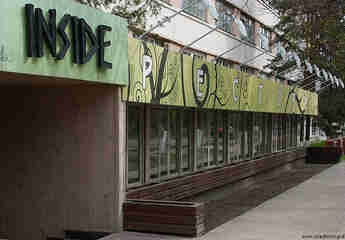
In the early 1970s, the theater moved into a new building, whose architects received a State Prize for the design. Innovative for its time, the glass-and-concrete structure looks almost translucent and airy, while six sculptures of jesters and musicians decorate the facade at the level of the second floor.

fotki.yandex.ru, ninalpru
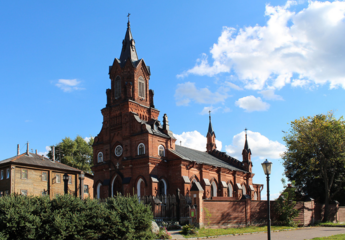
This red-brick Catholic church, known as the Church of the Holy Rosary of the Blessed Virgin Mary, stands out brightly in Vladimir's cityscape with its Gothic forms. Its sharp spire and clean lines clearly point to a pseudo-Gothic style.
This beautiful church appeared in Vladimir in the 1890s, soon after the city's small Catholic community was established. Architects Afanasyev and Karabutov managed to fit this unusual building harmoniously into the city panorama.
During the Soviet era, the church was not destroyed. For a time, it was even considered one of the city's revolutionary monuments: between 1905 and 1907, soldiers from the Vladimir garrison secretly met here under the guise of worshippers.
From 1930, the bell tower was used as a radio transmitter. Later, ordinary families were housed inside the church, and in the 1970s exhibition halls were set up there.
In the 1990s, the Church of the Holy Rosary of the Blessed Virgin Mary was returned to the Roman Catholic parish, reconsecrated, and restored. Today, services are held here daily for the re-established Catholic community.

watertowers.ru
From a distance, Vladimir's Water Tower can easily be mistaken for a fortress tower, and even up close it hardly looks like an industrial structure. It was built in 1868 on Kozlov Val near the Golden Gate and rebuilt in its current form in 1912 to a design by local architect Zharov.
In keeping with tradition, the pseudo-Gothic tower has a circular plan and is crowned with a tented roof. The red brick walls emphasize the dramatic silhouette of the three-tiered structure, making it look more like a work of art than a purely practical facility.
In the 1950s, after Vladimir's water supply system was modernized, the tower lost its original function and became a monument of engineering architecture.
Today, the building houses a museum with an exhibition called "Old Vladimir." At the top, there is an observation deck with excellent panoramic views over much of the city.

ejeweek.ru, Alexander Sulimov
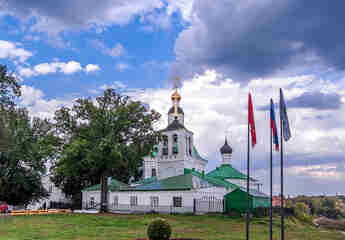
The present-day Church of the Transfiguration on Spasskaya Street in Vladimir probably has the longest history of any church in the city. It was built at the end of the 18th century on the site of an earlier church erected in Prince Andrei Bogolyubsky's court back in 1164. Some sources date the original construction even earlier, to 1116. In any case, it was destroyed in the great city fire of 1778.
It was immediately decided that a new church should rise on the site of the lost shrine. The architects made every effort to recreate the appearance of the original building. The result is quite unusual – a 12th-century Old Russian style with touches of the Baroque that was fashionable at the time. Two surviving artifacts from the previous church were transferred to the new one: a silver chalice from 1638 and an altar cross from 1658.
After standing unused for half a century during the Soviet period, the church was reopened to worshippers only in the 1990s.
Today, the white-stone Church of the Transfiguration has a high hipped roof topped by a seven-sided drum and an onion dome with a cross. Beside the main building, you can also spot a newer chapel opened on November 6, 1998 – the Day of Remembrance for Orthodox soldiers fallen in battle.

strana.ru, Pavel Pelevin
Vladimir never had a patriarchal residence, yet as early as the 16th century Patriarch's Garden was laid out here as a favorite retreat for senior clergy from the capital.
It lies right in the city center, just a few blocks from the Assumption Cathedral, but many tourists do not even realize it exists because this beautiful park is tucked away in a ravine descending toward the Klyazma River in picturesque terraces.
Right after World War II, Patriarch's Garden became the main station for young naturalists, who planted practically every meter with useful and decorative greenery. Shaped flower beds bloom with bright colors and delicate fragrance, while strawberries and currants grow between them. Linden and birch trees stand alongside lilac bushes and fruit trees – apple, cherry, and plum. The garden also contains many unique, rare, and locally exotic plants, as well as herbs and specimens of flora from neighboring countries.
The scenic descent to the river takes the form of a long, gentle staircase with neat terraces, benches, gazebos, a multi-jet fountain, and an artificial pond along the way. From the top of the stairs, there is a wonderful panorama of the river and the surrounding area.

Flickr, Alexxx1979
Stretching from the Golden Gate to Cathedral Square, Bolshaya Moskovskaya Street is one of the oldest and most important streets in the city. It is mentioned in chronicles from the early 17th century, but it very likely existed even earlier and may be almost as old as Vladimir itself.
Walking here, you will see a wide variety of buildings dating mainly from the 18th and 19th centuries. The character of Bolshaya Moskovskaya Street is shaped by its surviving ceremonial buildings: the City Duma, Government Offices, Noble Assembly, theological seminary, boys' gymnasium, and others. According to the regular city plan of 1781, this was considered the city's main street, which is clearly reflected in its architecture.
Strictly speaking, until 1899 the street was known simply as Bolshaya. Only later was it divided into two parts: the eastern section became Nizhegorodskaya, and the western section became Bolshaya Moskovskaya. Electric lighting appeared here in 1909, a bus route opened in 1935, and a trolleybus line followed in 1952.

poputi.su, Denis Konkov
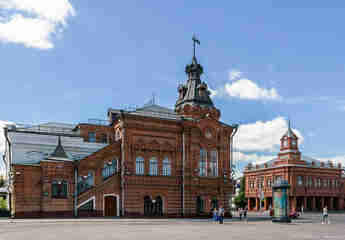
The former City Duma building in Vladimir looks more like a fairy-tale terem than an official institution. Architect Yakov Revyakin, who built it in 1907, drew inspiration from the Moscow Duma building. The same red brick was used here, and the motifs are distinctly Old Russian – the tented roof forms, decorative window surrounds, and keel-shaped arches all point clearly to traditional Russian folk architecture.
Before the Revolution, the building served as the City Duma and also housed a court and several commercial departments. After the Soviets came to power, the city authorities remained here until 1948, and later the Palace of Pioneers and Schoolchildren moved in. Classes continued in this architectural monument until 1985, after which the children were moved to a newer, more suitable building.
After standing unused for 20 years, the City Duma building fell into poor condition. Restoration began only in the 2000s, and after a successful revival it reopened in 2008 as the elegant House of Friendship – a venue for ceremonial receptions, award presentations, and other important city events.

pmvd.info
Vladimir's majestic cathedrals – St. Demetrius Cathedral and the Assumption Cathedral – gave the city's central square its name. Cathedral Square is a must on any sightseeing route: both on the square itself and around it, you will find many landmarks, including architectural monuments such as the boys' gymnasium, Government Offices, Noble Assembly, and City Duma.
The center of Cathedral Square is occupied by a large monument erected in 1958 for Vladimir's 850th anniversary. It consists of three figures – a warrior facing the Golden Gate, an architect looking toward the Assumption Cathedral, and a modern proletarian who seems most interested in the industrial zone and its factories.
You can also see a monument to Lenin here, set on the pedestal that once held a statue of Emperor Alexander II. Nearby stands the monument to icon painter Andrei Rublev, which has marked the entrance to the nearby Pushkin Park since 1995.
Because of its large size – about one hectare – Cathedral Square was once used as a military parade ground, and even today it regularly hosts events ranging from parades to concerts and festivals.

Panoramio, Yuriy Rudyy
The grand monument to the 850th anniversary of Vladimir has adorned Cathedral Square since 1958.
In fact, there was a historical twist in the anniversary celebration, because the city's age was then counted from 1108 – the date mentioned in chronicles as the founding of Vladimir by Prince Vladimir Monomakh. But in the late 1990s, a group of scholars presented evidence that a settlement had already existed here by 990, founded by Prince Vladimir the Great. That means the city was actually celebrating not its 850th year in 1958, but its 968th. Even so, the city's venerable age and achievements certainly deserved to be commemorated in a striking 20-meter monument.
The monument itself is a white-stone stele shaped like a truncated pyramidal column. At its base sit three three-meter figures. The statue of the ancient architect, holding a carved capital for a column, symbolizes the historic buildings preserved in Vladimir as architectural monuments. A stern warrior in medieval armor leans on a mighty sword, with a shield resting by his leg, representing the military glory of all the city's sons who ever went to war. On the third side stands a Soviet worker depicting the presentation of the 150,000th tractor to collective farmers in 1957, embodying the spirit of the communist era when labor was seen as both the means and the purpose of life.

Panoramio, Yuriy Rudyy
Set on a white stone pedestal, the bronze figure of Andrei Rublev looks striking and expressive. The great icon painter is shown at work: in one hand he holds a prepared icon panel, and in the other a brush, as if he has paused only for a moment and is just about to return to painting.
The monument was unveiled in 1995 to mark Vladimir's 1,000th anniversary. This work by the famous Russian sculptor O. K. Komov was the last of his life, and he spent nearly 20 years developing the overall concept.
The monument stands on Cathedral Square, not far from the Assumption Cathedral, where many of Rublev's frescoes still survive. His influence on the development of Russian icon painting is hard to overstate: he stood out among his contemporaries for the originality of his artistic techniques, his unique use of color, and the clarity and purity of his compositions.

Flickr, Alexxx1979
The monument to the two baptizers of the Vladimir land – city founder Prince Vladimir the Great and Saint Fyodor – looks out over the Klyazma River from the viewpoint in Pushkin Park. The garden beside the Assumption Cathedral provides a fitting setting for this imposing monument, and the viewing platform at its base offers an excellent panorama of the river and the city's central districts.
The monument to Prince Vladimir and Saint Fyodor was created quite recently, in 2007, to mark the 850th anniversary of the rise of Vladimir Rus. On a tall columned pedestal, Prince Vladimir rides a horse bearing a banner with the image of Jesus Christ. Beside him stands Saint Fyodor in ancient clerical robes, blessing the people with one hand and holding a Bible in the other.
Between the columns of the pedestal are figures of saints and heroes: Ilya Muromets, Prince Vsevolod the Big Nest, Maria of Vladimir, their son Georgy, Grand Princess Olga of Kyiv, and Princes Alexander Nevsky and Andrei Bogolyubsky. Sofia of Suzdal is also depicted here – she was forced into a monastery by her husband, Tsar Vasily III, because she could not bear children, and was later canonized as a saint.

ejeweek.ru, Alexander Sulimov
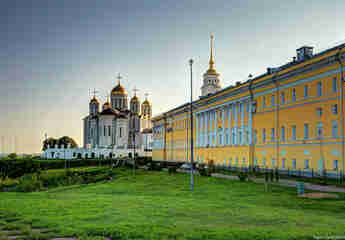
For more than eight centuries, the famous Assumption Cathedral has graced Vladimir's skyline. This majestic church, founded in 1158 by Prince Andrei Bogolyubsky, was conceived as the main cathedral of Vladimir-Suzdal Rus.
The building is made of limestone and decorated with stone carving. Craftsmen from many countries and regions were invited to build it, including masters from Kyivan Rus, Greece, and Germany. The cathedral's splendor was emphasized by a gilded dome rising 33 meters above the ground. The floors were covered with mosaics, and the walls and ceilings were filled with colorful frescoes.
At the end of the 12th century, the Assumption Cathedral was badly damaged by fire. It was restored, though its appearance changed slightly. Half a century later, the forces of Batu Khan invaded Vladimir, looted the cathedral, and then burned it.
After the victory over the Mongol-Tatar yoke in the late 14th and early 15th centuries, the time came to restore Russian cities and their Orthodox churches. For the restoration of the Assumption Cathedral, Prince Vasily I Dmitrievich invited the legendary icon painters Andrei Rublev and Daniil Cherny from Moscow, and they covered the walls with unique frescoes.
Today, the white cathedral has been fully restored. Services are held here, and it also functions as a museum.

Flickr, EgorSP
Palaty is a cultural and educational complex that brings together an art gallery, a children's museum center, and an exhibition devoted to the noble and landed estates of Vladimir. This grand building, which now contains three museums and several halls for temporary exhibitions, once served as the Government Offices of the provincial administration. The three-story classical building was created in 1785 to a design by architect Blank.
The first floor of the Palaty Museum Complex houses the Children's Museum Center, opened in 1993. Here, schoolchildren can learn what Vladimir was like 200-300 years ago, how peasants lived, what children's daily life was like in the 19th century, and even how people survived in the Stone Age. One hall shows how pupils studied before Peter the Great, while another explains the history of bookmaking. Displays such as "Epic World," "Fun Fair," and "Friends' Toys" are especially popular with children and full of ideas for imaginative play.
The second-floor art gallery presents masterpieces of Russian art – from 13th-century icon painting to Soviet artists. The collection of 18th-20th century works includes beautiful portraits by Levitsky, seascapes by Aivazovsky, and paintings by Shishkin and Vasnetsov.
Another large exhibition is devoted to the noble estates of the Vladimir region. Here you will find artworks, luxurious clothing, Baroque furniture, refined tableware, and domestic decor from aristocratic homes. Recreated interiors show how Russian nobles lived in the 18th and 19th centuries.

Flickr, Alexxx1979
Built in the 1190s during the reign of Prince Vsevolod Yuryevich, St. Demetrius Cathedral is distinguished by grand, weighty proportions meant to symbolize the power of princely authority. It suffered repeatedly from fires, wars, and other disasters, yet each time it was carefully restored.
The cathedral's walls are richly decorated with stone carvings. There are around six hundred carved fragments in total, depicting mysterious scenes – birds, plants, animals, mythological creatures, saints, horsemen, and other images whose meanings are not always fully understood today.
Inside the cathedral, ancient frescoes still survive, including a 12th-century Last Judgment that is sometimes confused with the work of the same name by Andrei Rublev in the neighboring Assumption Cathedral.
Thanks to restoration work, the final stage of which was completed only in 2004, you can admire this magnificent monument of Old Russian architecture in all its beauty. A special microclimate has been created inside to prevent deterioration, and the white-stone walls are coated with a protective compound.

poputi.su, Denis Konkov
Vladimir's History Museum is famous for both the number and quality of its exhibits. It holds vast collections of authentic antiques and artifacts, most of them beautifully preserved.
Your journey into the past begins in the hall devoted to the Sungir Cro-Magnon site. During construction of a city factory in 1955, workers discovered burials that scientists later dated to 25,000 years ago. The best pieces from the 70,000 archaeological finds are displayed here, including ornaments, tools, and children's toys made from mammoth bone.
The following halls contain relics from the period of the Baptism of Rus as well as artifacts from the time when Vladimir was a capital city. The exhibitions on the second floor cover later history, from the 17th century to the middle of the 20th century.
Orthodoxy is inseparable from Vladimir's history. Not only did the great baptizers of Rus live here, but the famous icon painter Andrei Rublev also worked here. Separate displays in the museum are devoted to his art.
A great deal of attention is also given to the history of major Russian dynasties, especially the Romanov family and the tragedy of 1917.
We strongly recommend visiting this museum. According to many visitors, it is one of the country's best and most fascinating regional history museums.

livejournal.com, tatiana-gayduk
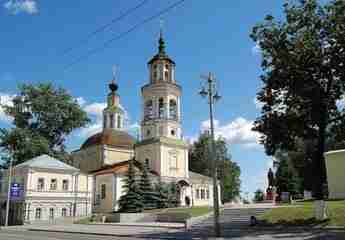
This church dedicated to St. Nicholas the Wonderworker appeared in Vladimir in the second half of the 18th century. Before that, a wooden church stood here but was destroyed by fire. The new church took eight years to build, from 1761 to 1769.
The structure of the church changed very little over the centuries, with only one additional side chapel added. The beauty and uniqueness of its Baroque architecture helped it survive the Soviet era, when many other roadside churches were destroyed.
Nikolo-Kremlin Church is a classic example of a pillarless church. It features a spacious central interior, two side chapels, and a four-tiered bell tower.
In 1962, a planetarium was opened inside the church, which had been closed since 1934. This happened in honor of Yuri Gagarin's spaceflight the year before. The church dome turned out to be perfect for projecting the night sky.
The building still functions as the city planetarium today, despite ongoing discussion about returning the church to purely religious use. For now, though, a visit to Nikolo-Kremlin Church lets you enjoy its elegant architecture and learn plenty about space at the same time.

Flickr, Alexxx1979
Set on a hill almost in the center of Vladimir, the Nativity of the Virgin Monastery was founded in 1175 by Prince Andrei Bogolyubsky.
His younger brother, Vsevolod Yuryevich, developed the monastery by building housing for the monks and a single-domed church that has not survived. Alexander Nevsky was buried here in 1263, but several centuries later, in 1724, his relics were moved to St. Petersburg by order of Peter the Great.
Over its long history, the monastery was expanded and rebuilt many times. In the 17th century, stone treasury cells, a bell tower, the gate Church of the Nativity of Christ, and other buildings appeared here.
Since the bishop's residence of the Vladimir diocese was also located here, the Bishop's Chambers were added as well. Later, during the reign of Alexander II, the monastery and its cathedral underwent major reconstruction. In 1930, the cathedral and the bell tower were destroyed.
Today, the monastery complex is a beautiful architectural monument where many styles and periods of building art come together. The walls and towers, treasury cells, monks' cells, and Bishop's Chambers are especially noteworthy.
The monastery plays a major role in Vladimir's recognizable skyline, especially when viewed from the valley of the Klyazma River.

Yandex.Photos, AMF - dos
A visit to the Stoletov Brothers House-Museum immerses you in the atmosphere of the second half of the 19th century – more specifically, the everyday life of a merchant family residence. It is hard to find a more convincing exhibition of daily life from that era.
The museum opened in 1976 in a 19th-century wooden wing attached to the Stoletov family's two-story estate. The interiors of the living and working rooms have been recreated here, and you can see antique furniture, tableware, and paintings gathered through long and careful work.
Yet the museum is devoted not only to the interiors, but above all to the Stoletov brothers themselves – remarkable figures known not only in Russia but abroad as well.
The elder brother, Nikolai Grigoryevich, a general of infantry, became famous as an outstanding military commander and public figure. He founded the city of Krasnovodsk on the Caspian Sea, commanded the Bulgarian militia during the Russo-Turkish War of 1877-1878, and became a national hero of Bulgaria. Nikolai Stoletov also took an active part in the geographical exploration of the Amu Darya lands.
The younger brother, Alexander Grigoryevich, made his name in the progressive science of physics. One of his achievements was the discovery of the first law of the photoelectric effect. He carried out an enormous amount of important research in optics and electromagnetism. The physics laboratory at Moscow University was created thanks in large part to his efforts.
The Stoletov House-Museum preserves many authentic letters, books, manuscripts, documents, and personal belongings that once belonged to these outstanding brothers.
This brings our route "What to See in Vladimir in 1 Day" to an end. We have tried to show you the city's most important sights, though there are plenty of other interesting places as well. You can find them all on the interactive map of Vladimir. The guide you create there syncs with the free Ever.Travel mobile app for iPhone and Android. How does it work? Very easily – take a look at our overview!