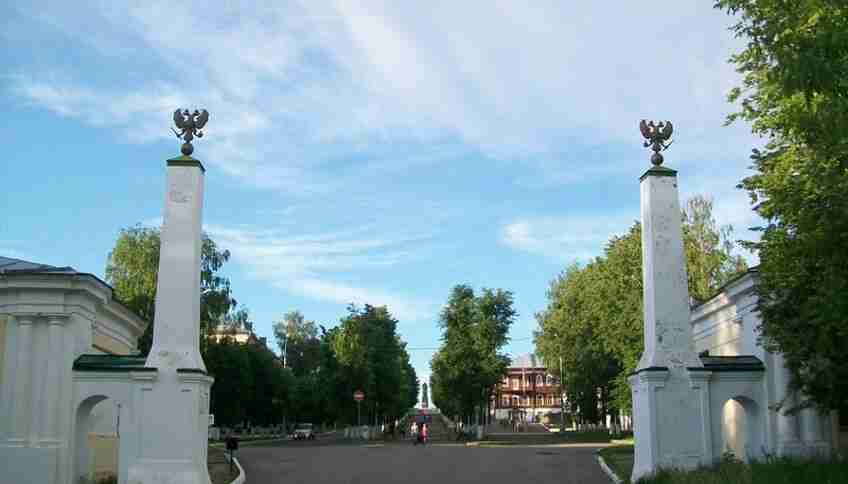
This gate in Kostroma has a rather tenuous connection to Moscow. The obelisks were installed in 1823, for the visit of Emperor Alexander I, who at that time was traveling around Russia. The local architect P.I. Fursov was instructed to arrange the entrance to the city for the arrival of the important guest. Thus, two four-sided obelisks crowned with double-headed eagles were installed, with rusticated walls adjoining them.
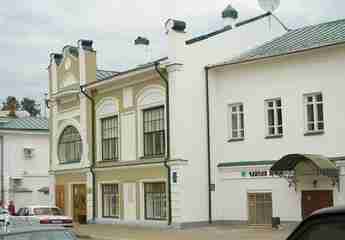
At the beginning of the 20th century, the composition was slightly rebuilt in honor of the celebration of the 300th anniversary of the House of Romanov - on both sides of the obelisks appeared two small buildings, constructed according to the design of architect N.I. Gorlitsyn.
The double-headed eagles were dismantled during the October Revolution of 1917 for obvious reasons, but in 1993 they were restored to their original place.
Only the two obelisks have survived to the present day in their original form; the other elements of the ceremonial entrance were either rebuilt or abolished.
In the 20th century, Moskovskaya Zastava lost its functional significance. Today it is an architectural landmark of Kostroma and a Cultural Heritage site of the Russian Federation.