There is no data on the founding date of this temple. But, most likely, it was built in the 9th-10th centuries during the reign of King Yashovarman I, because on the stele standing nearby, there is an inscription about the founding of a Buddhist monastery here in the 9th century. And the temple surely had some connection to it.
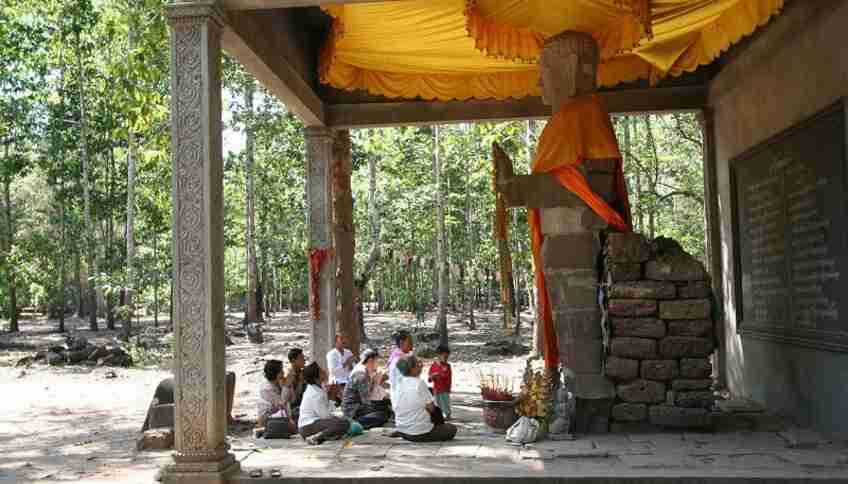
Now Tep Pranam is even difficult to call a temple, because all that remains of it is the foundation, a long laterite platform leading to the main entrance, and a statue of Buddha sitting on a lotus under the roof of a terrace open on all sides.
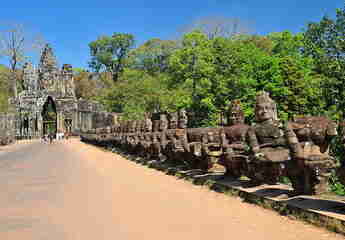
The entrance is guarded by lion statues, and the balustrade of the nagas has partially survived, which was clearly installed later than the lions. Nagas are snake-like mythical creatures that have a human head and torso, and everything below is a serpent's tail. Images or statues of nagas are very often found on the approaches to temples.
The pose of the Buddha sitting on the terrace means "touching the earth," that is, Buddha calls the earth as a witness. Its height is 6 m, plus the pedestal on which he sits is 1 m. According to historians, this statue was assembled from different blocks, some of which belong to an older period than the others.
A little to the west of it there is another sculpture of Buddha. It is slightly smaller - 4 m, and the pose means peace, a sense of protection, and literally translates as "without fear" (abhaya mudra).