
Flickr, adosborn36
Updated for 2026: Phuket is busier than it used to be, but this route still works beautifully if you start early, ride defensively, and leave the waterfalls for a day after rain.
Phuket has one corner that feels miles away from the beach clubs and resort strip: the Old Town in Phuket Town. Many visitors barely make it here, which is exactly why it remains one of the island's most rewarding stops.
The mood is unmistakably old Phuket. Much of the area was built up in the late 19th and early 20th centuries, when the tin boom brought money, migrants, and new ideas to the island.
Wander slowly and you'll see why people love it: handsome shophouses, little cafes, Chinese shrines, family-run businesses, and details that make nearly every building feel storied. The neighborhood is still closely tied to the island's long-established Chinese-Thai community.
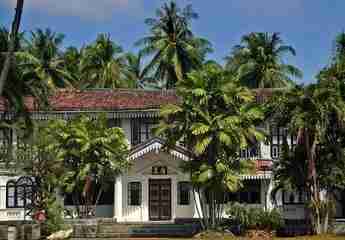
Most of the old buildings have kept their original character, and many owners have restored them with a light touch. The result is Phuket's signature Sino-Portuguese streetscape, where local influences meet European forms.
If you want the most atmospheric corners, look for the century-old herb and spice shops, the old post office, and the small museums scattered through the quarter.

Flickr, My Little Corner SG
Chinese communities have shaped Phuket for generations, especially since the island's tin-mining era. Their influence is still everywhere, in temples, family names, food, architecture, and local traditions. Thai Hua Museum on Krabi Road is one of the easiest places to understand that story.
The building itself is part of the appeal. Built in 1934 in the island's Sino-Portuguese style, it first served as a school for the children of Chinese immigrants and is now protected as a heritage landmark.
Inside, the exhibits focus on everyday life rather than luxury. Expect old photographs, documents, household objects, religious items, and tools tied to Phuket's mining past. In the courtyard, the oversized tin-mining scoop is impossible to miss.

Flickr, Jae Rustia
Phuket Old Town is special because so much of its historic fabric is still intact. Many of the best-known buildings date from the late 19th and early 20th centuries, and some are still owned by the same families who built them.
Chinpracha House is one of the standout examples. It was built in 1903 by Phra Pitak Chinpracha as a family residence on what was then the edge of town. Today it sits in the heart of the old quarter and remains in family hands.
From the street you only get a partial view, so the real pleasure is stepping inside. Visitors can explore the first floor and the central courtyard.
The house still holds a remarkable collection of period pieces: furniture, paintings, old photographs, and beautiful Italian floor tiles.
In the kitchen, everyday utensils and copper and clay cookware help bring the household back to life.
The open courtyard with its pond is a classic feature of this style of house, designed to help air circulate in the tropical heat.
If you want to picture how a wealthy Phuket family once lived, this is one of the most evocative places on the island.

thaiguests.ru
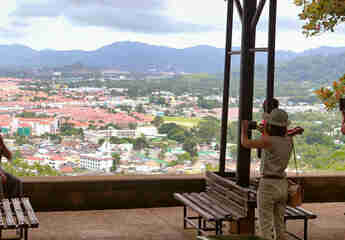
For a quick sense of Phuket Town's layout, head up to Rang Hill. The lookout opens onto wide views over the city, the coast, and, on a clear day, nearby islands in the Andaman Sea.
This hillside once marked the edge of town. Phuket has long since grown around it, but it still feels like a separate, breezier retreat above the traffic.
There are a few places to eat at the top, including the long-running Tunk Ka restaurant, so it works well as a lunch or sunset stop.
You'll also find a monument to Phraya Ratsadanuphradit, a former governor remembered for helping modernize the region in the early 20th century.
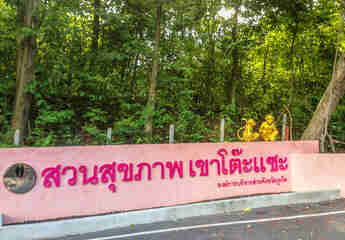
Locals come here to jog, picnic, and stretch out on the grass, and the resident macaques are always on the lookout for an easy snack, so keep your bag zipped.

Panoramio, Aleksey Nikitin
Thalang National Museum is a good stop if you want context before riding farther north. It covers the history of Phuket and southern Thailand, from early settlement to the island's better-known conflicts and legends.
The collections mix archaeology, ethnography, and local history. Artifacts recovered on land and from the Andaman Sea help piece together everyday life in earlier centuries.
One of the museum's notable pieces is an ancient stone Vishnu image, a reminder of the deep Indian cultural influence that once reached Thailand's southern coast.
There are also dioramas and displays on regional warfare, trade, and daily life among the area's different communities. A major section is devoted to the sisters Chan and Muk, the local heroines of 1785.
Outside, some exhibits reflect the memory of the 2004 tsunami through reconstructed dwellings, damaged boats, and personal belongings recovered afterward.

traumziel-thailand.com
This monument honors Phuket's most famous local heroines, sisters Chan and Muk, later given the titles Thao Thep Krasattri and Thao Sri Sunthon. Their story is tied to the Burmese invasion of 1785, during the wider Siamese-Burmese wars.
At the time, Phuket was in a vulnerable position: the governor had died, and no replacement had yet taken office. Chan stepped into the vacuum and helped organize the island's defense.
According to the traditional account, Chan and Muk ordered local women to cut their hair short and dress as soldiers, making Phuket's forces appear much larger from a distance. While the enemy hesitated under siege, local fighters kept up pressure with night raids.
Eventually the Burmese withdrew. The sisters were later honored by King Rama I, and their monument remains one of Phuket's best-known landmarks. The anniversary is still commemorated on the island each year.

Panoramio, Aleksey Nikitin
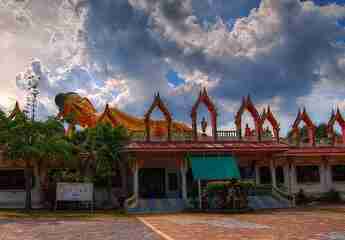
Wat Sri Sunthon is better known to many visitors as the Reclining Buddha temple, and once you see the huge golden figure stretched along the roofline, the nickname makes perfect sense.
Its formal name honors Sri Sunthon, the younger of Phuket's two famous heroines, remembered alongside her sister for helping defend the island in 1785.
The story, retold all over Phuket, says the sisters used deception as much as force: they made their small army look larger than it was and bought time while local fighters harassed the besiegers.
Their victory is still remembered in Phuket, and their names live on in roads, schools, temples, and other public places across the island.
The temple dates to the late 18th century, and even from a distance it stands out thanks to the giant reclining Buddha.
Around the grounds you'll see brightly painted animal statues and other symbolic details that echo Buddhist ideas of rebirth and moral consequence.

Flickr, JRaptor
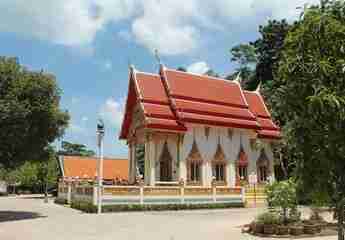
Wat Phra Nang Sang is often described as Phuket's oldest temple. No one can date it with complete certainty, but it is clearly one of the island's oldest and most storied religious sites.
Like many old Thai temples, it comes with a legend. One version says a royal woman wrongly accused of adultery later founded the temple after surviving her ordeal.
That story is why the temple is sometimes linked with the name Wat Luad Khao, or "Temple of White Blood," a reference to the tale that proved her innocence. Today, Wat Phra Nang Sang is the name you'll hear most often.
Three entrances lead into the complex, watched over by giant guardian figures. The grounds include several temple buildings, each with its own style and detail, including a shrine to Ganesha.
Golden roofs, Buddha images, murals, and portraits of abbots fill the interiors, so there is plenty to linger over once you step inside.
One of the temple's most interesting relics is a set of ancient tin Buddha images, kept in a modest white building that's easy to walk past.

Panoramio, eJungle
Wat Phra Thong is another of Phuket's old temples, dating back to the era when Thalang was the island's main center. It is best known for the legend behind its half-buried Buddha image.
The story begins with a young boy who tied his buffalo to a post sticking out of the ground. Soon afterward, both the boy and the animal fell mysteriously ill and died.
Later, the boy's father dreamed that a golden Buddha was buried in the field. Villagers dug at the spot and discovered that the "post" was actually the top of the Buddha image.
They were never able to uncover the statue completely, different versions of the story mention swarms of wasps and other ominous signs, so the image was left visible only from the chest up, and the temple was built around it.
The grounds are elegant, with richly decorated pavilions, slender columns, and pointed roofs. There is also a small museum with ceramics, clothing, weapons, books, and other pieces of local monastic and everyday life.

Flickr, andibecker
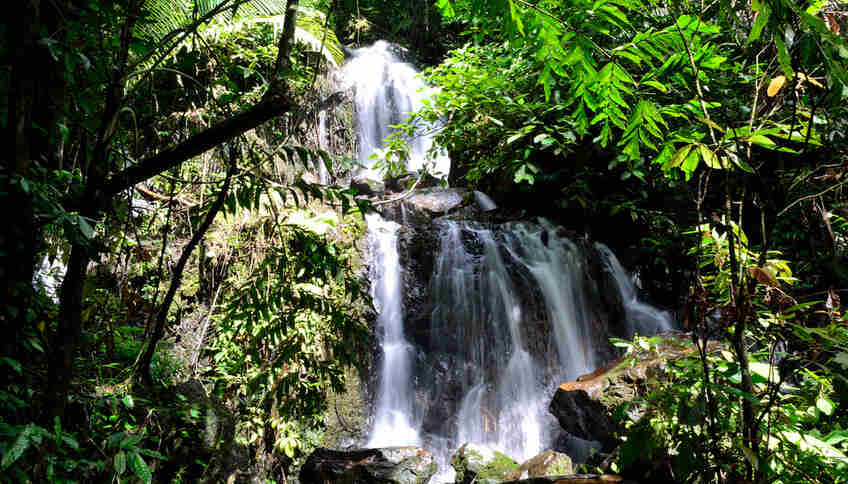
If you're in Phuket during the wetter months, usually from May into October or November, the island's waterfalls are at their best. Ton Sai is one of the highlights inside Khao Phra Thaeo's protected forest.
No, Phuket's waterfalls are not huge, but that's not really the point. Ton Sai is all about the setting: giant old trees, dense tropical greenery, and a pocket of rainforest that feels far removed from the beach road.
One approach follows a more demanding nature trail through the forest, with benches and signs explaining the local ecosystem, rainforest plants, towering ficus trees, termites, and the wildlife that lives here. Wear proper shoes if you take this route.
There's also an easier approach from the developed entrance with parking, restaurants, and a bungalow area. From there it's a gentle walk to the falls and the shaded pools.

Flickr, jeffgunn
Bang Pae sits in one of Phuket's greener, quieter corners and is one of the island's best-known waterfalls. Unlike many smaller cascades, it drops in a more direct sheet, which makes it feel more dramatic.
The fall itself is modest in height, but the cool pools and stream below make it a refreshing stop on a hot day.
With luck, you may spot birds and other wildlife in the surrounding forest, especially where the stream cuts through the thicker vegetation.
The rock around the water forms broad granite slabs that are perfect for sitting and listening to the flow.
The forest here feels old and lush, with towering trees overhead and dense bamboo pushing up below them.
On the way in, you'll pass rubber plantations and other reminders that Phuket's interior has long had a working life beyond tourism.

phuket-fever.ru
Khao Phra Thaeo protects one of the last substantial stretches of primary forest left on Phuket. It is best known to most visitors for Ton Sai and Bang Pae waterfalls, but the real draw is the feeling of stepping into the island's wilder interior.
In places, the landscape still looks much as it did generations ago. The reserve shelters rare palms, ferns, and other native plants, along with colugos, giant squirrels, and a long list of tropical birds.
It is also home to the gibbon rehabilitation project. The center works with gibbons that were once kept as pets or used in tourist shows, helping them relearn how to live with others of their kind.
When possible, rehabilitated animals are released back into protected forest. It's one of the most hopeful conservation stories on the island, and a reminder that Phuket is much more than beaches.