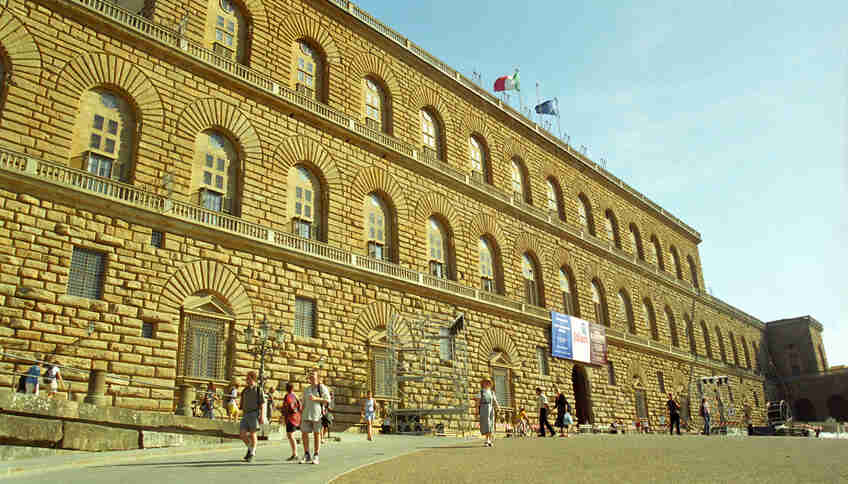
Palazzo Pitti, Florence

Flickr, The Web Ninja
Before we start, a quick note: this route is also available in our travel planner app for iPhone or Android. Download it for offline maps, GPS, and an easier way to organize your Florence trip. Now let's begin.
Updated for 2026: Palazzo Pitti still works best as a full-day stop. Book ahead when you can, expect timed entry at busy periods, and save some energy for the gardens.
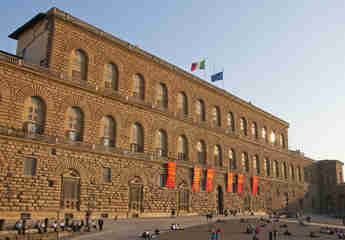
Palazzo Pitti has the stern, commanding presence you might expect from Florence's largest palace. With its rusticated stone facade, heavy proportions, and almost fortress-like silhouette, it looks severe from the outside. Inside, though, it opens into a world of grand state rooms, major paintings, and the lived history of Florence's ruling dynasties.
Today, Palazzo Pitti is one of Italy's biggest museum complexes. The Palatine Gallery pairs richly decorated Baroque rooms with works by Raphael, Tintoretto, Titian, Van Dyck, and Rubens, while Pietro da Cortona's ceiling frescoes are an attraction in their own right. Elsewhere, the Gallery of Modern Art traces Italian painting through the 19th century, and the palace collections include decorative arts, jewelry, and precious objects from different eras.
Palazzo Pitti was commissioned in the mid-15th century for Luca Pitti, who wanted a residence grand enough to rival the Medici. That ambition did not last: the palace eventually passed to the Medici, later housed the House of Lorraine and the kings of Italy, and finally became part of the Italian state. Today, several museums are spread across the complex.

Flickr, lukecanvin
The Palatine Gallery is one of Florence's great painting collections, with works by Van Dyck, Botticelli, Rubens, Caravaggio, Titian, Raphael, and many others. It occupies the first floor of Palazzo Pitti, the grandest of the city's palaces.
There are 26 rooms in all, and the setting matters almost as much as the art. Baroque decoration, elaborate stucco, and ceiling frescoes turn the gallery into a sequence of theatrical salons. The mythological rooms painted by Pietro da Cortona are especially memorable, full of energy and invention.
Raphael is one of the stars here: look for the "Madonna della Seggiola," the "Madonna under the Baldachin," the "Portrait of Cardinal Bibbiena," the "Vision of Ezekiel," and more. Many works are still displayed in rooms long associated with the Medici collection, which adds to the sense that you are walking through a princely residence rather than a neutral museum.
Give yourself time. The Palatine Gallery alone holds hundreds of paintings, and it is only one part of Palazzo Pitti. Even a focused visit can easily stretch beyond an hour.
If you like planning trips yourself, try our travel planner for iPhone or Android. You can save places and ready-made walks, spread them across your days in Florence, and share plans with friends - all in one simple, free app.
Gallery of Modern Art in Florence

Flickr, Lance Griffin
This gallery is also housed in Palazzo Pitti. Its collection grew from works transferred from the Academy of Fine Arts and is now displayed on the palace's second floor, in rooms once used by the court and household.
Today the museum fills 30 rooms. The displays follow a broadly chronological route, letting you trace the development of Italian art from the late 18th century into the early 20th. Furniture and period interiors help place the paintings in context.
Early rooms feature neoclassical works by Giuseppe Bezzuoli and Pietro Benvenuti, alongside sculpture such as Pietro Tenerani's romantic "Psyche" and Giovanni Dupre's "Abel."
The gallery is especially strong on the Macchiaioli, the Tuscan painters who used bold patches of color and light to break with academic convention. If that movement interests you, this is one of Florence's best stops.
Also see more Florence guides and routes:

wikimedia.org
This is one of Florence's best stops for anyone interested in fashion history. Historic dress, accessories, and theatrical costumes from the 18th to the 20th century are the focus here.
The gallery is housed in the Meridiana wing of Palazzo Pitti. The core collection comes from garments and accessories once kept in palace storage, and it includes rare surviving pieces associated with Cosimo I de' Medici, Eleonora of Toledo, and their family.
Because textiles are so fragile, conditions are carefully controlled and displays are rotated regularly. That makes repeat visits rewarding and helps you trace changes in style, cut, and fabric over time.
Another highlight is the collection of designer and collector Umberto Tirelli, which includes 90 stage costumes made for theater, film, and television.
A restoration workshop nearby helps conserve delicate fabrics, which is one reason these original garments can still be shown today.
Boboli Gardens

Flickr, Prof. Mortel
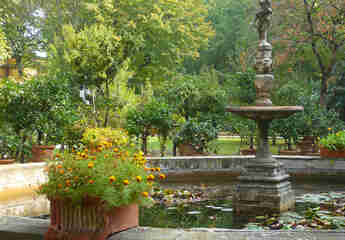
Any list of Florence's great green spaces has to include the Boboli Gardens, spread across the hillside behind Palazzo Pitti. Begun in the 16th century for the Medici court, they helped define the model for formal Italian gardens later copied across Europe.
Expect broad lawns, gravel paths, clipped hedges, fountains, terraces, statues, and garden architecture tucked between long views and shaded corners.
Many of the sculptures you see outdoors are copies, with the originals protected in museums, but the atmosphere is still magical. The Buontalenti Grotto is a highlight, with richly decorated interiors and a theatrical facade.
The gardens also hosted Medici court spectacles that helped shape the early history of opera. Today the amphitheater is centered on an ancient Egyptian obelisk.
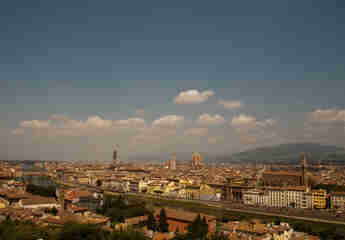
Another reason to come is the view: from the higher paths, Florence opens up below you. The Boboli Gardens are beautiful, calm, and spacious - an ideal break between museum visits.

Flickr, LEON SETIANI
This museum occupies the Casino del Cavaliere, a 17th-century building on one of the high points above the Boboli Gardens. Opened in 1973, it displays porcelain once owned by Tuscany's ruling families - the Medici, the House of Lorraine, and the Savoy.
The collection is arranged by period, place, and maker. You will see pieces from the Doccia manufactory that were used at court, along with works produced in other Italian and European centers, including Naples.
Some of the most interesting pieces were gifts from Napoleon to his sister Elisa Baciocchi: elegant vases and table services from the Sevres manufactory. They capture a moment when European porcelain was still a relative luxury.
Among the oldest works on display are pieces associated with Gian Gastone, the last grand duke of the Medici line.

Flickr, JavierVazquez
Another lovely corner of Florence lies on the hillside above the city: the Bardini Gardens, a four-hectare retreat of terraces, statues, staircases, and lush planting. They are less famous than Boboli, which is exactly why many visitors love them.
The story of the site goes back to the 13th century, when it belonged to the Mozzi family. What began as working land gradually took on the character of a pleasure garden, with Baroque stairways, statues, fountains, and formal landscaping.
Later owners added their own touches, including Carolath von Beuthen, who further embellished the estate.
In the 20th century the property was acquired by Stefano Bardini, whose name it still bears. He opened a road to the villa, reshaping parts of the grounds in the process.
After decades of neglect, the gardens were restored in the 2000s and reopened. Today they are once again one of Florence's most peaceful places to wander.

Flickr, klong35
The largest of the three grottoes in the Boboli Gardens, the Buontalenti Grotto is also known as the Grotta Grande, or Great Grotto. Bernardo Buontalenti designed it for Francesco I de' Medici between 1583 and 1593.
Artificial grottoes were highly fashionable in late Renaissance gardens, blending sculpture, painting, water, and architecture into fantastical spaces. The Buontalenti Grotto is one of the best examples, complete with dramatic textures and cave-like ornament.
The entrance is framed by two columns. On either side are niches with figures of Ceres and Apollo, while above them sits the Medici coat of arms supported by female allegories of Peace and Justice.
Inside, the grotto unfolds in three sections. The first, and largest, is dressed with imitation stalactites and stalagmites, shells, stonework, and painted scenes of an imagined garden populated by goats, sheep, monkeys, and even big cats.
The second chamber continues the same dreamlike style. In the third, alongside frescoes and niches, you will find a green marble fountain beneath a ceiling painted as an open sky with birds in flight.
It is the kind of place where time disappears. Modern readers may know it from Dan Brown's novel "Inferno."

wikimedia.org
Jeweled cups, antique vases, and diamond tiaras make this one of the most dazzling stops in Palazzo Pitti. The appeal is not just the sparkle, though - the collection says a lot about court taste, ceremony, and power.
The Silver Museum occupies 25 rooms in the left wing of Palazzo Pitti. Inside are gem-set cups, silver and enamelwork, jewelry from the 17th to the 20th centuries, ivory, and other decorative objects tied to court life and collecting.
The Medici fascination with precious objects began early. Cosimo de' Medici started the collection, Piero expanded it, and Lorenzo the Magnificent enriched it with rare antiquities. Among the standout holdings are the so-called vases of Lorenzo, prized for both their artistry and their history.
More routes and guides around Florence: