Temple of Literature

Flickr, khaisq
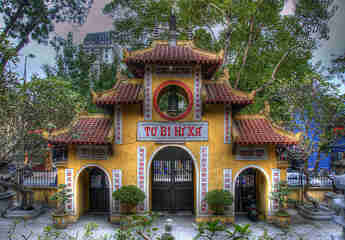
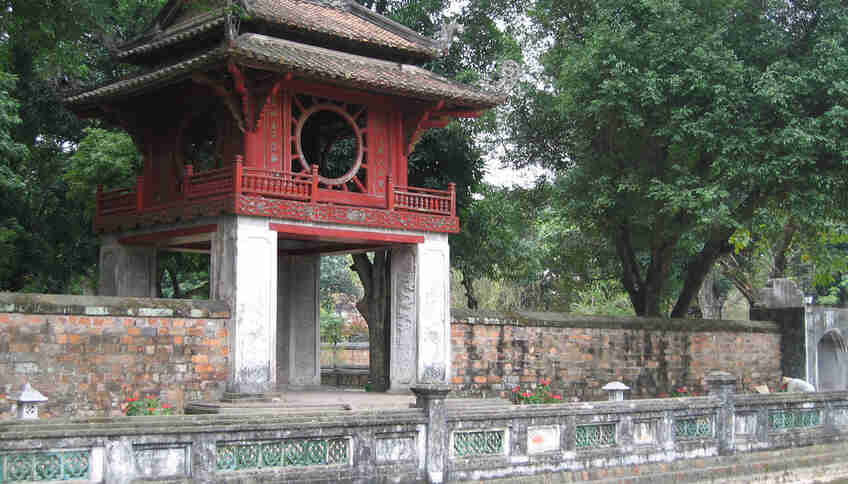
The Temple of Literature (Van Mieu, Vietnamese: Văn Miếu) is a pagoda complex with a park, the first university of Vietnam. The Temple of Literature was founded in 1070 by Emperor Ly Thanh Tong in Hanoi and dedicated to Confucius. On its grounds, in 1076, the first Vietnamese university was established to educate the sons of mandarins.

panoramio.com, Vithaya Jearaditharp
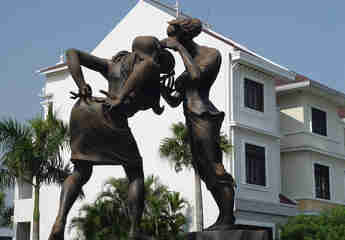
Art in Vietnam can conditionally be divided into two major periods – colonial and modern. During the French occupation of the country, the creative explorations of local painters, sculptors, and other artists, if not suppressed, were under the significant influence of the standards of Western civilization.
The National Museum of Fine Arts in Hanoi, opened in 1963, reflects practically everything accumulated over the long years of Vietnam's cultural life. Here you can see many paintings by local artists, as well as sculptural compositions belonging to different historical eras.
Within the museum's walls is a large number of artifacts from ancient times – archaeological finds, examples of pottery, and household items of the peoples who once inhabited the territories of Southeast Asia. Special attention is paid to works of folk art and ethnic motifs. Several exhibition halls are devoted to lacquer painting, which has always been considered a priority among Vietnam's traditional crafts.
Lenin Park

blogspot.com, enhenyero
Lenin Park (Công viên Lê Nin, cong vien Le Nin, formerly Chi Lăng, Chi Lang) is located opposite the Army Museum in Vietnam's capital Hanoi, on Dien Bien Phu, Tran Phu, and Hoang De streets. The triangular park, with a total area of 17 183 meters, includes an architectural monument to Lenin. Lenin Park used to be called Thong Nhat, which translates as “United.” This name has a complicated history. It reflects the hope of the northern part of the country divided in two (the park opened in 1960) for reunification with the southern half. In April 1980, in honor of the 110th anniversary of Lenin's birth, the park was renamed and to this day bears the name Lenin Park. This is where the annual Spring Flower Festival is held during Tet[1]. The park is also a place where residents of nearby neighborhoods exercise. The monument to Lenin, by sculptor A. A. Tyurenkov[2], was installed in the park in 1982[3]. Lenin's name on the monument is written in Vietnamese — “V.

Flickr, jovijovijovi
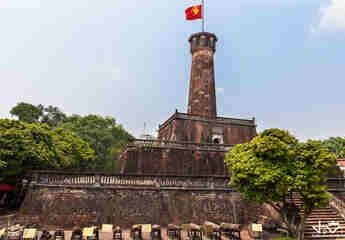
The Hanoi Citadel is a rare example of Vietnam's ancient architecture that has survived to the present day. The Flag Tower is part of this enormous complex, which began to be built back in the 11th century during the reign of the Ly dynasty, and the subsequent Tran, Le, and Nguyen dynasties expanded its territory and added new structures up to the 19th century.
The tower, over 30 meters high, was built in 1812. The French colonizers, during their conquest of Vietnam, did not destroy it, but used it as an observation and communication point. Incidentally, the tower's original purpose was not military at all, but scientific – they planned to set up an observatory here.
Now the red-and-yellow national flag of Vietnam constantly flies at its top. It was first raised in this place in 1945, immediately after the August Revolution.
Since 2010, the tower has been accessible to tourists visiting the military history museum, and in the same year the entire Hanoi Citadel was included on the UNESCO World Heritage List.
Army Museum

Flickr, Jos van der Heiden
The Army Museum is dedicated to the combat history of the Armed Forces of Vietnam. It is located in Hanoi. It displays examples of Soviet, Chinese, as well as American and French military equipment and weapons. Address: 28A, Ba Dinh District, Hanoi. The museum is open from Tuesday to Sunday from 8 to 11 and from 13 to 16. Monday is closed. The museum ticket also includes admission to the Flag Tower, from whose observation deck there is a beautiful view of Hanoi and the surrounding area. Lenin Park (Công viên Lê Nin) adjoins the museum grounds. The military museum in Hanoi is one of the seven Vietnamese museums of national significance. Its opening was preceded by a series of exhibitions held with the goal of supporting the spirit of the Vietnamese military. Ultimately, the Hanoi Military Museum was opened in 1959 on the 15th anniversary of the founding of the People's Army of Vietnam. The initiator of the museum's creation was President Ho Chi Minh.
Hanoi Citadel

Flickr, Le-Mim-Chien
The Hanoi Citadel (Vietnamese: Hoàng thành Thăng Long) is a cultural complex that includes the first royal complex from the Ly dynasty and was later expanded during the Tran, Le, and Nguyen dynasties. The ruins roughly coincide with today's Hanoi Citadel. The royal palaces and most of the buildings in Thang Long were destroyed to one degree or another by the end of the 19th century due to the actions of the French army during the conquest of Vietnam (Thang Long is the old name of Hanoi). In the 20th century the complex continued to be destroyed because of ongoing wars. Only at the beginning of the 21st century did systematic excavations begin. On December 28, 2007, the Central Sector of the Imperial Citadel of Thang Long - Hanoi was classified as an architectural monument of national significance, and on August 12, 2009, it was declared a Special National Monument. The Central Sector of the Imperial Citadel was inscribed on the UNESCO World Heritage List on July 31, 2010 at the 34th session in Brazil.