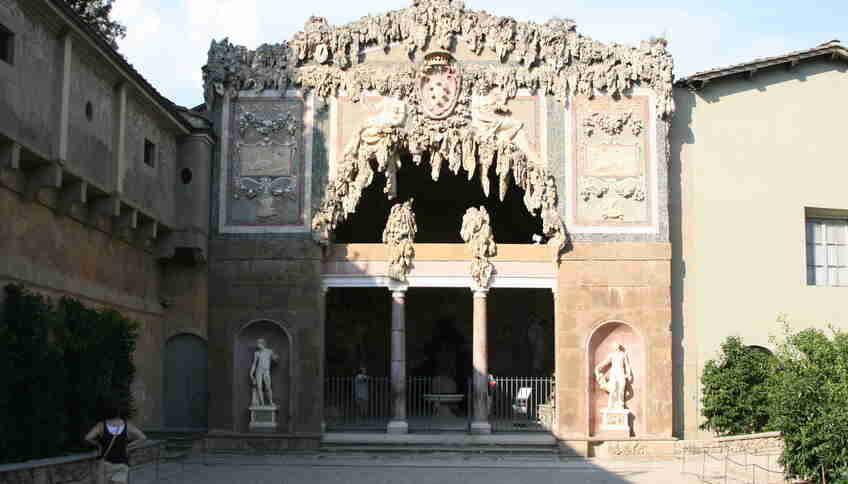
The largest of the three grottoes in the Boboli Gardens – the Buontalenti Grotto – has another name that is not hard to guess – the “Large Grotto” or “Grotta Grande”. It was created by the architect Bernardo Buontalenti commissioned by Francesco Medici between 1583 and 1593.
At that time, it was very fashionable to invite artists and architects to design decorative caves, reconstructing the natural relief. The grottoes were decorated with fountains, sculptures, and frescoes on esoteric and mythological themes. This can also be seen in the Buontalenti Grotto, which, among other things, is decorated with stalactites and stalagmites.
The entrance is framed by two columns. On both sides of them there are niches with sculptures representing Ceres and Apollo. On the upper part of the facade, you can see the coat of arms of the Medici family, supported by two female figures symbolizing peace and justice.
Inside, the grotto is divided into three parts. The first is the largest, and its walls are decorated with skillfully crafted stalactites and stalagmites, stones, shells, and corals. From floor to ceiling, they are covered with wall paintings depicting a fantastic garden in which you can make out goats, sheep, monkeys, and even cheetahs.
The second hall is decorated in the same style as the first. And in the third room, in addition to frescoes and niches, there is an extra element that distinguishes it from the others - a green marble fountain. And on the ceiling, the sky with flying birds is depicted.
All this splendor is so mesmerizing that you can lose track of time. Perhaps that is why the science fiction writer Dan Brown chose this grotto for one of the scenes in his new novel “Inferno”.