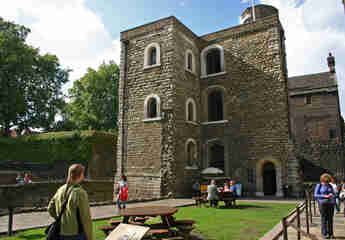
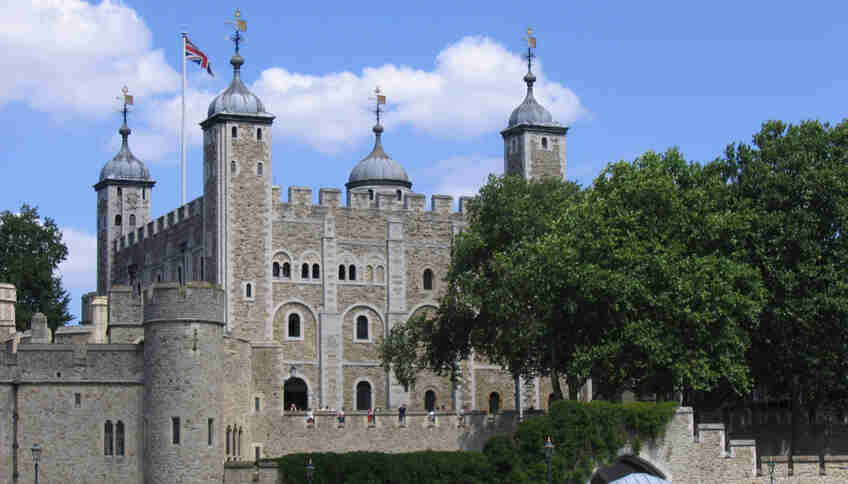

The famous Tower of London is the oldest fortress, built more than 900 years ago. Solid and mighty, just like England itself!
Translated from English, “Tower” means "tower." William I began erecting defensive structures on this site to intimidate the peoples he had conquered. Gradually, the fortress began to expand, new buildings appeared, but overall it remained the same quadrangular structure with a massive stone wall, surrounded by a deep moat, which allowed it to remain the most impregnable castle in Europe.
Over its many centuries of history, the Tower of London managed to serve as a warlike fortress, a royal residence, a treasury, a military warehouse, a mint, a prison, an astronomical observatory, and even a zoo. But perhaps the longest period was when the Tower housed a prison — from 1190 to 1952. It mainly held prisoners from noble families, including princes and kings. Many prisoners were later executed. Such a fate befell more than 1500 people. Their bodies are buried in the Tower's basements.
In the 13th century, a menagerie appeared on the fortress grounds. It all began when Emperor Frederick II gave his father-in-law Henry III an elephant, a polar bear, and three leopards. Then more and more animals appeared, which were first displayed for the amusement of royal figures, but later they began to be shown to all the other townspeople as well. In the 19th century, it was decided to move the animals from the Tower to a new zoo built in the expanses of Regent's Park.
The mint in the London fortress was located there for more than five centuries. Silver coins were constantly minted in one of the fortress towers. In addition, the royal treasures and the coronation regalia are still kept here. The largest diamond in the world, Cullinan I, is also securely hidden behind the fortress walls. Like all ancient castles, over time the Tower became surrounded by ominous legends and its own ghosts. Many assure that they saw the ghost of George II in the windows, and the headless Anne Boleyn in the park. Some often encounter here the souls of murdered children: 12-year-old Edward V and his 9-year-old brother Richard.
But for those who do not believe in such tales, there is a very real story that ravens must always be kept in the castle (no fewer than six). By order of Charles II, a new position of "ravenmaster" was even established — a person who must look after the ravens. It turns out there is a belief that England will prosper only as long as the winged guardians remain in the Tower.