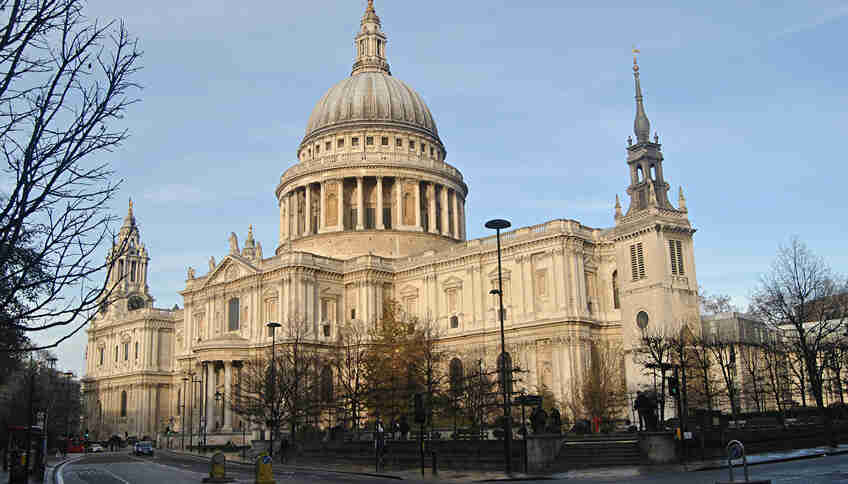

On Ludgate Hill in London stands a cathedral of astonishing beauty, built in honor of Saint Paul. On this site there have already been at least five cathedrals at different times, and all of them were dedicated to this saint.
The first one appeared as early as 604, but it burned down in a fire because it was wooden. Stone churches were then built, but they met the same fate. The St Paul's Cathedral that we can see in London today was erected in 1708. October 20 is officially considered the date from which its history is reckoned - the day its architect, Christopher Wren, celebrated his 76th birthday. During his lifetime, after the Great Fire of London in 1666, he restored 51 churches, including St Paul's Cathedral - one of London's main attractions.
From an architectural point of view, the cathedral's dome is an extremely complex structure. Many modern specialists still admire this marvel of engineering. Although it was not included in the original design at all, Charles II and the senior clergy insisted that St Paul's Cathedral in London should receive a dome like that of St Peter's Basilica in Rome. As a result, residents of the British capital and countless tourists can now enjoy a panorama of the city from the external gallery that encircles the cathedral's dome.
Inside the building there is another remarkable gallery, known as the Whispering Gallery. If you stand at one end of the gallery and whisper something, it will be heard perfectly at the other end. Of course, no one just takes this on faith, so don't be surprised if, while walking through the cathedral, you spot foreigners whispering under their breath.
According to tradition, Anglican churches were not meant to have lavish interior decoration. But in 1860 it was decided to create a charitable fund that would make it possible to embellish the interior. That is how graceful sculptures, beautiful benches, delicate grilles, and mosaics appeared in the cathedral.
St Paul's, as local residents call it, is not just a cathedral where services and various religious ceremonies are held, but also the residence of the Bishop of London. Many famous Britons are also buried here, including the cathedral's architect. His grave is not marked by a monument; instead, there is a slab bearing the inscription that his memorial is everything that surrounds you.
St Paul's Cathedral is one of those London attractions that can be visited for free. Anyone can simply come to a service, quietly sit on a pew, look around, and listen to the organ. You probably won't be able to walk around as if you were in a museum during the service, but even just being inside is already wonderful!