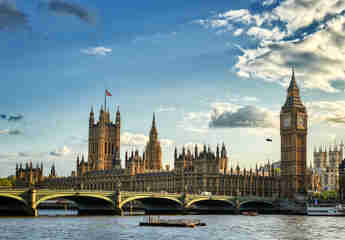
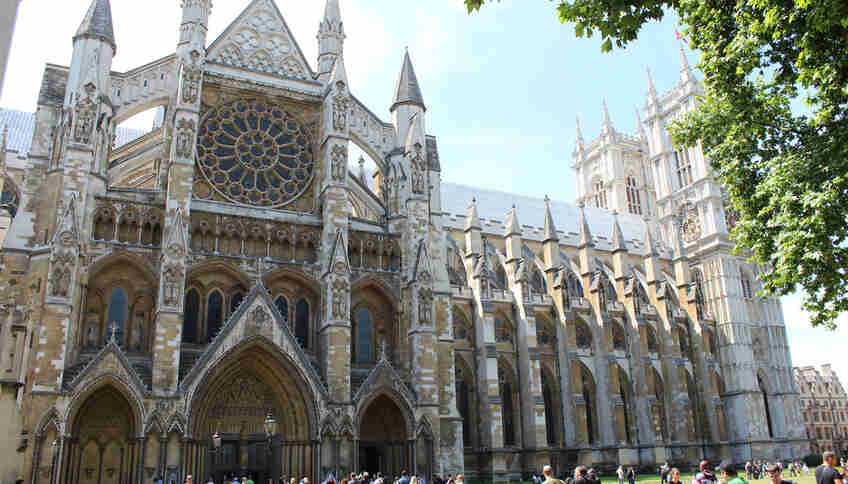

Under the vaults of Westminster Abbey, the most important religious events for the British have been held for centuries: coronations, royal weddings, and the funerals of the highest-ranking figures of the state.
Westminster Abbey is the Collegiate Church of St Peter, where monks lived and worked until the middle of the 16th century. Its founder was Edward the Confessor, the penultimate Anglo-Saxon king of England. Despite his high position, he devoted a great deal of personal time to the church, championed Christian virtues, and promoted an ascetic way of life. For this he was canonized and recognized as a saint.
At the end of his life, Edward practically withdrew from power, handing the reins of government over to his younger brother. Westminster Abbey became the work of his life. A magnificent temple was built, of which, unfortunately, little now remains, but in terms of architecture it was in no way inferior to the current one. This is evidenced by a drawing embroidered on an 11th-century tapestry depicting the church’s previous appearance.
However, it is difficult to count the number of changes and additions that took place during the construction of Westminster Abbey, which continued from 1242 to 1745 with several interruptions. However, the Gothic structure of the building was largely formed during the reign of Henry III.
The two distinctive towers adorned with openwork arches have long become one of the most recognizable symbols of London. And the recent royal “wedding of the century,” footage of which flew around the world, made it even more popular. Millions of television viewers watched with bated breath the marriage ceremony of Prince William and Kate Middleton. Before them, several generations of royals were married within the walls of Westminster Abbey, including Elizabeth II and the Duke of Edinburgh.
For wedding ceremonies, the interior of the abbey is decorated with an avenue of trees standing on both sides of the aisle. On ordinary days this avenue is not here, but there is still plenty of interesting things for tourists. For example, Poets’ Corner, where the ashes of famous writers and poets such as Dickens and Browning are kept. Here also rests the famous 18th-century actor and playwright David Garrick, William Blake, Henry James, and others. Among those celebrities closer to our own time, one can name the actor, director, and producer Sir Laurence Olivier. There is even a plaque bearing Shakespeare’s name here, but do not be misled on that account, as Shakespeare himself is buried elsewhere. Almost all the kings and queens of England, however, rest precisely here. In total, there are about 3000 tombs in the church.
However, it would be wrong to call Westminster Abbey only a religious building; the structure houses a real treasury containing works of art, masterpieces of painting and rare tapestries, antique fabrics, and extraordinarily beautiful church objects. Moreover, it can be characterized as a research center thanks to the rich collection of ancient manuscripts, folios, and important archival documents kept here.