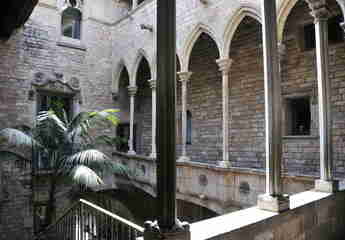
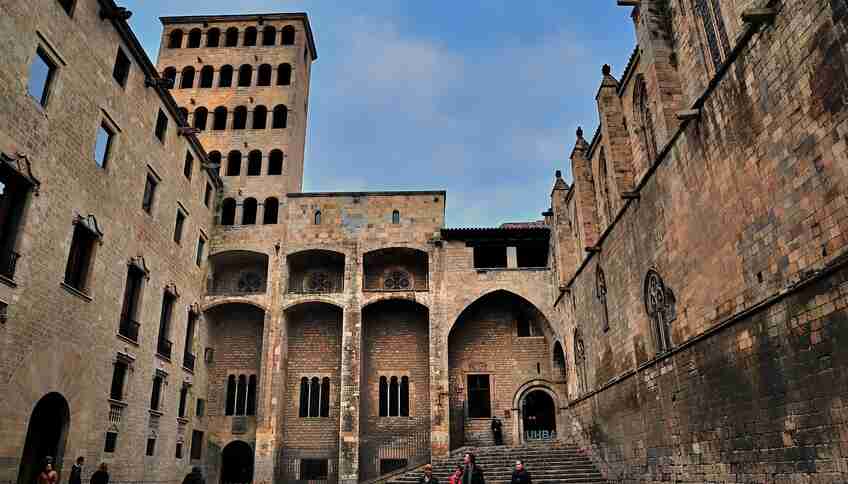
Plaça del Rei is a unique ensemble of medieval architecture made up entirely of historic buildings.
Its main attraction is the Grand Royal Palace, which was built as early as the 11th century at the order of Pedro the Pompous and for centuries served as the residence of the counts of Barcelona. It was here that Christopher Columbus informed his sponsors Isabella of Castile and Ferdinand of Aragon about the discovery of a new route to India.
A hundred years before that, in the 15th century, King Martin of Aragon lived in the palace, and the city noise irritated him greatly. To get rid of the unwanted sounds coming from the local market, he decided to build a barrier fortress opposite his residence and at the same time obtain an excellent place in the courtyard for knightly tournaments.
Next to King's Square are the Church of Saint Agatha with its tall bell tower, the Lieutenant's Palace — the residence of the viceroys, and the Clariana Padellàs House, which now houses the city history museum. Interestingly, this house was originally located in a completely different place and was literally moved here brick by brick at the beginning of the 20th century. At the same time, archaeological excavations showed that houses and streets of ancient Roman Barcino had been preserved beneath the square, and these can be seen by visiting the museum.
All the buildings of Plaça del Rei stand so close to each other that the enclosed space of the square can be accessed only through a small passage from carrer del Veguer and the alley baixada de Santa Clara.
Do not confuse King's Square with the Royal Square (Placa Reial) — the former is located directly in Barcelona's Gothic Quarter, while the latter is closer to the sea and La Rambla.