
Troitskaya Nadvratnaya Church

Flickr, twiga_swala
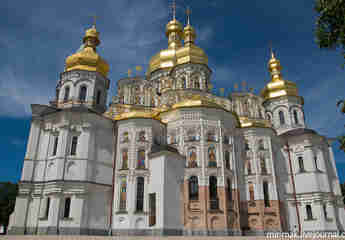
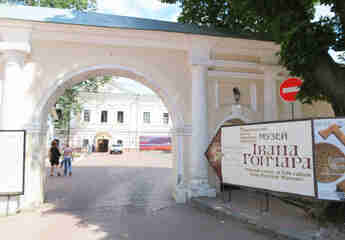
Troitskaya Nadvratnaya Church is an Orthodox church forming the main entrance to the Kievo-Pechersk Lavra. It was erected at the beginning of the 12th century, after which it was reconstructed many times. The church was built in 1106-1108 as part of the Lavra fortifications, above the main entrance to the underground monastery. The church was founded by the grandson of the prince of Chernigov and Grand Prince of Kiev, Sviatoslav Yaroslavich, who renounced his princely status and became a monk of the Pechersk Monastery on November 17, 1106 under the name Nikolai Svyatosha.[1] Nikolai was a monk for 36 years and founded a hospital in the Lavra. After the significant destruction of the Uspensky Cathedral during the Mongol invasion in 1240, Troitskaya Nadvratnaya Church became the main church of the monastery.[1] In 1957-1958 restoration work was carried out in the church, including work to restore lost decorative elements, gilding of the vault, and retouching of the exterior paintings.[1]
Kievo-Pechersk Lavra

restinua.com
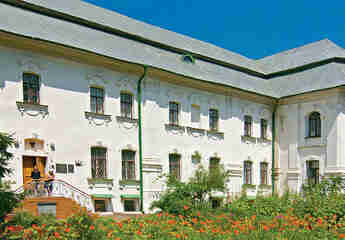
Kievo-Pechersk Lavra (Ukr. Kiyevo-Pecherska Lavra) is one of the first monasteries founded in the Old Rus' state. It was founded in 1051 under Yaroslav the Wise by the monk Anthony, a native of Liubech. One of Anthony's first disciples, Theodosius, became the co-founder of the Pechersk Monastery. Prince Sviatoslav II Yaroslavich gifted the monastery the plateau above the caves, where later magnificent stone churches decorated with paintings, cells, fortress towers, and other buildings arose. The names of the chronicler Nestor (author of The Tale of Bygone Years) and the painter Alipius are connected with the monastery. From 1592 to 1688 it was a stavropegion of the Patriarch of Constantinople; from 1688 the monastery received the status of a lavra[1] and became a 'royal and patriarchal Moscow stavropegion'; in 1786 the lavra was subordinated to the Kiev metropolitan, who became its archimandrite. In the Blizhnie and Dalnie caves of the Lavra rest the incorrupt relics of God's saints; there are also burials of laypeople in the Lavra (for example, the grave of Pyotr Arkadyevich Stolypin).
Uspensky Cathedral

Flickr, thisisbossi
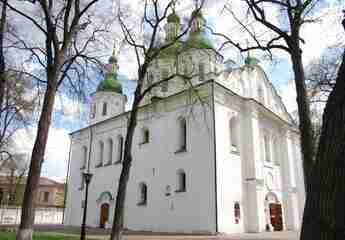
The Cathedral of the Dormition of the Most Holy Mother of God (commonly the 'Great Church') is the main cathedral church of the Kievo-Pechersk Lavra, the 'God-created' prototype of all monastery churches of Ancient Rus, and the burial place of the Kiev princes. It was founded in 1073 at the initiative of Theodosius of the Caves and built in three years with the money of Prince Sviatoslav II Yaroslavich. Its construction was shrouded in legends. The Kievo-Pechersk Patericon links the construction and decoration of the church with Greek masters who came to Kiev from Constantinople at the instruction of the Mother of God, who appeared to them in a dream with an image of the church: 'And I sent the measure — the belt of My Son.' The patericon names as the most active participant in the construction the nephew of Yakun the Blind, the noble Varangian Shimon Afrikanovich, from whom many Russian families later traced their lineage — the Velyaminovs, Vorontsovs, and Aksakovs. D. S. Likhachev associated the construction of the Uspensky church with the beginning of the spread of veneration of the Mother of God in Rus: P. A.
Blizhnie Caves

pecherskajalavra.blogspot.com
Blizhnie Caves, or Antonievy Caves, are a complex of underground caves in the Kievo-Pechersk Lavra where the relics of the Pechersk ascetics rest. They were founded in 1057, when Saint Anthony named Saint Varlaam the first abbot of the Kievo-Pechersk Monastery. Monk Anthony left the monastery and later settled on a new hill, where he dug a new underground chamber, and the Blizhnie Caves are now located on this site. In these caves is the burial place of the founder of the Pechersk Monastery, Venerable Anthony. Of the three existing entrances to the Blizhnie Caves, the original one was probably the western entrance, which could be reached from the narthex of the Krestovozdvizhenskaya Church. The Blizhnie Caves have from time immemorial consisted of three streets connected to each other by passages. The main one is Pecherskaya Street, adjoining which is the Church of the Entry of the Mother of God into the Temple — the largest in the Blizhnie Caves.
Krestovozdvizhenskaya Church

Flickr, peatc
Krestovozdvizhenskaya Church is an 18th-century architectural monument and the most significant structure above the Blizhnie Caves of the Kievo-Pechersk Lavra. It was built in 1700 with funds from the Poltava colonel Pavel Semyonovich Gertsik. After the construction of the church was completed, the finishing of its interior began in the Cossack Baroque style typical of that time. In 1769 the woodcarver K. Shverin made a four-tiered wooden iconostasis for the church. In the 1740s a one-story gallery was added to the eastern wall of the church, which simultaneously served as one of the entrances to the Blizhnie Caves. At the end of the 18th century, a refectory with a single pear-shaped dome was added to the west side of the church. Since 1990 Krestovozdvizhenskaya Church has been active and belongs to the Ukrainian Orthodox Church (Moscow Patriarchate).
Dalnie Caves

5travel.net, cbeta
Dalnie Caves are a complex of underground caves of the Kievo-Pechersk Monastery. In the Dalnie Caves rest the relics of 49 canonized saints. Today the total length of the underground corridors is 293 m, of the Varangian ones — 200 m. One of the founders of the Kievo-Pechersk Monastery, Theodosius of the Caves, was buried in 1074 in his cell in the Dalnie Caves, which after this saint are also called Theodosius Caves. The relics of Theodosius were found in 1091 and solemnly transferred to the Uspensky Cathedral of the Kievo-Pechersk Lavra. In 1240, when the troops of Batu Khan captured Kiev, the relics were hidden to avoid desecration. The burial place was kept secret and was forgotten over time. The Dalnie Caves were founded as a completely separate complex. The study of their history is complicated by the fact that no systematic archaeological research has been carried out in them. According to researchers, the Varangian Cave should be considered the oldest, since the origin of the monastery itself is associated with it.
Annozachatievskaya Church

Panoramio, SergeyUA
Annozachatievskaya Church, or the Church of the Conception of Saint Anne, is a 17th-century architectural monument. It was built in 1679 in the Kievo-Pechersk Lavra above the entrance to the Dalnie Caves. Steps lead from the church interior to the underground labyrinth. This single-domed structure initially had Baroque forms. In 1809-1810 the church was rebuilt, replacing the Ukrainian Baroque dome with a tented one. The author of this rebuilding was A. I. Yakushkin (as a monk, Hieromonk Arseny, overseer of the Dalnie Caves). In 1881, when cracks appeared in the walls of the church, they were partially relaid and the dome was shifted toward the altar apse. After the last rebuilding, the interior of the church was painted again and the oak iconostasis that still exists today was installed.