St. Volodymyr's Cathedral

Flickr, Jorge Lascar
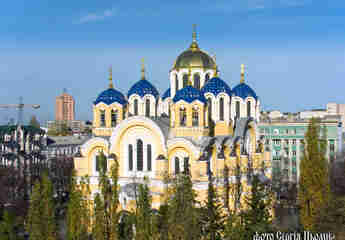
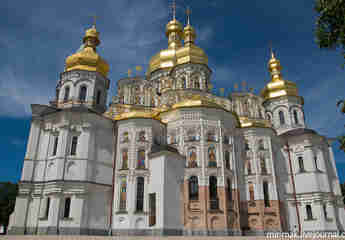
St. Volodymyr's Cathedral is a monument of Neo-Byzantine architecture in Kyiv on Taras Shevchenko Boulevard, whose decoration was worked on by leading artists of the Russian Empire. It is now the main church of the Ukrainian Orthodox Church of the Kyiv Patriarchate. In 1852, Metropolitan Filaret of Kyiv and Galicia (Amfiteatrov), in his letter to Emperor Nicholas I of All Russia, expressed the idea of the need to build in Kyiv a church that would be a monument to the Grand Prince of Kyiv Volodymyr Sviatoslavych. It was decided that the church would be built exclusively with charitable donations. On July 12, 1853, Emperor Nicholas I approved the report of the Holy Synod on the construction in Kyiv of a cathedral church in the name of Saint Equal-to-the-Apostles Prince Volodymyr, and already in August a construction committee was created, consisting mainly of clergymen. The design of the church was entrusted to the architect Ivan Shtrom.
Golden Gate

wikimedia, Okosmin
The Golden Gate is located in Kyiv! Do not confuse it with the one in Yaroslavl! The Golden Gate (Ukr. Zoloti Vorota) is one of the few monuments of defensive architecture of the Old Rus state from the reign of Prince Yaroslav the Wise. Under Yaroslav the Wise, the territory of Kyiv expanded actively, which required new defensive fortifications to be built—powerful ramparts with reinforced wooden cells and deep moats were constructed. The city of Yaroslav the Wise was surrounded by earthen ramparts with a total length of 3.5 kilometers; they ran along what are now the streets of central Kyiv—from Lviv Square (where the Lviv Gate was located) along Yaroslaviv Val Street to the Golden Gate, descended to Independence Square (where the Lyadski Gate stood), and rose again to Mykhailivska Square. In The Tale of Bygone Years it is mentioned: The Kyiv Golden Gate got its name from the Golden Gate of Constantinople, which served similar functions. Probably, this was a kind of rivalry with the great Byzantine Empire.
Khreshchatyk

Flickr, www.sapr.in
Khreshchatyk (Ukr. Khreshchatyk) is Kyiv's main street. Length—1.3 km, direction—from north to south. It begins at European Square, passes through Independence Square, and ends at Bessarabska Square. The street's name comes from Khreshchatyi Yar (that is, crossed by transverse ravines). In 17th-century documents, this whole area was called the Khreshchata Valley.
Monument of Independence of Ukraine

Flickr, Charlie Martono (busy)
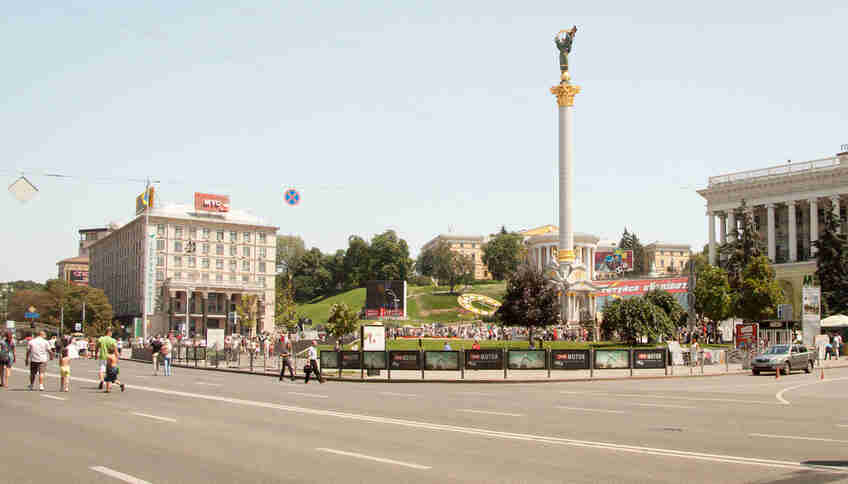
The Monument of Independence of Ukraine (Ukr. Monument Nezalezhnosti) is a monument dedicated to the independence of Ukraine. The monument is located in the center of Kyiv on Maidan Nezalezhnosti. Stylistically, it is a mixture of Ukrainian Baroque and Empire style. The monument was erected in the compositional center of Independence Square in Kyiv in honor of the 10th anniversary of Ukraine's independence in 2001. It is a 52-meter column crowned with the figure of a girl (Berehynia) in Ukrainian national costume holding a branch of viburnum in her hands. Total height—62 meters[1]. As the model for creating Berehynia, the project's author Anatolii Kushch used his daughter, Kristina Katrakis[2].
Maidan Nezalezhnosti

Flickr, Anosmia
Maidan Nezalezhnosti (Ukr. Maidan Nezalezhnosti — colloquial variant “Maidan”; means “Independence Square”) is the central square of Kyiv. It is located between Khreshchatyk, Borys Hrinchenko Street, Sofiivska Street, Mala Zhytomyrska Street, Mykhailivska Street, Kostolna Street, Instytutska Street, Arkhitektora Horodetskoho Street, and Taras Shevchenko Lane. Until the 10th century, the area around today's Maidan was called Perevesyshche and was a swamp. Where Sofiivska Street now begins, there were the Lyadski Gate, which led to the upper city. At the end of the 18th and beginning of the 19th century, the site of the future square was a wasteland with the remnants of defensive ramparts opening onto it. The 1868 “Description of Kyiv,” compiled by Nikolai Zakrevsky, mentions the market square in the middle of Khreshchatyk, “from old times called Goat Swamp.” Zakrevsky notes that the market is located “near the tract called Goat Swamp.”
Lyadski Gate

Panaramio, Lyera Sholokhova
Lyadski Gate, or the Lyadska Brama, were the southeastern wooden gates of ancient Kyiv that led to the princely part of the city, also known as the Old City. They are mentioned in the chronicle of 1151 as gates leading to the “land of the Pechenegs.” The road to the Pechersky Monastery and Klov also passed through the Lyadski Gate. The Lyadski Gate were part of the unified defensive line of ancient Kyiv, built during the reign of Yaroslav the Wise in the 1030s. The earthen rampart that began at the Golden Gate ran east along today's Prorizna Street and slightly above it to the intersection with Borys Hrinchenko Street, making a turn toward the Lyadski Gate[1]. The Russian historian S. M. Solovyov supposed[2] that the name of the gate might have been connected with the place where Poles lived compactly in Kyiv. Historian N. V. Zakrevsky also adhered to this version, quoting the Laurentian Chronicle: “...That the word Lyadsky, Lyadskyi means Polish is evident from the following text. Under 1031.
Saint Sophia Cathedral

Flickr, Matt. Create.
The Cathedral of Holy Sophia (Saint Sophia Cathedral) is a church built in the first half of the 11th century in the center of Kyiv, according to the chronicle, by Prince Yaroslav the Wise. At the turn of the 17th-18th centuries, it was externally rebuilt in the style of Ukrainian Baroque. Inside the cathedral, the world's most complete ensemble of authentic mosaics (260 sq. m) and frescoes (3000 sq. m)[1] from the first half of the 11th century, as well as significant fragments of wall painting from the 17th-18th centuries, have been preserved. It remained an active church until 1929; in 1934 it became a museum—the Saint Sophia Preserve. It is now the heart of the National Preserve “Sophia of Kyiv”[2], one of the largest museum centers in Ukraine, which also includes the 11th-century Golden Gate, the 12th-century St. Cyril's Church and the 18th-century St. Andrew's Church in Kyiv, as well as the Sudak Fortress with monuments from the 6th-15th centuries in Crimea. In 1990, Saint Sophia Cathedral, like the Kyiv Pechersk Lavra, became the first architectural monument on the territory of Ukraine to be included on the UNESCO World Heritage List.
Saint Sophia Square

kuzminskypartners.com
Saint Sophia Square is one of the central and oldest squares of Kyiv. On Saint Sophia Square are the bell tower of Saint Sophia Cathedral and the monument to Bohdan Khmelnytsky. The square is located between Volodymyrska Street, Volodymyrskyi Passage, Alla Tarasova Street, Sofiivska Street, and Rylskyi Lane. According to legend, on the site of Saint Sophia Square, which was a field near the city walls, Yaroslav the Wise defeated the Pechenegs in 1036, after which he built Saint Sophia Cathedral on this spot and named the square in front of it Sophia. After the construction of the government offices in 1854—1857, it was separated from the neighboring Mykhailivska Square, where the restored St. Michael's Golden-Domed Cathedral is located. From 1921[1] to 1944 it was called Red Heroes of Perekop Square, in honor of the Red Army's victory over Wrangel's forces near Perekop in 1920. From 1944 to 1993 it bore the name of Bohdan Khmelnytsky after the monument located in its center, erected in 1888.
Bohdan Khmelnytsky Monument

Flickr, dbmmedia
The Bohdan Khmelnytsky Monument in Kyiv is a monument to the Ukrainian historical and political figure, Hetman Bohdan Khmelnytsky. It was ceremonially unveiled on July 11, 1888 on Saint Sophia Square in Kyiv as part of the celebration of the 900th anniversary of the Baptism of Rus. It is one of the symbols of Kyiv and a work of art of the 19th century. The idea of creating the monument arose in society at the initiative of the historian and professor of Kyiv University Nikolai Kostomarov in the 1840s. After permission was obtained from the imperial government in 1860, a committee was created headed by Mykhailo Yuzefovych, a university professor and head of the Kyiv Archaeographic Commission. The first design of the monument, created by the famous sculptor Mikhail Mikeshin, was quite harsh—the horse of Bohdan Khmelnytsky was knocking a Polish nobleman, a Jewish leaseholder, and a Jesuit off a cliff, before which a Little Russian, a Chervonoross, a Belarusian, and a Great Russian listened to the song of a blind kobzar.
St. Andrew's Church

Flickr, Ortaparmak Photography
St. Andrew's Church (Ukr. Andriivska tserkva) in Kyiv is an Orthodox church in honor of the Apostle Andrew the First-Called; it was built in the Baroque style to the design of the architect Bartolomeo Rastrelli in 1754. It is located on the steep right bank of the Dnipro, above the historic part of the city—Podil. Andriyivskyy Descent runs down from it, connecting the upper city with the lower one. It is currently used for worship by the Ukrainian Autocephalous Orthodox Church: daily morning liturgies and evening services, blessing of water, baptisms, weddings, and special services are held. It was built by order of Empress Elizabeth Petrovna in 1749—1754 by local builders under the guidance of the Moscow architect Ivan Fyodorovich Michurin on the site where, according to legend, a cross was raised by the Apostle Andrew the First-Called during his journey to the north (according to The Tale of Bygone Years and others). The original drawings of St. Andrew's Church are kept in Vienna's Albertina.
Andriyivskyy Descent

Flickr, MomentaryShutter
Andriyivskyy Descent in Kyiv (Ukr. Andriivskyi uzviz) is one of the ancient routes connecting the Upper City, its central part, with the trading Podil. On January 20, 2012, the Ministry of Culture of Ukraine issued an order according to which Andriyivskyy Descent received the status of a monument of urban planning of local significance (protection No. 675 Kv). According to Academician Rybakov, the historical name of Andriyivskyy Descent is Borychiv Uzviz. However, this version is not confirmed by any topographical landmarks when compared with medieval acts of land ownership [source not specified 1050 days]. On the contrary, according to them, the chronicle Borychiv Uzviz was located where the funicular now runs, and parallel to it lies Borychiv Descent Street. The modern name Andriyivskyy Descent received comes from St. Andrew's Church, built at the top of the street in the middle of the 18th century.
Richard the Lionheart Castle

livejournal.com, senat-perm
“Richard the Lionheart Castle” is the poetic name of house No.15 on Andriyivskyy Descent in Kyiv, an architectural monument of the 19th century built in the style of British Gothic. It was named by Viktor Nekrasov in honor of King Richard the Lionheart, the hero of Walter Scott's novel “Ivanhoe.” The house, in the form of an old castle, stands on the complex terrain of the former chronicle hill Vozdykhalnytsia just below St. Andrew's Church. The monumental facades are decorated with architectural elements of castle-fortress structures—various towers, spires, crenellated wall tops, and so on. On the left side of the house rises a tall tower with fortress features. At different times the house was home to the well-known Ukrainian artists F. Krasytsky, I. Makushenko, and F. Balavensky. A memorial plaque to the Ukrainian artist G.P. Dyadchenko is installed on the facade of the house (he lived here in 1909-1921). Several display cases of the One Street Museum are devoted to the history of the house and its residents.