
In Search of Barcelona's Identity
If you're lucky enough to make it to Barcelona, and even stay not far from La Rambla, the first thing you should do is have breakfast with the locals at Boqueria Market.

Today, perhaps only there can you still find remnants of local cultural identity that have not been erased by globalization and accession to the European Union. In Asia, you can find such treats on every corner, but here in Europe, you need to go to a city market for them.

Three Christmas piglets
By the way, have you already read the Barcelona overview that will come in handy during your trip? If so, then it's time to think about what to see when you arrive in the city! For this, we recommend using the Barcelona attractions map. It marks dozens of interesting places, and you simply need to choose the ones you like. Add them to your trip plan, spread them across several days of travel, and then simply sync with the free Ever.Travel mobile app. This is very convenient: during your trip, the offline map will always be at hand, and GPS navigation will easily help you find the places you want, including Boqueria ;)
History of Boqueria Market
La Boqueria was first mentioned in historical chronicles as early as 1217. In the Middle Ages, markets appeared in city squares, at road intersections, and near city gates. The latter was connected, oddly enough, with tax avoidance! Peasants from all around brought their goods here to sell them outside the city limits so as not to pay taxes into the treasury.

The gates next to which this market was located were called Pla de la Boqueria, and they were what gave it its unofficial name. In those days, meat, vegetables, and fruit were sold here.

As the centuries passed, the city grew, and with it the market. In the XVI century, the Carmelite Monastery of Saint Joseph stood on the spot where Boqueria is located today. At the beginning of the XIX century, the monastery burned down, and in 1835 its ruins were cleared away, with the decision to create a beautiful square with grand entrances, columns, and fountains in its place.

It is important to understand that by this time La Rambla had already become the most popular promenade in the city. And its proximity to foul-smelling butcher stalls full of carcasses, rats, and decidedly unglamorous vendors upset the townspeople a great deal.

So at some point it became necessary to move the market farther from the boulevard and deeper into the quarter. And there, as you remember, monumental columns had already been erected on the site of the destroyed monastery. So they decided to shelter the market for a short time in the new square. But nothing is more permanent than the temporary... Since then and to this day, it has stood in this place.
You can learn even more interesting facts about Boqueria Market and La Rambla by downloading the Barcelona audio guide in the Ever.Travel mobile app!

After the area was arranged, convenient tables were set up here for traders, and the market square was divided into streets and sectors: separate ones for meat, fish, poultry, vegetables, and fruit.
In 1914 the market got a roof and the La Boqueria emblem, made in the Art Nouveau style.

Walking along La Rambla, you will surely notice a large number of flower stalls. They are here because once, when traders sold any goods, they gave each customer a flower. That is why this business blossomed here so luxuriantly.

They say that today a place in the market is passed down from generation to generation, and many modern vendors inherited their business from their grandfathers and great-grandfathers. But... Asian labor is making its mark not through pressure, but through patience, and already now most of the traders' assistants are Asians. And, sad as it may be, you have almost your last chance to see the European Boqueria as it existed some hundred years ago.

See also guides to other, no less interesting attractions of Barcelona:
And Finally, Breakfast
But we invited you to the market, promising a delicious breakfast, not just interesting stories ;)
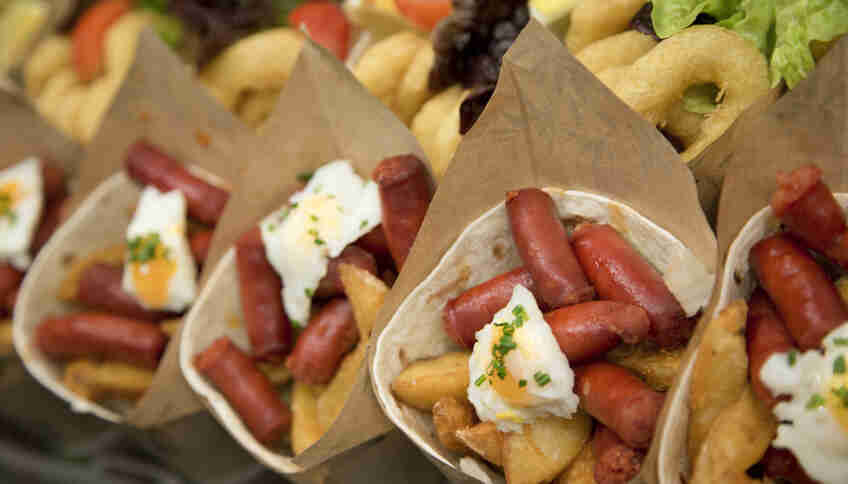
To start with, we recommend freshly sliced and already packed fruit. A fork is included. Right here you can also find freshly squeezed juices and cold shakes.

You can continue breakfast in one of the restaurants. Each of them has its own history, so we advise you first to stroll through the morning market, look over all its offerings, and only after that make your choice.

Bar Boqueria is famous for simple but hearty Spanish food. It is located deep inside the market and attracts mostly locals.
The first and surest sign of good cuisine.... (there should be a drum roll here) is the locals. Believe me, they know where breakfast is worth having!

Quioso Modern offers various seafood snacks. Here you have calamari rings, fresh shrimp, and lobster for breakfast.

Pinotxo Bar is located right at the entrance to the market. As a rule, there are many visitors here. Whether because of its proximity to the entrance or because of its delicious dishes based on fresh seafood.

Clemen's bar has been delighting its guests since 1969!

Breakfast at a market bar certainly does not rule out tasting the freshest ham. For those in a hurry, there is a takeaway option.
Well, are you already drooling? ;) And do you want to have breakfast at Boqueria every day? Just imagine: the freshest fruit and vegetables, aromatic ham and cheeses, divinely prepared seafood... Nothing could be easier, let us find you a hotel near Boqueria Market. No commissions, only quality search across hundreds of accommodation options in Barcelona!
And after a hearty breakfast, when you're full, it's the perfect time to go shopping! We highly recommend buying local cheeses and ham as gifts for your family and friends. By the way, the fattier the ham, the more expensive it is.


Where to go after breakfast? Strange question! Barcelona still has so much more to offer:
Pork Exhibitionism, and Where It All Came From
And finally, we want to tell you why Spaniards hang pork hams at all, and where the roots of this pork exhibitionism come from. The whole point is that in the Middle Ages a large Jewish community lived in Spain. In 1492 Isabella of Castile and Ferdinand of Aragon confronted the Jewish community with a difficult choice: either accept Christianity or leave the country. Some Jews converted, but continued to secretly observe Judaism. And so, in order to identify false believers, all Christians were required to hang pork hams in their homes. And, as you know, the consumption of pork is forbidden by Jewish religious law. Thus, all those who violated the royal order were discovered and accused of being false Christians.

At the end of your visit to La Boqueria Market, we advise you to stroll through the fish rows, between stalls with all kinds of sea creatures. Even though you will not be able to buy all this and take it home with you, these may be your best shots!


With that, we conclude our little gastronomic adventure and want to remind you about the Barcelona attractions map. It marks dozens of places no less interesting than Boqueria. Add them to your favorites, plan routes for several days, and go to Spain fully prepared!