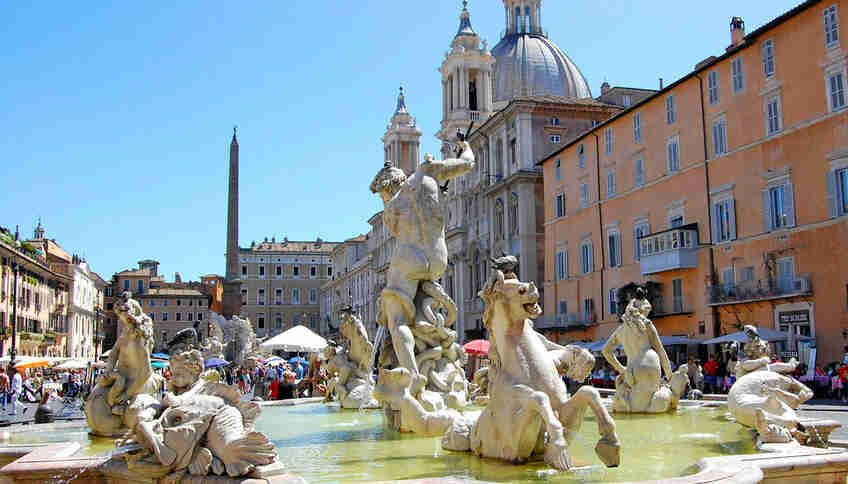

On the site of a former stadium today stands one of the most beautiful squares in Rome, where you can always find street performers of every kind.
Piazza Navona got its name from athletic contests. The very word “contest” in Greek sounds like “agona” (“agona” or “in agone”, then people started saying “n’agone”, and as a result it became “navone/navona”). And competitions took place here because there used to be a stadium on this very spot, built as far back as Julius Caesar. Even now, Piazza Navona has preserved its oval shape.
Athletic competitions gradually gave way to contests among merchants, who lured absent-minded customers away from one another, and later to the rivalry of two renowned sculptors. The confrontation between Giovanni Lorenzo Bernini and Francesco Borromini has become a true legend.
We help you plan a trip to Rome. Travel planner and guide for iPhone or Android. Hundreds of attractions, ready-made walking routes, the ability to create your own routes, an offline map, and GPS. Everything you need for an interesting trip.
In the 17th century, Bernini built the magnificent Fountain of the Four Rivers in Piazza Navona. At its center is a huge obelisk brought from Egypt, and around it are figures of men personifying the greatest rivers of the four continents: the Ganges, the Nile, the Danube, and the La Plata. Behind this fountain, at about the same time, the no less grand Church of Saint Agnes was erected, on which Borromini worked. It is said that he felt offended because the sculptures of Bernini’s fountain “turn away” from his church. At the same time, Bernini believed that Borromini had deliberately made the statue on the facade of the church so haughty, looking down condescendingly at his fountain. The sculpture is installed on the church facade, which is slightly concave inward, which is the architect’s signature style. This creates the impression that one of the figures of the fountain is stretching out a hand, wishing to support the “falling” church, while another turns away from it, covering its head with a veil so as not to look at Borromini’s architectural masterpiece.
This was not the end of the rivalry between the two masters; their next works also, as luck would have it, were located not far from one another, so the complaints continued. But it is worth noting that Rome only benefited from this confrontation!
Thank you! Every time you book hotels on Booking.com through our site, you help us describe one more place, create one more route, or develop one more city. Thank you for that!
banner booking
However, these are not the only attractions of Piazza Navona: there are also the Fountain of the Moor and the Fountain of Neptune, as well as the Church of Saint Mary. Three fountains in one square are not just architectural splendor, but also an urban necessity. Fountains help freshen and cool the air in the heat. There is a well-known case when the treasury ran out of money to maintain the city’s fountains, and Pope Innocent X announced an additional tax — for fountains. In response, the people of Rome shouted: “Pane, pane, non fontane!”, which translated means “Bread, bread, not fountains!”. Apparently, the money was found after all, since Rome’s most famous fountains remain in operation to this day.
Routes and guides for Rome:
- Guide to Rome
- What to See in Rome in One Day
- First Self-Guided Route in Rome: the Vatican and the Vatican Museums
- Second Self-Guided Route in Rome: Castel Sant'Angelo – Piazza Navona - Pantheon - Trevi Fountain
- Third Self-Guided Route in Rome: Colosseum — Roman Forums — Piazza Venezia — Trajan’s Column — Imperial Forums
- Fourth Self-Guided Route in Rome: Trastevere District
- Night Walk in Rome