
Flickr, TravelSmart2012
Before we begin our walk, we would like to remind you that this tour is part of our mobile application - a travel planner for iPhone or Android. By downloading it, you can not only use this route, offline maps, and GPS, but also fully plan your trip to Dubai. So, let's go!
The first secular school in Dubai began to be built more than 100 years ago, in 1912, with funds from Sheikh Ahmed bin Dalmuk. Unfortunately, the distinguished founder did not live to see its opening, and his son Mohammed, having finished construction, named the school after his father - Al Ahmadiya. This ancient educational institution is located in the center of the old city and is easy to find - any resident of Dubai will show you the way.
This school is a very important place for the Arab people. The best teachers from Iraq and Saudi Arabia once taught Arabic, literature, mathematics, and Quranic studies here. Education was free for all primary classes, the expenses were covered by Sheikh Mohammed bin Dalmuk himself, and only well-off senior students paid a symbolic fee.
The influence of Al Ahmadiya School on the development of science and culture in the UAE is enormous; it marked the beginning of the era of widespread secondary education in Dubai. Many graduates of the school became learned people and continued educational work in other regions of the Arab world.
Today the school has been restored and functions as a museum where you can see photographs, drawings, and the interior as it was over several decades.

Flickr, andlongoni
Dubai is notable not only for its epic skyscrapers and attributes of a beautiful life. There are places here that seem untouched since the last century, as if no oil had ever been found on the Arabian Peninsula.
One such urban district is Bastakiya, located between two old markets on the bank of Dubai Creek. Almost all of its buildings are historically authentic or restored with documentary accuracy, corresponding to the times when Iranian merchants came and settled here. It is even surprising that such a large district has remained untouched, given the very high cost of land in Dubai.
Nowadays, Bastakiya is a historical monument, one of the city's main tourist attractions. Here you can visit museums, wander through the narrow streets of old Dubai, visit souvenir shops, drink tea in a cafe, or have lunch in a restaurant. Be sure to notice the wind towers, innovative for the beginning of the 20th century, which served to ventilate and cool the lower floors of the houses.
We also recommend dropping by Bastakiya in the evening, when it gets dark and the buildings are illuminated from inside and out - it is a mesmerizing sight, as if stepped from the pages of Scheherazade's tales.
Do you like traveling on your own? Then download our travel planner for iPhone or Android. Something tells us you have not seen a more convenient trip planner yet ;) The ability to add places and ready-made walking routes to favorites, distribute them across several days of your trip, and share plans with friends. All of this is very easy, beautiful, convenient, and most importantly free!
Al Fahidi Fort

inaresort.com
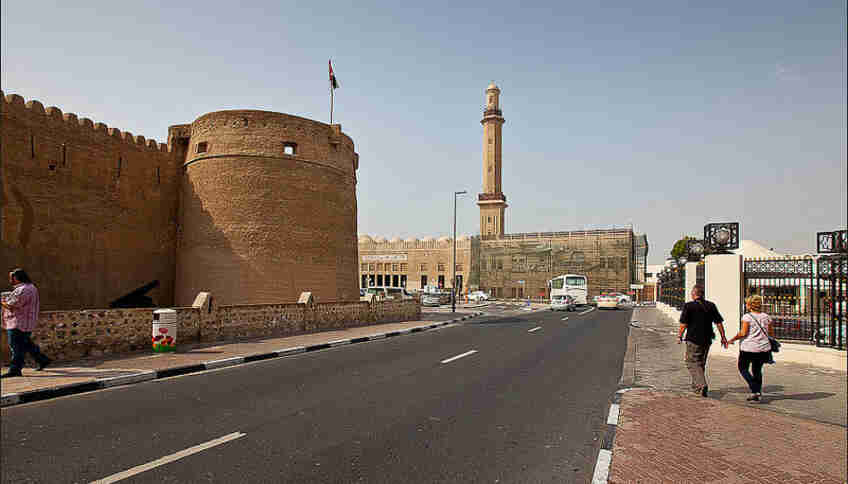
The large fort, built in 1878, is today the oldest building in Dubai. The fortress was erected as a defensive fortification with the functions of a state prison and military arsenal. The two round towers and fortress walls that have survived to this day were built on the site of an earlier 1799 castle, which for some time served as the residence of the sheikhs of Dubai. The fort's long history, large size, and good condition made it an ideal place for founding the Dubai Museum, which opened here in 1970.
The museum in Al Fahidi Fort is especially interesting because most of the exhibits are life-size: real boats of fishermen and pearl divers in the fort courtyard, full-scale dioramas in the museum halls, and antique household items, weapons, and clothing provide an excellent idea of life in Dubai in past centuries. Here you can see a reconstruction of the old Dubai bazaar, the homes of townspeople, and the houses of wealthy merchants in different eras. Particularly interesting are the exhibits devoted to the culture and way of life of the Bedouins - their dwellings, household utensils, clothing, musical instruments, and unusual crafts.
Each gallery has thematic musical accompaniment and an interactive screen where you can choose a film about life in an Arab bazaar, a Bedouin oasis, or a pearl divers' settlement.
See also other interesting routes around Dubai:

Алексей Наседкин
The Bur Dubai district today is a major international business center, but even in this oasis of modern life there is room for archaic traditions. Small abra boats are used as a means of getting around the Creek - nimble and fast water taxis, as if they came from the distant past.
At any time of day or night, you can visit the Bur Dubai piers and hire an abra to cross to the other side of the creek, take an excursion toward the sea, or to Al Maktoum Bridge, located deeper in the creek. There are many boat stations along the piers. Even by local standards this pleasure costs mere pennies, but the impressions from the boat ride will be more than abundant, because from the boat there are wonderful views of the coastal sights and historical monuments.
Having crossed to the other side of the creek, you can stroll through the city market, have lunch in a cafe, or buy souvenirs in the local shops. Do not miss the chance to visit the Gold Souk and the Spice Souk.
If you wish, by bargaining with the boatman, you can rent the entire boat and take a private excursion where no one will stop you from enjoying the local color.

Flickr, elsa11
Heritage Village is an open-air museum located on the bank of Dubai Creek in the Shindagha district. Opened in 1997, it is considered a very important historical attraction of the UAE, because its role is to show and preserve the ethnography and culture of the emirate of Dubai as they were 50 years ago, before the oil boom.
The museum looks like a village built in a traditional Eastern style. Here there are residential houses and craft workshops where you can watch potters, jewelers, and tinsmiths at work, and if you wish you can even take part in the process.
If you get hungry, bakeries are at your service, where you will be offered real Arabic flatbreads. To keep visitors entertained, performances by musicians and dancers are held in Heritage Village. Guests are also happily taken for camel rides.
As in an ordinary museum, here you can see various archaeological exhibits, some of which date back to the 15th-5th centuries BC.
They say that in the future the government plans to improve this place: expand the museum complex to the size of the entire Shindagha district, lay convenient pedestrian paths, and build a market and shopping complex.

bintnet.com
Admit it, we know very little about Arab women. Despite the fact that they played a significant role in the history of the country, they still remain a mystery to the whole world. However, in Dubai there is a place designed to lift the veil of mystery - the Women's Museum, the only one in the country and one of only four of its kind in the whole world.
The museum's founder, Rafia Obaid Ghubash, believes that it is wrong to perceive local women as an isolated community, because women in the Middle East have always been and remain socially active members of society.
This museum is located not far from the Gold Souk, in the Deira district, in a building once called the girls' house and intended for young unmarried girls. The collection is quite extensive; here you will see many exhibits telling about the everyday life of Arab women, items of clothing, traditional jewelry, as well as kitchen and household utensils.
Special attention in the exhibitions is paid to photographs and documents that Rafia Obaid Ghubash collected for more than five years. They show the influence women have had on the cultural and political life of the Arab Emirates, on the process of state formation, from long ago right up to our time.

Flickr, C0NTRAST
Arab spices are a story unto themselves, a story of the creation of cuisine, a story of world trade and immeasurable riches, a story almost 5 thousand years long. It was spices that formed the basis of trade relations between West and East, and they were valued at their weight in gold, often literally rather than figuratively.
To this day spices and seasonings are called the "Gold of the East," and you will find the biggest selection of these fragrant treasures at the Spice Souk in Dubai.
There is probably no seasoning that cannot be found in this enormous market: from the simplest and cheapest spices and herbs to unique and valuable seasonings such as saffron, orchid root, or black lemon. There are dozens of kinds of pepper here alone - from the mildest, like white and pink, to varieties of which a single speck can start a real fire on your taste buds.
The Spice Souk consists of narrow lanes filled with hundreds of stalls. Most often it is a family business, and the lively spice merchants continue the work of their grandfathers or great-grandfathers. They are ready to vividly tell you how to use one spice or another, while, of course, trying to fleece you nicely by naming a price several times higher than for locals. Do not forget that this is a real Eastern bazaar; bargaining is customary here, so do not be shy about driving the price down.
Nevertheless, we advise you to bring plenty of money before heading to the Spice Souk - you should definitely buy familiar seasonings, because they are of the highest quality here and differ dramatically from what we buy in our stores. And, of course, take along a few unusual spice blends that on cold winter evenings will remind you of your journey and give you true bliss of taste.

Алексей Наседкин
You cannot visit Dubai and not visit the largest gold market in the world! Nowhere else will you see such a quantity of jewelry made from every kind of this precious metal, not to mention that the prices here are among the lowest in the world.
The splendor and abundance of gold is simply shocking; it is as if you find yourself in the palace of King Midas, who turned everything around him to gold with a single touch. Gold sash belts, bracelets covering the whole forearm, enormous necklaces weighing several kilograms - all of this truly amazes the unspoiled European guest. The reason for the existence of such massive jewelry lies in the traditions of the Arab world, according to which a woman after a divorce can take from the house only what she is wearing. That is why Arab women constantly wear an unimaginable amount of gold on themselves - just in case.
But you should not think that such jewelry is beyond your means or not to your taste. Arabs are a very energetic people who love and respect trade, and they are constantly expanding the popular assortment. Nowadays the Gold Souk offers hundreds of thousands of pieces of jewelry for every taste and budget. Here you can buy jewelry at least 30% cheaper than anywhere else, and if you know how to bargain well, gold will cost you only slightly above the London exchange price.
The main thing when bargaining with Arabs is to stand your ground to the very end. From the start, name a price one third lower than what you are ready to pay for the item. The seller will insist on his price, gradually bringing it down, but you should stand your ground, slowly moving up to the price you have set for yourself. If your numbers stubbornly refuse to meet - walk away. Even if this seller does not run after you agreeing to your price (and most likely he will), you will easily bargain successfully in any other of the hundreds of gold stalls in this market.
Dubai Creek

Flickr, mycanvaspix
Dubai Creek became the source of life for the city: it was on its banks that the first settlements of pearl divers and fishermen arose, from which one of the most impressive metropolises later grew. With the development of trade in this part of the world, ships began to come into the creek, and around its ports and docks grew the city of wealthy merchants and shipowners.
Today Dubai's skyscrapers stretch along both sides of this natural sea inlet, which has already been widened and deepened several times to meet the needs of the growing city. At the point where the creek joins the Persian Gulf, its width is only 115 meters, and toward the end Dubai Creek widens to 1400 meters. At this point the Ras Al Khor lagoon is surrounded by a beautiful green park reserve where thousands of migratory birds live.
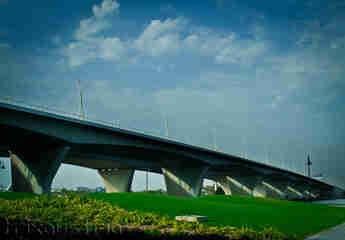
The creek is crossed by three bridges, and beneath it runs the Al Shindagha Tunnel. But the most interesting way to cross Dubai Creek is by abra water taxi, on which you can not only get from the Deira district to Bur Dubai, but also go for a ride along the picturesque creek. Gliding leisurely over the waves of Dubai Creek, you will be able to fully enjoy the magical views of fantastic skyscrapers, well-kept embankments, luxurious yachts, and retro boats darting across the creek. In addition to a sightseeing tour, you can also ride along the Dubai creek in a floating restaurant on a ship and enjoy the view of millions of lights of this special city with a delicious dinner and the splash of waves.
Other guides and walks around Dubai: