Mala Strana and Hradcany
Updated for 2026: Prague is as walkable as ever, but the historic center is busier than it used to be. Start early, book major interiors ahead when you can, and wear shoes you trust on cobblestones and steep uphill stretches.
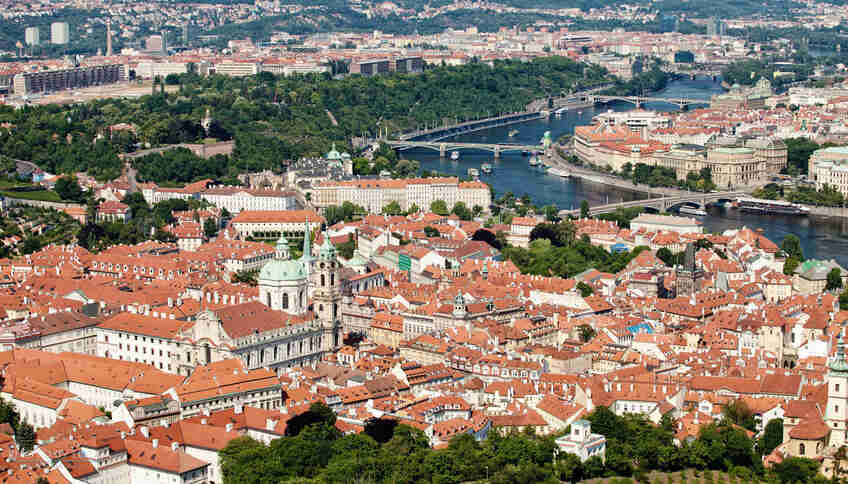
Mala Strana, Prague's Lesser Town, is one of the city's oldest and most atmospheric quarters. Set below Prague Castle and across the river from Old Town, it has held on to its distinct character: narrow lanes, Baroque and Renaissance facades, grand palaces, church domes, and pockets of gardens and parkland.
Find this self-guided walk through Mala Strana in the travel planner for iPhone and Android. Download it free to plan your Prague trip. This and other routes, hundreds of sights with photos and descriptions, offline maps, and GPS are available as soon as you install the app.

Flickr, Greg Headley
Settlement here dates back at least to the early Middle Ages. By the 12th century, a stone bridge already linked this side of Prague with the city center, helping Mala Strana grow into a busy quarter on an important trade route.
Mala Strana was repeatedly damaged by fire and war, and much of the district you see today took shape between the 16th and 18th centuries. For centuries it had a strong German-speaking community alongside Czech residents.
The area's highlights are its palaces, gardens, and churches - there are more palaces here than in any other part of Prague. If you have time, wander over to Kampa Island and climb Petrin Hill for one of the best views in the city.
If you still need a hotel, now is a good time to book one on booking.com. Every time you book hotels on Booking.com through our website, you help us create another guide, another route, or another city. Thank you!
Booking banner
This self-guided Prague walk takes you along the liveliest streets of Mala Strana and up to two historic shrines in Hradcany. It is a proper half-day route rather than a quick detour, so give yourself plenty of time.
If you still have the energy afterward, Prague Castle is a short walk from the last stop, Loreta. Still, we suggest giving the self-guided tour of Prague Castle a day of its own. There is too much to see there to rush it.
You can preview all the streets and sights on Prague's interactive map. Follow this route as it is, or add extra stops in our free travel planner for iPhone and Android.
We have crossed Charles Bridge and stepped onto the western bank of the Vltava. Our walk through Mala Strana begins.
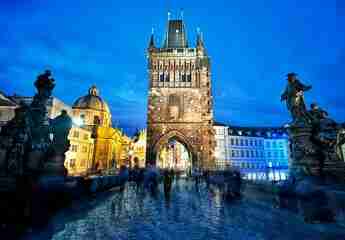
Charles Bridge links two of Prague's historic quarters: Stare Mesto (Old Town) and Mala Strana. That is why the towers at either end carry matching names: the Old Town Bridge Tower on the east side, and the two Lesser Town Bridge Towers on the west.

HONZAS55.RAJCE.IDNES.CZ
The shorter tower dates back to the 12th century. It began as part of the riverside defenses, later served as a prison, and from the 16th century to the late 18th century housed a customs office.
The taller tower was built in the mid-15th century, three centuries after its neighbor. Its design echoes the Old Town Bridge Tower more closely. Niches were prepared for statues of Czech kings, but the Hussite wars stopped those plans. Later it served as a warehouse and a signal tower. Today it has been fully restored and is open to visitors.
Once we pass through the towers, we step onto Mostecka Street, where our introduction to Prague's left bank really begins. A walk on this side of the bridge usually combines Mala Strana, Hradcany, and Prague Castle.
Mostecka Street leads straight to St. Nicholas Church and Lesser Town Square. On the way you can duck into one of the souvenir shops or stop by the Museum of Ghosts and Legends.
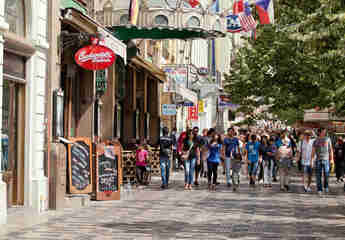
The name Mostecka has been used since 1911; before that the street was simply known as the road to the bridge. That makes sense: it runs from Charles Bridge to Lesser Town Square. For centuries this was one of Prague's busiest streets because the Royal Route passed through here. It is still crowded today, especially in high season.

Flickr, philrickerby
Many people come here for the souvenir shops. One after another, they line the street with marionettes, sweets, postcards, and every kind of Prague keepsake you can imagine.
Another fun detail: houses in the Czech lands were not officially numbered until the late 18th century, so buildings were identified by painted signs, reliefs, or sculptures instead. That is why you still spot hares, bears, ostriches, and other symbols on facades along Mostecka Street.
From Mostecka Street we turn right into Lesser Town Square, often considered one of the oldest settled parts of Prague.
Its dominant feature is the magnificent St. Nicholas Church, ringed by Liechtenstein, Kaiserstein, and Smiricky palaces.
St. Nicholas Church (Mala Strana)
The dome of St. Nicholas Church rises above the rooftops of Mala Strana. Built for the Jesuits between 1704 and 1755, the church was begun by Christoph Dientzenhofer and completed by his son Ignaz after the elder architect's death. It is widely considered one of Prague's great Baroque landmarks, inside and out.

Flickr, ChippyD
The bell tower, which seems to merge with the church's dome, was originally a separate civic structure rather than part of the church itself. From here town criers warned residents about fires and announced important news.
Inside, the church is a showcase of frescoes and mid-18th-century sculpture. Above the nave is the huge fresco "Apotheosis of St. Nicholas," among the largest of its kind in Europe. Sculptural groups by Ignaz Platzer depict saints and angels, and at the center of the altar stands a copper statue of St. Nicholas. In 1787, Mozart himself played the 4,000-pipe Baroque organ.
After visiting the church, we turn onto Nerudova Street and start climbing toward Strahov Monastery. Keep your camera handy: almost every facade here is worth a second look.
This street is named after the celebrated Czech writer and journalist Jan Neruda, who lived here from 1831 to 1894. He was born in the house "At the Two Suns" - not to be confused with the Nobel Prize-winning poet Pablo Neruda. Today the building bears a memorial emblem showing a young man with a shield and a Masonic triangle. According to local lore, the house got its unusual name because a single sun emblem was already taken, so the owner simply doubled it.
After his father's death, Jan moved to another house on the same street, "At the Three Black Eagles." It is now home to the "Neruda" Hotel. Nearby stands the house "At the White Swan," which looks almost like a palace: Baroque, nearly three centuries old, fronted by heavy wrought-iron doors and an oval emblem with a swan above them.

Flickr, jamretsam324
The artist Petr Brandl once lived in the house "At the Red Lion" and painted works for St. Margaret's Church and St. James's Church. After a late-20th-century renovation, the building reopened as a hotel of the same name.
Nearly every house on Nerudova Street has its own story, which is exactly why this stretch is so enjoyable to walk.
More walking tours in Prague:
Just to the right of Nerudova Street lies Prague Castle. Save this self-guided Prague Castle route for another day. You cannot come to Prague and skip the historic castle complex, the royal palaces, and St. Vitus Cathedral!
More ready-made Prague routes:
- Classic route: Walking route through Prague: Stare Mesto and the Jewish Quarter
- Mysticism and religion: Self-guided walk through the Jewish Quarter "Josefov"
- Only have one day in the Czech capital? Start with What to see in Prague in one day
Let's keep going: Nerudova Street flows into Uvoz, which brings us up into Hradcany. Continue uphill and follow Pogorelec Street. At the end, turn left and one of the Czech Republic's oldest monasteries comes into view.
Strahov Monastery
Strahov Monastery was founded in 1140 by the Premonstratensian order, and it remains a working monastery today. Over nearly nine centuries it was damaged by fire and war more than once, and in the 18th century it even faced closure. It survived in part because its extraordinary library was opened to the public.

Flickr, Tarakanov Dmitry
Along with its remarkable library - more than 200,000 volumes and around 3,000 manuscripts - the monastery also built up an important painting collection from the 18th century onward. Today it holds more than 1,500 paintings. The complex itself is impressive too, with frescoed halls, ornate stucco, and sculpture throughout.
Film crews noticed all this as well: the famous library has appeared on screen in movies including "Casino Royale" and "From Hell."
Strahov was once extremely wealthy, with vineyards, farmland, and a thriving trade in its own produce. Of those former holdings, the brewery is the best-known survivor today, and it is still a great place to stop for beer brewed in a long local tradition. Reserve ahead if you want a table.
After visiting the monastery, head back a short way along Pogorelec Street, but turn left before you reach Uvoz. Czernin Palace, now home to the Czech Ministry of Foreign Affairs, will be on your left. On the right is the final stop on our walk: Loreta.
Loreta
Prague Loreta is an architectural complex centered on a replica of the Holy House of the Virgin Mary, along with the Church of the Nativity of the Lord, a treasury, and a monastery. The Prague version of the house from Loreto in Italy was built in Hradcany in 1626 at the initiative of the noblewoman Benigna Katerina Lobkowicz. She funded the shrine and invited the Italian architect Giovanni Orsi. According to tradition, a few stones and timbers from the original house in Loreto were built into the Prague copy.
The Holy House quickly became a major pilgrimage destination, and more buildings grew up around it. In the 18th century, father and son Dientzenhofer redesigned the wider complex in the Baroque style.

Flickr, Vladimir Tylkin
Loreta is crowned by an elegant clock tower and belfry. Since 15 August 1695, a chime of 30 bells cast in Amsterdam has sounded across Prague each hour. Locals have long considered the music especially beautiful - and, in old tradition, even healing.
Loreta remains one of Prague's most important pilgrimage sites. Even if you are not coming for religious reasons, it is worth visiting for the architecture, the frescoes, the sculpture, and the treasury's remarkable church art in gold and precious stones from the 15th to 17th centuries.