
When it comes to architectural landmarks per square kilometer, Rome has long been in a league of its own. It is the kind of city where you can simply wander the streets, turn wherever your eyes lead you, get pleasantly lost, and suddenly find yourself in places that are wonderfully strange and fascinating.
We put together this route to include Rome's main sights in an order that lets you see them all in a single day. To be fair, you definitely will not have time to explore every stop in depth, but you will be able to tick them off your personal list of “I saw it with my own eyes.”
Of course, nothing stops you from breaking this route into several days of your trip. That is easy to do with our free mobile app – travel planner and guide for iPhone or Android.
Vatican
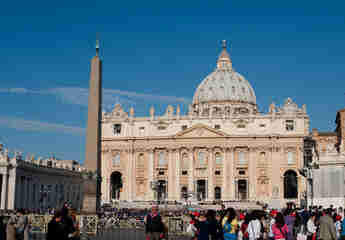
We will begin this one-day walk through Rome in Vatican City. As you probably know, it is the smallest state in the world. Its entire territory covers just 40 hectares – about the size of a golf course. Getting into the Vatican is both easy and impossible at the same time. Some of its sites, such as famous St. Peter's Basilica and Piazza San Pietro in front of it, are open to everyone. The moment you step onto the first stone of the square, you are already on Vatican territory. It is hard to imagine an easier border crossing :)

St. Peter's Square. Flickr, maxunterwegs.
Then there is the walled Vatican. Behind it lie the Pope's residence and the Vatican Museums – one of the greatest treasure houses in the world. This is also where the legendary Sistine Chapel is located. To visit the Vatican Museums properly, set aside a separate day from morning until evening, because they hold tens, if not hundreds, of thousands of celebrated works of art. Keep in mind that the queues here are usually enormous, and waiting can easily take two or three hours, so we strongly recommend buying tickets in advance.

Sistine Chapel. Flickr, ShivRamky.
Most of the Vatican is closed to tourists – nobody is going to let you casually stroll into the area where the Pope lives. Still, there is one loophole ;) On the official website you can book a tour of the Vatican Gardens. It is a rare chance to walk where the Pope himself takes his strolls. But again, this deserves a separate day, so let's return to what you can manage on a fast-paced sightseeing dash :)

Vatican Gardens. Flickr, R4all.
From Via della Conciliazione we step onto St. Peter's Square and approach the main church of the Vatican – and, really, of the entire Catholic world. It was built on the site where St. Peter was executed and where his tomb is believed to be. The largest church in the world took centuries to complete, and several great masters shaped its design and decoration, including Bramante, Raphael, Michelangelo, and Bernini.
This and other walks around Rome are part of our free mobile app – travel planner for iPhone and Android. Download it to use this tour, offline maps, and GPS – and to plan your entire trip to Rome.

St. Peter's Basilica. Flickr, R4all.
Be sure to visit this basilica, and if you want to know what to pay special attention to, use the audio guide to St. Peter's Basilica in the Ever.Travel mobile app. It costs several times less than the official one, by the way ;)

Interior of St. Peter's Basilica. Flickr, [~Bryan~].
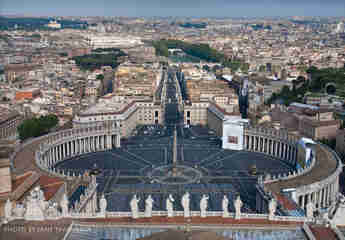
We also strongly recommend climbing up to the basilica dome. From here you get a breathtaking view of Piazza San Pietro, which seems to open its arms to embrace the faithful, as well as the whole Eternal City. From this height you will also spot the next landmark on our route.

View of St. Peter's Square from the basilica dome. Flickr, dacrous.
Everything you need to know before your first trip to Rome – helpful tips for independent travelers.
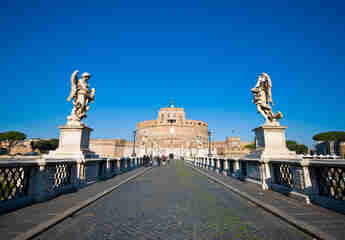
Castel Sant'Angelo is one of Rome's oldest structures, built by Emperor Hadrian back in the 2nd century. Surprisingly, the ruler erected it as his own tomb. Only later was the mausoleum rebuilt into a fortress and papal residence. At one time it even housed a prison. In all its history, only one prisoner is said to have escaped – the many-talented Benvenuto Cellini, artist, jeweler, sculptor, musician, and formidable fighter. Today the building is a museum.

Castel Sant'Angelo. Flickr, San Diego Shooter.
Castel Sant'Angelo got its name during the time when plague was raging across Europe. One day the Pope looked up and saw an angel above the castle. It was the Archangel Michael, giving a sign that the epidemic was coming to an end.
From Castel Sant'Angelo, the bridge of the same name crosses the Tiber. Interestingly, in Hadrian's time it was just an ordinary river crossing. It only gained its famous look in the 17th century, when Lorenzo Bernini added statues of Saints Peter and Paul and ten angels holding symbols of Christ's Passion.

Ponte Sant'Angelo. Photo by Evgenia Tsvankina.
Look closely and you will spot a spear, a crown of thorns, a cross, nails… The baroque angels are incredibly beautiful, and many tourists never stop to think that these sculptures are not only expressive but deeply symbolic as well.

Angels on the bridge. Photo by Evgenia Tsvankina.
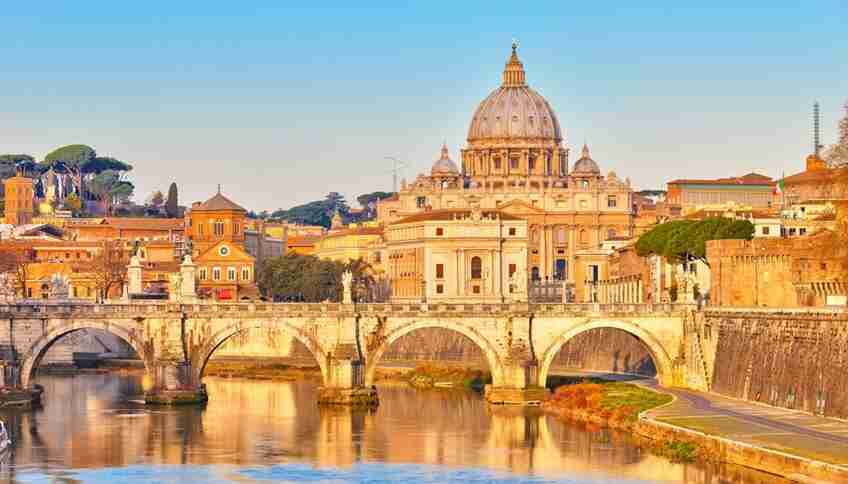
Cross Ponte Sant'Angelo to the other side of the Tiber, turn left, and continue along the embankment. At the next bridge, turn around and… one of the most famous and picturesque views in Rome will open before you.

View of St. Peter's Basilica. Flickr, Rome Cabs.
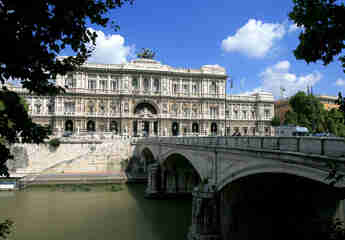
On the far side of the bridge stands what is arguably Rome's most controversial building in architectural terms – the Palace of Justice. Let's move closer and take a proper look.

Palace of Justice. Flickr, rbpdesigner.
Locals are not especially fond of this building and jokingly call it not a palazzo, but an overblown monstrosity. There is simply too much decoration piled onto it. People say the architect never intended such an overload of ornament, but during construction the money had to be written off somewhere. Sadly, corruption scandals followed the project through all twelve years it was being built. Ironic, considering this is the Palace of Justice and not some flashy casino.
By the way, on this side of the Tiber near the Vatican you can find a very good hotel at a reasonable price. And if uniqueness matters more to you than room rates, take a look at our travel expert Anatoly Selyaninov's article on five truly unforgettable hotels in Rome.
Church of the Sacred Heart

Church of the Sacred Heart. Flickr, attilio47.
We continue our walk along the opposite bank of the Tiber and come to a snow-white Gothic church that feels completely un-Roman. It was built in memory of souls believed to have gone to purgatory. Legend says a chapel once burned down on this spot. Only a few columns remained, and on one of them, amid the soot and scorch marks, people could make out the outline of a face – a sign, they believed, that a soul had entered purgatory.
Mausoleum of Augustus

Mausoleum of Augustus. Flickr, jrrosenberg.
We reach the nearest bridge and cross back over the river. Turning left and heading inland from the embankment, we pass several baroque churches and arrive at the Mausoleum of Augustus. Its shape recalls Castel Sant'Angelo a little, though it has survived in far worse condition. The founder of the Roman Empire built it as a tomb for himself and his family, and later other emperors were buried here too. But with the fall of the Empire, the mausoleum declined as well.
By the way, are you reading this after buying your tickets to Rome, or are you still just planning the trip? If those precious booking confirmations have not landed in your inbox yet, do not wait too long – the closer your travel dates, the more expensive flights become. Still, you can always check Aviasales to compare the best fares from dozens of airlines and agencies.
Piazza del Popolo
Next, along Via di Ripetta, we head for Piazza del Popolo – one of the most famous squares in the world. Remember the saying “All roads lead to Rome”? One of the most important of them was the Via Flaminia, and it ended right here. Hundreds of travelers from other cities entered Rome through this square and were instantly captivated by the Eternal City. Though not only by its beauty – for centuries public executions were held here as well. They were banned only in the 19th century, but the crowds have not disappeared.

Piazza del Popolo. Flickr, Simon Saint.
An Egyptian obelisk rises in the center of the square. It is 36 meters high, and hieroglyphs praising Ramses II and his deeds are carved into its pale stone. Yes, you understood that correctly – this obelisk predates the Roman Empire itself. You will come across Egyptian obelisks again and again in other parts of the Eternal City.

Obelisk in Piazza del Popolo. Flickr, Luigi R. Viggiano.
A fun detail for visitors from St. Petersburg: this very square helped inspire the architectural plan for the center of Russia's northern capital. The same can be said of many other European cities as well.
Villa Borghese
We have seen about a third of the route we planned, so we have every right to take a break :) If you climb the staircase leading up from Piazza del Popolo, you will arrive at Villa Borghese. This is a city park covering 80 hectares. On this vast territory you will find dozens of attractions, an art gallery with the Borghese family collection, the National Etruscan Museum, a modern art gallery, the Globe Theatre, the Pietro Canonica house museum, and a museum displaying the collection of the noted collector Carlo Bilotti. All of these sights deserve a separate day, but for now let us simply relax among the greenery, fountains, and graceful statues.

Villa Borghese. Flickr, Jonathan Martin Photographie
By the way, if after climbing up from Piazza del Popolo you turn right and walk along the edge of the park, a breathtaking panorama of Rome will open up before you. The same path will lead you to the next stop on our route.

Panorama from Viale Gabriele D'Annunzio. Flickr, never meant to see.
If you are staying in Rome for more than a day, we recommend trying a private guide. Exploring on your own is wonderful, of course, but only a professional guide will tell you the kind of stories you would never guess by yourself. We picked out three especially original tours for you:
- Night Segway tour of Rome – when the city winds down, it is the perfect time to glide comfortably through the capital.
- Baroque Rome – few cities in the world can match Rome for the sheer number of baroque landmarks. Enjoy the very best.
- Jewels of Tivoli – just 23 km from Rome you will find villas that inspired Versailles and Peterhof. It is absolutely worth seeing.
Trinita dei Monti Church
The two symmetrical towers of Trinita dei Monti are visible from afar. As you get closer, notice that there is another obelisk set on the small square in front of the church.

Trinita dei Monti Church. Flickr, rbpdesigner.
It is generally believed that Pope Sixtus V was the one who turned obelisks into deliberate elements of Rome's urban design. While reshaping the city's most famous central squares, he often ordered obelisks topped with crosses to be installed. They symbolized continuity between ancient pagan Rome and the new Christian city. They also served, in part, as wayfinding markers for pilgrims, highlighting important places to visit. Against the low-rise skyline of old Rome, these monuments could be seen from far away.
Trinita dei Monti was built more than 500 years ago. Over the centuries it has been rebuilt several times, yet it remains an impressive architectural monument. Inside are genuine works of art, the most famous of them being the sculptural group “Deposition from the Cross,” a masterpiece by Michelangelo's student Daniele da Volterra.

Daniele da Volterra's “Deposition from the Cross.” Flickr, Roma ieri, Roma oggi di Alvaro de Alvariis.
Spanish Steps
Leading down from Trinita dei Monti to the Spanish Steps is the famous Spanish Steps staircase. From above it does not look nearly as monumental as it does from below, so head down. You will also get a sense of just how iconic this place is – it has appeared in dozens of films. Every second tourist seems to feel obliged to eat gelato on these steps like Audrey Hepburn's heroine :)

Spanish Steps. Flickr, jackfre2.
At the foot of the steps lies a square with the Barcaccia Fountain. It is a boat frozen in stone in memory of events from 1598, when a major flood struck Rome and a boat ran aground right here in the square.

Barcaccia Fountain. Flickr, fguthrie.
From the Spanish Steps we continue along Via di Propaganda, cross Via del Tritone, and suddenly we are very close to Rome's most beautiful fountain. Built against the wall of Palazzo Poli, it is something majestic and truly grand.

Trevi Fountain. Flickr, Lopiccolo.
This is an entire sculptural composition with Neptune commanding his sea chariot at the center. Every self-respecting tourist has to visit the Trevi Fountain at least once. Getting a photo without someone else's arms and legs in the frame can be a challenge, though – there are always crowds. The fountain is especially beautiful in the evening and at night, when the city slips into twilight and the colored lights come on. And do not forget to toss a couple of coins over your left shoulder – you do want to come back someday, right?

Fontana di Trevi. Flickr, Daniel Peckham.
The next stop on our one-day walk through Rome is the ancient Roman temple dedicated to all the gods. To get there, stand facing the Trevi Fountain, turn left, and simply keep walking straight ahead.
The Pantheon was built as early as AD 126 under Emperor Hadrian. From the outside it looks magnificently grand, with massive columns towering several times higher than a person.

Pantheon. Flickr, Fab05.
Inside, it feels even more awe-inspiring: the enormous dome is mesmerizing. At the very top is an opening – the oculus. Through it the light enters the temple, or rather a sharply defined, almost tangible column of light. There are no other windows, but that does not make the interior dark at all – instead it creates a unique atmosphere. And in winter, when snowflakes begin to fall through the 9-meter oculus, it feels as if nature itself is performing a little magic.

The Pantheon oculus. Flickr, Matt Franks Photography.
By the way, the Pantheon contains the tombs of several famous Italians, including Raphael, King Victor Emmanuel II, and his son Umberto I. After seeing them, we continue on to Piazza Navona, just three blocks west of here.
It is believed that Piazza Navona took its name from the Greek word for “contests,” which were held here in ancient Rome. Notice the square's elongated oval shape – that is no accident. Competitions and performances really did take place here, much like in the Colosseum, only on a smaller scale. Later the games were banned, the site stood empty, and in the Middle Ages houses began to rise around the remains of the stadium, gradually forming a new city square.

Piazza Navona. Flickr, TOBI_2008.
Three fountains were built here at different times, the most remarkable being the central one – the Fountain of the Four Rivers. It was commissioned from the great baroque architect Lorenzo Bernini, while the church of Sant'Agnese opposite it was built by Francesco Borromini. Few people realize how fiercely the two architects rivaled one another – their feud kept all Rome gossiping.

Fountain of the Four Rivers and Sant'Agnese Church. Flickr, LizAlonso.
We tell this story in more detail in the audio walk “From Castel Sant'Angelo to the Pantheon”, which you can find in the Ever.Travel mobile app. When you are standing at these three landmarks, you can play the relevant track whenever you like.

Piazza Navona. Flickr, Alan Dreamworks.
Today Piazza Navona is interesting not so much for the baroque intrigue between two genius architects as for its many artists, street performers, and easy-going strolling atmosphere.
Torre Argentina Square (Area Sacra)
From Piazza Navona we head out onto Corso del Rinascimento, turn right, then left onto Via Vittorio Emanuele II, which leads us to the remains of ancient temples known as Area Sacra.

Area Sacra. Flickr, mclarenjk.
At Torre Argentina Square you will see something unusual: right in the middle of the noisy modern city stand ruins with fragments of columns and flights of stairs. Cats rule this area now, but once four splendid temples stood here. Scholars still do not know their exact purpose, so they are simply called Temples A, B, C, and D. One theory suggests that one of them was a “temple of a lucky day.” Apparently that was once a thing too: stop by in the morning, ask the gods for luck, and get on with your day.

Torre Argentina Square. Flickr, Pantchoa.
But this place is famous for another historical fact: in 44 BC Julius Caesar was killed here during a Senate session. The conspirators stabbed him 23 times. They say Caesar had been warned about the plot, but he preferred “to die once rather than live forever in fear of death.”
Next, continue the walk along Via del Plebiscito, passing the Church of the Gesu and Palazzo Venezia to reach the square of the same name. Here stands the grand white Vittoriano monument, dedicated to Victor Emmanuel II, the first king of unified Italy.

Altare della Patria. Flickr, jeff_a_goldberg.
This monument is also known as the Altare della Patria, or Altar of the Fatherland, but Romans are not especially fond of it and have given it nicknames like “the typewriter” and “the wedding cake.” Architecturally, the Vittoriano is overloaded with details – columns, reliefs, statues, and more. To Romans it feels excessive, pure eclecticism. Visitors, however, are usually deeply impressed by it.

Vittoriano. Flickr, Seanbmurphy.
At the front of the monument stands a striking statue of King Victor Emmanuel II on horseback. Beneath it lies the Tomb of the Unknown Soldier.
Trajan's Forum
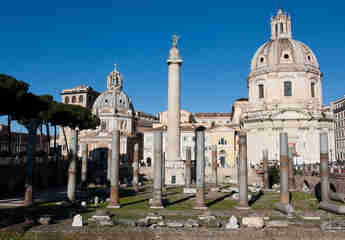
If you walk around the Vittoriano on the left, you will see ancient Roman ruins. This is Trajan's Forum, once home to a market, basilica, libraries, public and political debates, and displays of war trophies brought back to the city.

Trajan's Forum. Photo by Alina Kovalevich.
As is well known, under Emperor Trajan the Roman Empire reached its greatest territorial extent. He was the first emperor from the provinces. The historian Cassius Dio described him as a just, brave man with simple habits: “Trajan was with the people not only in hunting and feasts but also in their labors and intentions… He liked to enter the homes of citizens freely, sometimes without guards. He lacked formal education in the strict sense, but in essence he knew and could do a great many things. I know, of course, of his fondness for boys and wine. But had he committed base or immoral acts because of these weaknesses, he would have been widely condemned. Yet it is known that he drank as much as he wished while keeping a clear mind, and in his relations with boys he harmed no one.”
This is the heart of ancient Rome. All public life once flowed through this place: new laws were passed, consuls were elected, and victors were celebrated. It lies just across the road from Trajan's Forum. If you are staying longer in the Italian capital, make sure to set aside time for a walk through the Roman Forum. It is incredibly fascinating, especially if you turn on the audio guide in the Ever.Travel app. With it, all these ruins seem to come alive and turn back into majestic temples and basilicas.

Roman Forum. WIKIMEDIA.ORG, STEFAN BAUER.
On a one-day walk through Rome, we can stroll along Via dei Fori Imperiali and view the Roman Forum from behind the fence. From here one of Rome's greatest landmarks is already visible – the mighty Colosseum. But it was not always like this. The road you follow along the Roman Forum was laid out in the 1920s on Benito Mussolini's orders and according to his plan. To build it, part of the ancient forums had to be demolished without long, careful archaeological research. In this way, part of the priceless history of the Roman Empire was buried beneath cobblestones and asphalt.
And there it is before us. The Colosseum arena was built on the site of an artificial lake created for Emperor Nero. He was so hated by the people of Rome that after his death his Golden House and lake fell into ruin. A more politically savvy emperor, Vespasian, decided to win the Romans' affection by gifting the city an amphitheater on the very spot where the despised Nero had once lived.

Colosseum. Shutterstock.
At first the Colosseum hosted entertainment, bloody combats, and animal hunts, but in the Middle Ages the amphitheater stood empty. Some especially enterprising popes did not hesitate to take building materials from its facades for their own projects, and the Colosseum was nearly dismantled piece by piece. The same almost happened to the Roman Forum and the Imperial Forums. Only thanks to later popes who took history more seriously have these monuments survived to the present day.

The Colosseum arena. Photo by Evgenia Tsvankina.
There are usually enormous lines for the Colosseum, so it is best to dedicate a separate day to visiting it as well. We also recommend buying tickets in advance. Keep in mind that the Colosseum ticket is a combined one – it also includes entry to the Roman Forum and the Palatine.

View from the Colosseum toward the Arch of Constantine and the Palatine. Photo by Evgenia Tsvankina.
Do not forget to download the audio guide to the Colosseum in the Ever.Travel mobile app. It costs several times less than the official one and tells you not only about the famous Flavian Amphitheater but also about the nearby Arch of Constantine.
Palatine Hill
Just two steps from the Colosseum lies the oldest architectural complex in Rome – the place where the history of the Eternal City is said to have begun. This is the Palatine, a vast hill usually visited together with the Roman Forum. On a one-day walk we will only see it from behind the fence, but if you can, do come back here on one of the following days of your trip.

Palatine Hill. Flickr, jch96.
According to legend, it was on this hill that Romulus and Remus encountered the she-wolf who took them in and fed them with her milk. Historians say that ruins believed to be the House of Romulus have even survived on the Palatine to this day.

Domitian Stadium. Flickr, isriya.
Over the centuries, the Palatine Hill held the huts of the earliest Italic peoples, imperial residences, luxurious palaces, and temples. Today all of it has become ruins surrounded by picturesque gardens, but seeing them with your own eyes is absolutely worth it.
Circus Maximus
After passing the Palatine, you will find another ancient structure on your right – Circus Maximus. You will immediately realize that the ancient Romans meant something rather different by “circus” than we do today. For them it was essentially a giant racetrack where chariot races were held. Up to twelve charioteers could compete at once for the title of the best. And the VIPs watched from specially arranged boxes, some of which archaeologists discovered only relatively recently.

Circus Maximus. Wikimedia.org, AlfvanBeem.
Today this vast open space often hosts large public events, mostly rock concerts.
Santa Maria in Cosmedin
After crossing Circus Maximus, you will come to Santa Maria in Cosmedin. It was built in the 6th century on the site of an ancient temple dedicated to Hercules. Behind the basilica's restrained facade hides a richly decorated interior with a mosaic floor, a Gothic altar, and antique candelabras.

Basilica of Santa Maria in Cosmedin. Flickr, yapingq.
What draws the biggest crowds, however, is the round marble mask known as the Mouth of Truth. Legend says a deity lives inside it and reacts sharply to lies. In the Middle Ages it was used as a lie detector: a person would place a hand into the mask's mouth and answer a question. If they lied, the hand would supposedly be bitten off at once. Incidentally, criminals were often executed right there on the patch of ground beside the church.

Bocca della Verita. Flickr, yapingq.
This place became truly famous after its appearance in “Roman Holiday,” and today there is traditionally a long line of tourists waiting for their turn at the Mouth of Truth.
Tiber Island
To finish our one-day walk through Rome, let's head down to the embankment and visit Tiber Island, which you can reach by one of the city's oldest crossings – Ponte Fabricio, built in 62 BC.

Ponte Fabricio. Flickr, Jocelyn777.
Tiber Island is wrapped in legends from its stone base to the top of the bell tower of San Bartolomeo. People once believed it had formed from the silt and mud that clung to the body of a tyrannical ruler thrown into the river. Scientists have long since proved the island's volcanic origin, of course, but the older story is far more entertaining, isn't it? ;)

Tiber Island. Flickr, Sebastian Niedlich (Grabthar).
Tiber Island has surprisingly clear outlines that, from above, resemble the silhouette of a boat. This is not a natural accident but a human-made form, created in memory of the boat that came ashore here during a plague epidemic. To everyone's amazement, a snake crawled out of it – the well-known symbol of Asclepius, god of healing. In 293 BC a sanctuary to this god was built on the island, and only after that did people agree to live here.

View of Tiber Island from the Palatine Bridge. Flickr, Snuffy.
Today the island is a lovely place not only to wander among ancient buildings, but also to buy souvenirs, sample local food, and even watch an open-air film. We'll leave you here to enjoy exactly that. Our one-day walk through Rome has been wonderfully full, and we hope it has been both useful and enjoyable.
Just a reminder: you can not only print this guide, but also map out the route yourself in our free mobile app – travel planner for iPhone and Android. Download it to use this tour, offline maps, and GPS – and to plan your entire trip to Rome. Explore Rome smartly and with pleasure!
See also our other guides to Rome: