
Flickr, RIFson
We suggest beginning this walk beside the largest and perhaps the most beautiful church in Budapest. It took more than half a century to build and was only completed in 1905. Several architects worked on it over the years, but the hardest task fell to Miklos Ybl: he took over the project in 1868, when the dome had collapsed. The design had to be reworked and the dome rebuilt from scratch.
After years of painstaking work, Hungary's capital received a magnificent basilica 96 meters high. There is no taller building in Budapest – only one equal in height, the Parliament. People say the number 96 is no coincidence: it recalls 896, the year the first Magyar tribes arrived on this land.
Since the church is one of the two tallest buildings in Budapest, it made perfect sense to place an observation deck on top. You can take the elevator up. The views over the city from this height are truly breathtaking.
Organ concerts are often held here in the evenings. Unlike many other Catholic churches, the singing is accompanied by the organ. The effect is so powerful it gives you goosebumps.
The basilica's main treasure is the Holy Right Hand – the mummified right hand of King Stephen, to whom the church is dedicated. It is kept in a gilded reliquary, and many visitors come to venerate it. Once a year, on August 20, St. Stephen's Day, the relic is carried out of the church and solemnly taken through the city streets.
Want more ideas for what to see in Budapest? Use the interactive city map, choose the places you'd like to visit, and simply add them to your favorites, spreading them across several days of your trip. It's easy and convenient. Here's to exploring Budapest on your own!

Flickr, Istvan
Next, let's make a small detour and head a couple of blocks away from the Danube to see the truly magnificent building of the Hungarian State Opera House.
In earlier times it was known as the Royal Opera House, since it was built in 1884 under Austro-Hungarian king Franz Joseph. Local aristocrats gathered here, and opera performances were conducted by outstanding composers such as Giacomo Puccini.
Today the Hungarian Opera House is said to have one of the three best acoustics in the world, after Milan's La Scala and the Paris Opera. Its horseshoe-shaped auditorium lets sound travel beautifully to all 1,260 seats. The chairs are upholstered in crimson velvet, gilded mirrors hang in the boxes, and above the audience rises a gorgeous dome painted by talented 19th-century artists.
Before entering the hall, guests climb a sumptuous marble staircase lined with statues, busts, and paintings. In such lavish surroundings it is easy to imagine yourself an aristocrat, although most locals no longer feel the need to dress in formal eveningwear. Many come in everyday clothes, so Russian tourists in furs and diamonds stand out immediately.
The facade is designed in the Neo-Renaissance style and richly decorated with Baroque elements. Sculptures of renowned Hungarian composers Franz Liszt and Ferenc Erkel greet visitors at the entrance. Erkel, by the way, was the first director of this theatre. Over his lifetime he wrote numerous choral works, piano pieces, and the Hungarian national anthem.
You can also find this route in the free Ever.Travel mobile app. Walking Budapest with it is genuinely great! You can download the guide for offline use, so you won't waste mobile data while roaming. At the same time, GPS will always show your location on the map. And unlike traditional paper guidebooks and maps, a mobile guide doesn't add a single extra gram to your luggage ;)

penziranytu.mnb.hu
Continuing to explore Budapest attractions, we come out onto Liberty Square, home to three magnificent buildings: Hungarian Television and Radio, the U.S. Embassy, and the country's National Bank. In the center of the square stands a monument to Soviet soldiers.
Notably, the buildings of the Hungarian National Bank and the Radio building, which once housed the Stock Exchange, were designed by the same architect – Ignac Alpar. These are considered among his finest works. In the bank's facade he used Greco-Roman and ancient Eastern elements. Massive columns, bas-reliefs, and statues perfectly emphasize the solidity and scale of the building.
What other architects dismissed as overly ornate, bankers and economists took as a sign of respect for their profession. As a result, Ignac Alpar was later entrusted with many other financial institutions. He had managed to create a building that met security standards and was beautiful at the same time.
In 2005, the Hungarian National Bank issued a commemorative coin marking the 150th anniversary of Ignac Alpar's birth. It is made of silver and has a face value of 5,000 forints.
See also other Budapest guides:

Flickr, Stockton Andrew
Another splendid building on Liberty Square is one of architect Odon Lechner's best-known masterpieces – the Postal Savings Bank. Its walls are adorned with golden majolica, and its roof is covered in emerald-colored tiles.
Whimsical forms, colorful tiles, glazed brick – all this has long been a hallmark of Hungarian Art Nouveau. In essence, it echoes the period when Budapest was occupied by the Turks for nearly 150 years, and has now become one of the city's calling cards.
The bank building looks wonderfully festive. The only pity is that you can't fully appreciate the roof from street level. The architect truly did a marvelous job – flowers, angel wings, a dragon's tail, and images of bees create a genuinely fairy-tale impression. The bee, by the way, was the symbol of the postal savings bank: people brought their money here just as bees gather honey. And if you look at the roof from above, you can see bees crawling toward the honeycomb.
When the architect of the Postal Bank was asked why he created so many decorations for a roof hardly anyone sees, Lechner answered that birds also deserve beauty.
Whether the original interiors have survived is unknown. But judging from the old photographs preserved in the archives, the building used to look every bit as lavish inside as it does outside.
Besides that, it's worth seeing:

Flickr, Eiji Kudo
Have you ever wondered what a building would look like if a different design had won the competition many years ago? In Budapest, you have a unique chance to find out!
Head to Lajos Kossuth Square, where the Hungarian Parliament stands, and you'll see another building created from the design of Alajos Hauszmann. He did not win the Parliament competition, but he still brought his idea to life by building the Palace of Justice – the very building whose pediment is crowned by a statue of Themis driving a chariot with three horses. Today it houses the Hungarian Ethnographic Museum. It is considered one of the largest in Europe, with more than 200,000 exhibits.
The museum halls host several exhibitions, two of them permanent: one tells the story of Hungarian culture and traditions, while the other explores Hungarian life from prehistoric times to the dawn of civilization. The museum also presents the everyday life of other peoples and continents, including Asia, Africa, America, and even Australia.
To better understand what many of the objects were used for – and to hear engaging stories about Hungarian life – it's best to use the services of a local guide. They will explain the traditions of hunting, fishing, leisure, and entertainment in detail.

Shutterstock
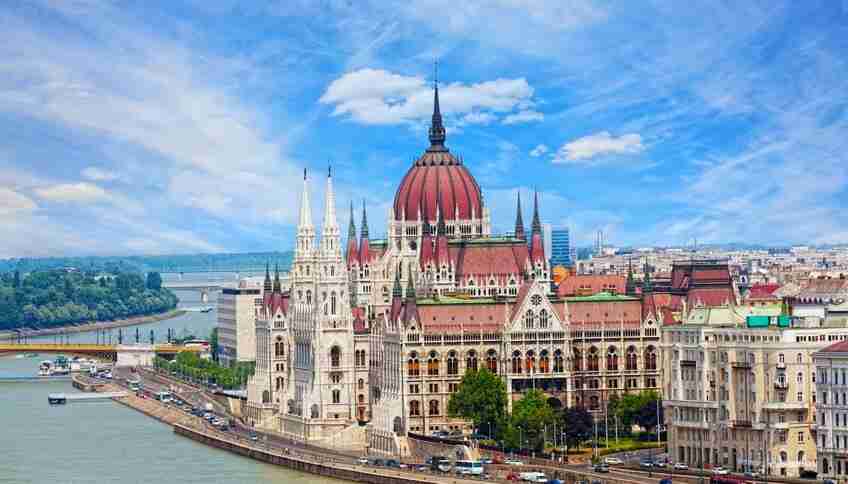
The largest building in Hungary stands on the bank of the longest river in Western Europe. This unique architectural complex was built over the course of two decades and is rightfully considered Budapest's main attraction.
Of course, we're talking about the famous Hungarian Parliament Building, constructed at the turn of the 19th and 20th centuries. Its architect, Imre Steindl, sadly never saw his creation completed. No, he did not die – by then he had simply lost his eyesight.
The plan was to complete the building by 1896, in time for the 1,000th anniversary of the Hungarian conquest of the homeland, but by then only the domed hall had been finished. The project was not fully completed until 1904. The building turned out so enormous that it includes around 700 rooms, nearly thirty staircases, and 10 (!) inner courtyards.
Guided tours of the Parliament Building in Budapest are offered daily, including in Russian. There is truly plenty to see: paintings, statues, lavish interiors, and above all the Holy Crown of St. Stephen – the symbol of Hungarian statehood. Fifty-five kings of Hungary wore this relic. Alongside it are kept the other regalia: the scepter, orb, and sword. Read more in the engaging story by Galina and Alexey Smirnov...
Interesting options for those heading to Budapest:
- A romantic dinner cruise on the Danube
- Budapest Card – an unlimited travel pass and 10-50% discounts on museums, baths, shops, and restaurants
- Private tours of Budapest

Flickr, Kachle
After seeing the Hungarian Parliament from the outside, and with a bit of luck from the inside, let's continue along the Danube embankment. On the way we'll encounter the profoundly moving Holocaust Memorial.
Right on the riverbank stand 60 pairs of shoes cast in iron: children's boots, women's shoes, men's footwear. These symbolize how, in 1944–1945 during World War II, fascists shot Jews on the banks of the Danube in groups of 50 to 60 people. As the story goes, to save bullets only one was used for the whole chain: the prisoners were tied together with barbed wire, and the first person was shot, falling into the Danube and dragging the others with them. According to existing information, around 10,000 people were killed here before Soviet troops entered the city.
Those sentenced to death were also forced to remove their shoes – again because of German thrift, so the footwear could later be given to someone else.
This memorial on the Danube embankment was unveiled in 2005, on the eve of the sixtieth anniversary of victory in World War II – April 16, the International Day of Commemoration for Holocaust Victims.
It is worth noting that several other places connected with the history of Budapest's Jews are located nearby. You may also want to visit the Great Synagogue – the largest in Europe and the second largest in the world, the Holocaust Memorial Center, whose halls contain photos and video evidence of the genocide of the Jews, the Jewish Museum, which stands on the site of the house where Theodor Herzl was born – the founder of the Jewish state and of the World Zionist Organization – or Raoul Wallenberg Memorial Park, named after the Swedish diplomat who saved tens of thousands of Hungarian Jews. If you want to explore this subject more deeply, we recommend taking a guided tour of Jewish Budapest with a professional guide.

Flickr, twiga_swala
We continue our walk along the embankment and soon come to a beautiful historic building that could easily be mistaken for a theater or museum. In fact, it is Hungary's highest scientific institution! Alongside its official offices, it houses a large concert hall, conference rooms, and a library containing valuable scholarly works.
The facades are decorated with numerous sculptures symbolizing different branches of knowledge. Above the main entrance, for example, stand statues dedicated to mathematics, natural science, history, law, philosophy, and linguistics. On the second facade facing the Danube are allegorical figures representing archaeology, poetry, and astronomy.
Figures also stand at the building's corners – statues of famous scholars. One of them is dedicated to Rene Descartes, the French mathematician, physicist, and natural philosopher. The sculptors were Emil Wolf and Miklos Izso.
If you manage to get inside the Academy, look at the paintings in the ceremonial hall. They were created by Hungarian artist Karoly Lotz, who also painted the walls of Tihany Abbey. His works can also be seen in the Hungarian Parliament Building, the Ethnographic Museum, the Museum of Applied Arts, the Opera House, and many other notable sites in Budapest.

Flickr, archer10 (Dennis)
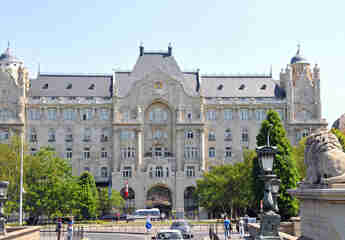
Only about a hundred meters separate the Academy of Sciences from Gresham Palace, built especially for Sir Thomas Gresham, the founder of the London Stock Exchange. The building was highly fashionable for its time and stood out even among Budapest's attractions. Its style can be described as Secession. There are only a handful of such buildings in the Hungarian capital. Today it houses a Four Seasons hotel. To their credit, the current owners have carefully preserved both the palace architecture and its interiors.
The windows of Gresham Palace look onto the historic bridge linking the two banks of the Danube. In the evening the palace is lit by hundreds of lights, giving it a beautiful pearly gray glow. Above the main entrance rises a bas-relief of Thomas Gresham.
Once inside, the first thing you notice is the elegant wrought-iron gate decorated with a bird resembling a peacock – one of the hallmark symbols of Secession. A few steps farther and a stunning glass dome opens above your head – an engineering marvel from the last century. The floor laid with white ceramic tiles has miraculously survived since the palace was built. Staircases with ornate cast-iron railings lead to equally remarkable apartments you can wander through as if you were in a museum.

Flickr, Guillaume Speurt
Our walk along the Danube continues, and soon we arrive at Vigado concert hall. In the past, balls and masquerades were held here, which is why it was once called the Redoute – from the German word for "dance hall." Let your imagination run free and you can almost see elegantly dressed ladies and masked gentlemen stepping outside for a breath of air after dancing. And one mischievous little girl in a jester's cap has even climbed onto the embankment railing and is surely plotting her next prank. We're talking about the Little Princess sculpture – beloved by locals and tourists alike.
Vigado Hall was built on the site of an earlier ballroom that was burned during the uprising against the Habsburg dynasty. The best architects, sculptors, and painters were invited to create it. Thanks to them, we can still admire the magnificent facade, graceful sculptures, and beautiful frescoes decorating the central vestibule. It is no surprise that Vigado is considered one of the most beautiful buildings in Budapest. And at night, when the lights come on, even passersby stop in awe.
At moments like this, only music seems to be missing! The stage of Vigado once heard composers such as Brahms, Liszt, and Wagner. These days concerts are less frequent; the hall is used mostly for contemporary art exhibitions, ceremonies, presentations, and award events.

Flickr, Alex Segre
Skirting the Vigado concert hall, we come to Vaci Street, which Russian-speaking tourists jokingly pronounce as "Vasya Street" (in Hungarian, Vaci utca). But there is nothing ordinary about it: this is where you'll find the city's most elegant buildings, expensive boutiques, luxurious restaurants, and cafes. For generations it was the favorite place for a promenade, and today it is the city's main shopping street.
It begins at Vorosmarty Square, home to the famous Gerbeaud Cafe, and ends at Fovam Square near the market. If you look at the map, you'll see that it runs parallel to the Danube just 200 meters away. These landmarks help you avoid confusing it with another street of a similar name – Vaci ut.
Alongside flagship boutiques of famous brands, Vaci Street also has shops selling unique folk crafts, as well as grocery stores filled with delicacies. And if you want to see what the old city looked like, head down into the underpass, where posters with vintage photographs of Budapest are sold.
Many people remember their walks along Vaci Street with nostalgia and speak about its special atmosphere. And it wasn't just tourists who noticed it: the jury of a competition for Europe's best pedestrian street did too. When the ranking was calculated in 2008, Vaci utca came ahead of streets in Milan, Paris, and Amsterdam!

Flickr, Tai Pan of HK
If you walk just one block farther along Váci Street and then turn back toward the Danube, you'll see one of the few Orthodox churches preserved in largely Catholic Hungary. Services in Church Slavonic can still be heard here every day.
The cathedral was built in 1801, and most of its icons have survived since the 19th century. One of the most venerated is the Bezdin Icon of the Mother of God, said to have been painted in Kyiv many centuries ago. The church also keeps relics of Saint King Stephen and Saint Moses the Hungarian, whose icons stand side by side – although, according to tradition, Moses became a hermit far from Hungary, at the Kyiv Pechersk Lavra.
Many parishioners and visitors to the Assumption Cathedral have no idea that fierce legal battles have unfolded around it. The church stands on land bought by Greeks back in the 18th century, and services were originally held here in Greek. But the cathedral was badly damaged during World War II, and its clergy asked the Moscow Patriarchate to take it under its care. Permission was granted, and the Assumption Cathedral in Budapest passed fully under the jurisdiction of the Russian Orthodox Church's Moscow Patriarchate.
At the beginning of the 21st century, however, the Patriarchate of Constantinople tried to reclaim it. Court after court rejected the claims, but the Greek community continues to raise the issue again and again.

BRODYAGA.COM
Next, head back to Váci Street and stroll along it at an easy pace until you reach the Központi Vásárcsarnok market hall.
This is not just a market – it is a market among markets. Pardon the phrase, but it really is incredibly beautiful. Its unusual architecture makes it look like a storybook palace, with red-brick patterns, ornate roof tiles, towers, and huge arched windows. The impression it leaves is unforgettable.
It is not only the largest covered city market, but also the first one built on such a grand scale. The building went up in 1897 by order of the city's first mayor, Károly Kamermayer. Remarkably, in all these years the Central Market Hall has never changed its purpose: from the beginning it has served purely as a place of trade, even though it looks grand enough to be a museum or gallery.
Inside there are two main floors and one underground level, where perishable goods were once stored like in a cellar. Today you'll find household items, food, souvenirs, and much more sold throughout the market. There are even a couple of cafés here.
While walking along Váci Street, make sure to step inside this market. In the blend of aromas, colors, goods, and vendors' calls, you can feel the city's rhythm and soul better than almost anywhere else. Even if you don't plan to buy anything, simply wandering through the aisles is a special pleasure.
This brings our route along the eastern bank of the Danube to an end, but Budapest still has plenty more to offer. Use the map of Budapest attractions and you're sure to find at least another dozen places worth visiting!