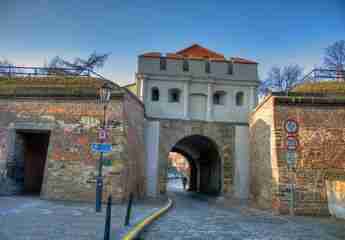
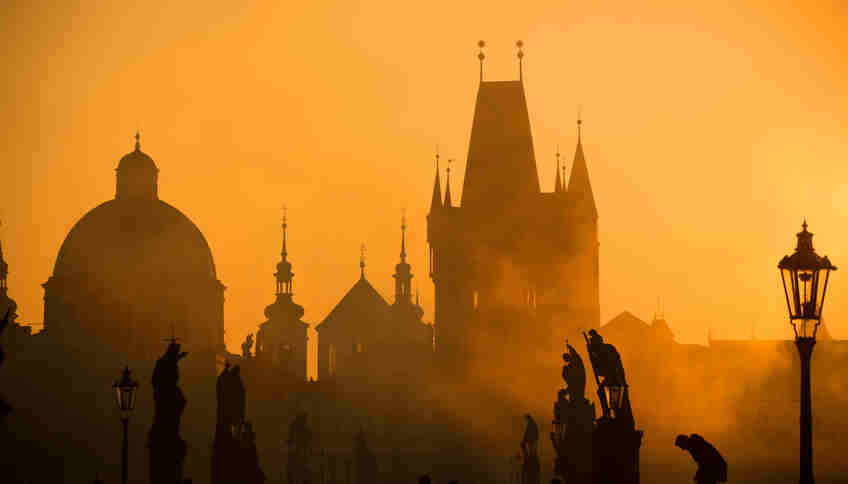
Many sightseeing routes around Prague begin at the Powder Tower, and for good reason. This is where the Royal Route once started on its way to Prague Castle. We will follow suit and begin our walk in the Stare Mesto district.

Powder Tower, Flickr, Vadiroma
Just a reminder: this Prague route is part of our mobile app – the Travel Planner for iPhone and Android. Download it and you can use this walk, offline maps, and GPS – and plan your entire trip to Prague in one place. Download it before you go.
Originally, the gate of the Powder Tower was meant to become one of the 13 entrances to the Old Town as well as an ornament for the royal palace. But because of mass unrest, the king abandoned the project and moved back to Prague Castle. The tower's rich interior decoration was almost completely lost in the mid-18th century during the Prussian siege.
Gunpowder was stored in the tower for a long time, which is how it earned its name. In the early 19th century it was restored and completed, though no longer in a purely Gothic style, but rather in a pseudo-Gothic one. The facade is decorated with sculptures of Czech kings watched over by angels. On the corners you can spot allegorical figures representing the virtues of Czech rulers. In the passage beneath the tower stands a knight's bust with an inscription calling on the people of Prague to live with order and honesty.
Today, the Powder Tower houses a museum that often hosts photography exhibitions. The interiors are done in Gothic style, and the windows are decorated with stained glass. The vaulted ceilings on the different levels deserve special attention – all of them are adorned with coats of arms and the "eagles" of the Czech lands.
We pass through the Powder Tower and step out onto present-day Celetna Street, which was once the Royal Route leading through the central market square to the royal residence. Our next stop is the House of the Black Madonna – and those famous cube-shaped cream-cheese pastries.
Every time you book hotels on Booking.com through our site, you help us cover one more place, create one more route, or build one more city guide. Thank you for that!
banner booking
This house is a rare example of Cubist architecture. Remember Picasso? It is almost the same idea, only in architectural form. The building was erected in 1919 on the site of a collapsed mansion, and the project was designed by the young, little-known-at-the-time architect Josef Gocar.
The ground floor of this very un-Prague-like house was given over to shops, the second floor became the now-iconic Grand-Cafe Orient – where you can try those famous cube-shaped pastries – and the top two floors were used for offices and living quarters.

The House of the Black Madonna, Flickr, 08 ROTCH simoneau
Today, the building's function has changed only halfway: the shop and cafe still operate as before, while the third and fourth floors are now home to the relatively new Museum of Cubism.
Its collection was assembled from three other Prague museums: the National Museum, the Museum of Decorative Arts, and the National Gallery. As a result, the Museum of Cubism now holds the largest collection of its kind in the world. The exhibits include Czech paintings, furniture and decorative pieces, as well as sculpture – all, of course, in the Cubist style.
As for the name, "At the Black Madonna" comes from the house sign on the corner of the building: a black Madonna holding the infant Jesus, created back in the 16th century.
Other walking routes in Prague:
As you approach famous Old Town Square along Celetna Street, you will spot one of the city's great landmarks. The silhouette of Tyn Church appears on what feels like half the postcards in Prague. It has become not only a spiritual center, but also one of the city's most recognizable symbols. Much of its almost mystical charm comes from its two pointed towers, visible from nearly anywhere in town, and from the many legends woven into its history. Read more in our separate article on Tyn Church.

Tyn Church, FLICKR, JOSED
Everything you need to know before your first trip to Prague – tips for independent travelers.
After visiting Tyn Church, it is time to take in Old Town Square, a place with truly magical charm. It first appears in 12th-century chronicles, when a large city market still stood here. Coronation processions, fairs, and parades once passed through this square; today, travelers stroll across it while horse-drawn carriages roll by. It is a fairy-tale setting where the air always seems filled with celebration – and the scent of freshly baked trdelnik. If you are wondering what to see in Prague, this belongs near the very top of the list. Read more in our article about Old Town Square.

View of Old Town Square and Tyn Church from the Town Hall. FLICKR, DMITRY RUKHLENKO
Old Town Square has at least a dozen attractions, but the most famous is the Prague Astronomical Clock, which has decorated the Town Hall tower for more than 500 years. Travelers come from all over the world to see it, and locals often arrange to meet beneath the Orloj. It is not only a beautiful invention and a brilliantly engineered mechanism, but also a little performance staged every hour from 8 a.m. to 9 p.m. Small figures emerge from the windows above the dial and play out a scene worthy of a medieval puppet theater. Read more in our separate story about the Prague clock.

The Prague Astronomical Clock, Flickr, Caligo Mentis
We have created special audio walks around Old Town Square and the Jewish Quarter, available in our Ever.Travel mobile app for iPhone and Android. Download it and explore the city in a more engaging way.
Not far from Prague's famous Orloj stands another fascinating city landmark: the so-called House at the Minute. Its name most likely comes from the fact that tobacco and all sorts of small goods were once sold here – the kind of things people referred to with the old word "minuciozni."

The facade of the House at the Minute, Flickr, kingfisher001
It is almost impossible to walk past this building without noticing it – the whole facade seems covered in delicate ornamental drawing. Interestingly, the house was originally built in the Gothic style in the early 15th century. A century later it was remodeled in the Renaissance spirit, and that was when it gained its unique painted decoration. Later, during a Baroque reconstruction, the paintings were covered up, only to be revealed again after the 1919 restoration.
The technique used here is called sgraffito, which literally means "scratching." It is created in a clever way: two differently colored layers of plaster are applied to the facade, then the still-damp top layer is scratched with a special tool to reveal the lower layer and create the design.
The walls of the House at the Minute feature numerous historical figures, scenes from mythology and the Bible, as well as allegorical figures representing human virtues.
By the way, the Stare Mesto district is a wonderful place to stay in Prague. You can find hotels in the center on Booking.com. Every time you book a hotel through our site, you help us describe one more place, create one more route, or build one more city guide. Thank you.
We continue in the same direction and arrive at famous Charles Bridge, marked by the tower named after the district where it stands – Stare Mesto. Unlike the towers on the opposite bank in Mala Strana, the Old Town Bridge Tower was built in the same years and by the same craftsmen as Prague's most famous bridge itself. In fact, Peter Parler's workshop built what feels like half of Prague's finest landmarks at the turn of the 14th and 15th centuries: St. Vitus Cathedral, Tyn Church, Charles Bridge, and more. Work on the tower was completed in 1380.

Flickr, Marcel Musil
Time has clearly left its mark on the appearance of this structure. Historians note that the Old Town Tower was once even more beautiful: its roof was covered with gilded plates, and the most important elements of its sculptures and statues were also finished with precious metal.
Still, those changes have done little to diminish travelers' fascination. The tower remains just as popular with people crossing through its gate onto Charles Bridge as with those climbing to its viewing terrace. Just 138 steps – and a wonderful panorama of Prague and the Vltava opens before you.
From here, we step onto Charles Bridge and head toward another Prague district – Mala Strana.
- A separate walking route through Mala Strana
Hard to believe, but this bridge is more than 630 years old. It has witnessed some of history's most important moments and seen many kings pass by. It owes its name to one of them – Charles IV. Today, Charles Bridge is one of Prague's most popular sights. Every day, hundreds of travelers stroll across it, taking photos against the backdrop of graceful statues and retelling old legends to one another. In our separate article on Charles Bridge, you can read a couple of especially interesting stories…

View of the Old Town Tower of Charles Bridge, FLICKR, BES-JUNIOR
Charles Bridge famously connects two Prague districts: Stare Mesto and Mala Strana. That is why the bridge towers on each side carry matching names: the Old Town Tower marks the crossing from the east, while the two Lesser Town towers stand on the west.

Lesser Town towers, honzas55.rajce.idnes.cz
Although the Lesser Town towers are linked by a stone arch, they differ noticeably in height, appearance, and even history. The lower tower dates back to the 12th century. At first it served as part of the riverbank fortifications, and later it was used as a prison for especially dangerous criminals. From the 16th century until the end of the 18th, it also housed a customs office.
The other tower – the taller one – was built in the mid-15th century, three centuries later than its neighbor. Its style is a little different and closer to that of the Old Town Bridge Tower. The facade was meant to be decorated with statues of Czech kings, and special niches were even prepared for them. But the Hussite wars put an end to those plans. As for its purpose, the tower was used as a storehouse and also served as a signal tower. Today it has been fully restored and is open to visitors.
Passing through the gate of the medieval towers, we enter Mala Strana. Following Mostecka and Nerudova streets – and Nerudova is famous for its unique houses, almost every one with its own name – we make our way to Hradcany Square. It could almost be called Palace Square, since it is lined with beautiful palaces from many different periods and styles.
Long ago, the lands of Hradcany were set aside for servants and attendants, but over time the district grew into a separate little town, now one of Prague's historic quarters.
Visitors come to Hradcany Square not only for the views, but also for the entertaining sight of the changing of the guard at the entrance to the President's residence. It takes place every hour, and at exactly noon it is accompanied by music.

Prague Castle, Flickr, Tarakanov Dmitry
One of the most striking landmarks on Hradcany Square is the Marian Column, also known as the Plague Column. Like many similar monuments across Central Europe, it was erected in gratitude for deliverance from the plague. In the early 18th century, the disease claimed thousands of lives. In 1713–14, mass prayers to the Virgin Mary were held on the very spot where the column stands today, crowned by her statue.
You can also see a monument to Tomash Masaryk, the first president of Czechoslovakia. It is probably the newest monument on the square, installed in 2000. Nearby, a path leads to a viewpoint with a stunning panorama over Prague. You may want to stop there first before heading on to one of the Czech capital's greatest landmarks – Prague Castle.
You will find all of the walking routes mentioned here in our free mobile app – the Travel Planner for iPhone and Android.
This ancient fortress, made up of several buildings, churches, and defensive structures, now serves as the official residence of the Czech president. It is also the largest presidential residence in the world. The same superlative applies to the fortress itself – it is Europe's oldest and largest castle complex, covering roughly 70,000 square meters.

Prague Castle, Flickr, Pantchoa
The greatest architectural jewel of Prague Castle is St. Vitus Cathedral. The cathedral was built in the 14th century, while the fortress itself dates back much earlier.
It is worth coming here for a full day – or better yet, setting aside several. Visiting Prague Castle is not just sightseeing, but a wonderfully absorbing journey in a kind of time machine. Read more in our separate article.
The tips of this cathedral's towers are visible from almost anywhere in Prague, but nothing compares to seeing it up close. The view is so breathtaking that it never really stops amazing you, even if you have been here before.

jrsretirement.blogspot.ru
St. Vitus Cathedral is a monumental building and one of the most beautiful churches in the world. It is also one of Europe's most famous long-term construction projects. Work began in the 14th century and continued for nearly six centuries – perhaps the most famous architectural marathon in Europe.
Over those centuries, decorative elements from many eras became woven into its architecture: Gothic, Rococo, Renaissance, and Baroque. The finest craftsmen from Bohemia, France, and Germany worked on the cathedral. Its famous stained-glass windows – which flood even gray days with color – were created from designs by Czech-Moravian artist Alphonse Mucha.
The cathedral facade is richly decorated with reliefs and delicate stonework, while the interior enchants with soaring vaults, beautiful statues, and intricate carving. And that is not all: St. Vitus Cathedral is home to what may be Europe's finest organ. Attending an organ concert here deserves a place on any Prague cultural itinerary.
The easiest way to explore Prague Castle is with our guide. After seeing the highlights – because fitting everything into one day is nearly impossible – make your way to one of the city's most intriguing little streets.
Colorful, tiny, and straight out of a fairy tale, the little houses of Golden Lane await you inside Prague Castle. Each one is unique in its own way, and some have long inspired legends and mysterious tales.

foto.mapy.cz
Take house No. 13, for example. They say there is a little window there through which you can look into another reality. Most likely, this is a loose retelling of the novel "The Golem," which describes a house at the end of Golden Lane – but who knows? In the magical atmosphere of old Prague, it is hard to say anything with complete certainty.
Franz Kafka, with all his wonderfully unusual writing, once lived right here on Golden Lane. And do you know why it is called "golden"? According to legend, the city's jewelers and alchemists were settled here so the king could always stay informed about all the truly "precious" developments.
By the way, you do not necessarily need to buy a ticket for Golden Lane: after 6 p.m., you can enter for free. The only catch is that many of the little houses may already be closed. Most of them now contain souvenir shops, where you can buy anything from tableware and coins to postcards, paintings by local artists, and even antique weapons. But many visitors simply prefer to wander the picturesque corners and take photos beside the houses and flowerbeds.
And that brings our guide to what to see in Prague in one day to a close. But if you decide to stay in the Czech capital a little longer, we recommend exploring more walking routes and downloading our mobile app for iPhone and Android, so you can use everything we talk about right on the ground.
See also these other Prague routes: