Plaka

Flickr, Tilemahos Efthimiadis
Plaka (Greek: Πλάκα) is the oldest district of Athens, located at the foot of the northern and eastern slopes of the Acropolis, with a labyrinth of narrow streets and houses built in the neoclassical style. Adrianou Street, located in Plaka, is the oldest street in Athens and, as excavations have shown, has preserved its course since ancient Greek times. Many houses stand on foundations from antiquity, although their facades were erected in the XVIII century. In the 60s of the XX century, many residents moved to other districts of Athens, and the empty houses and courtyards were taken over by taverns and wine cellars. At the end of the 70s, souvenir shops were added to them. The excellent location and numerous pedestrian streets have turned Plaka into an excellent place to live, and now real estate prices in the area are comparable to those in the fashionable districts of Athens.

Flickr, bradhostetler
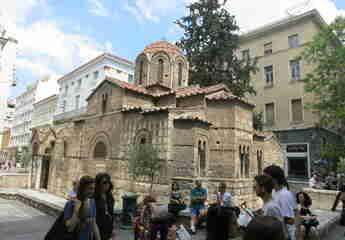
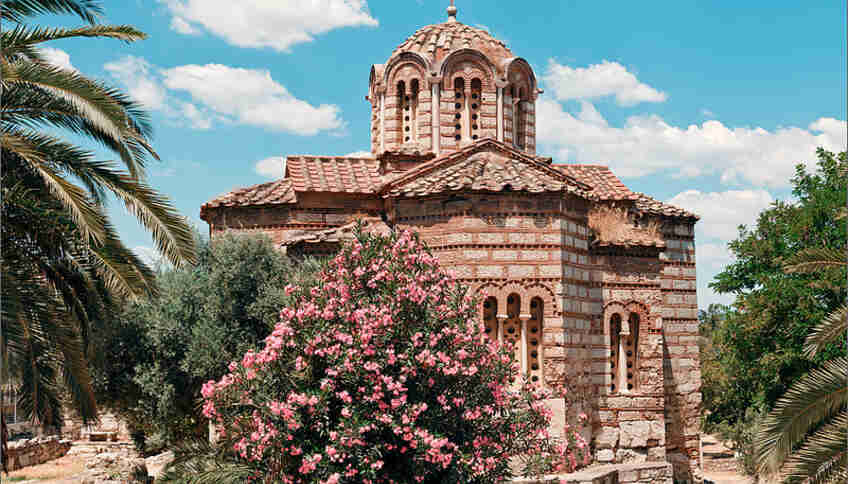
This low, squat church, built of roughly hewn stones, appeared in the center of Athens on the site of an even older ancient temple in the middle of the XI century. The Chapel of Saint Barbara with a dome and the outer porch-narthex were added later. The result was a three-part building of an unusual shape, unfamiliar to the eye both then and now. This, however, did not prevent the church from becoming well visited and beloved by the people.
However, in 1834 it came under threat: the large-scale rebuilding of the city required new roads, and the old church blocked the path of one of them. But the father of the Greek king Otto opposed the demolition of the church, the bishop supported him, and Kapnikarea remained whole and unharmed.
The church operates on an unusual schedule: on Monday, Wednesday, Saturday and Sunday from 8:00 to 14:00, on Tuesday, Thursday and Friday from 16:30 to 21:30. If you are lucky enough to get inside, pay attention to the paintings adorning the walls. In the middle of the XX century they were created by the renowned Greek artist and icon painter Fotis Kontoglou, whose style combines Byzantine traditions and modern pictorial techniques. He is recognized as the founder of a separate movement in Greek painting, and his works occupy a place of honor in the National Art Gallery.
Cathedral of the Annunciation of the Virgin Mary

Flickr, Biffo1944
The Cathedral of the Annunciation of the Virgin Mary in Athens (Greek: Καθεδρικός Ναος Ευαγγελισμού της Θεοτόκου), often referred to simply as Mitropoli, is the cathedral of the Archbishop of Athens and all Greece. Construction of the cathedral began on Christmas Day 1842; its foundation stone was laid by King Otto of Greece and Queen Amalia. Marble from 72 churches in Athens that were being demolished at the time was used to build the church. The overall project involved 3 architects, including Theophil von Hansen. Three years later all construction work was completed. On 21 May 1862, the cathedral was consecrated in honor of the Annunciation of the Mother of God (Ευαγγελισμός της Θεοτόκου) in the presence of the king and queen of Greece. The cathedral is domed and three-aisled. Inside the church are the tombs of two saints of Greece, killed by the Turks during Ottoman rule: Saint Philothei and Patriarch Gregory V of Constantinople.

sobory.ru, oldboy
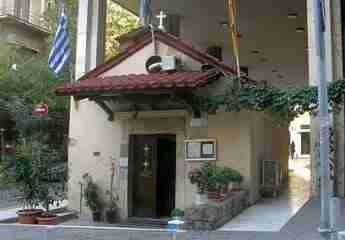
Agia Dinami Church is located literally beneath the building of the Ministry of Education and Religion. In antiquity, a Temple of Hercules stood on this site. The Christian church here was built in the XV century, and it acquired its modern appearance in 1912.
During the active development of the city, it was supposed to be demolished, had it not played an important role in the Greek Revolution. The Turkish occupiers used the ancient church as a factory for producing bullets, but the women workers managed to secretly carry ammunition out and pass it to the fighters for independence.
To preserve the historic landmark, it was decided to build a new house around it. It should be noted that this looks rather strange and unusual: the tiny church seems squeezed between the columns of an office building in the city's business district. Still, it is very convenient for officials and clerks to stop in here on their way to work to pray and light a candle.
It is believed that the holy power of the Virgin especially protects pregnant women and women in labor, so women from all around also often visit this original church at the corner of Pentelis and Mitropoleos streets. Behind the modest facade is a staircase leading downward - the main rooms of the church are underground.
National Historical Museum

Flickr, Robert Wallace
The National Historical Museum (Greek: Εθνικό Ιστορικό Μουσείο) is located on Stadiou Street in Athens. From 1875 to 1932, the palace housed the Greek Parliament, so the building is still often called the Old Greek Parliament (Greek: Μέγαρο της Παλαιάς Βουλής). Originally, the estate of the Athenian magnate Kontostavlos stood on this site. After Athens became the capital of Greece in 1833 (after Nafplio), King Otto chose the Kontostavlos house as his residence until the new Royal Palace - now the Greek Parliament - was built. In 1835, large ballroom and banquet halls were added. After the uprising of 3 September, which forced King Otto to grant a constitution, the National Assembly met in this building for the first time. In October 1854, the entire house burned down in a fire. The construction of a new building was planned according to the design of the French architect François Boulanger.
Monument to Theodoros Kolokotronis

album.foto.ru, Raveman
The Athens Monument to Theodoros Kolokotronis is an equestrian monument to the Greek military leader, a general of the national liberation revolution of 1821-29, Theodoros Kolokotronis, in the Greek capital of Athens, one of the city's most beautiful monuments. The Athens monument to Theodoros Kolokotronis is located on a small plaza in front of the building of the National Historical Museum (the so-called Old Greek Parliament) on Stadiou Street in the city center. The author of the monument, the Greek sculptor Lazaros Sochos, sculpted the Greek national hero in 1900 in Paris. The monument to Theodoros Kolokotronis was installed in its current location in 1904.
Cathedral of Saint Dionysius the Areopagite

livejournal.com, lyonka72
The Cathedral of Saint Dionysius the Areopagite (Greek: Καθεδρικός Ναός του Αγίου Διονυσίου του Αρεοπαγίτη) is a Catholic church located in Athens, Greece. The church is the cathedral of the Archdiocese of Athens and is named after Saint Dionysius the Areopagite. A plot of land for the construction of the church was acquired by the Greek Catholic community in 1847. The design of the church was drawn up by the German architect Leo von Klenze, who took as his model the Church of St. Boniface Abbey in Munich. Construction of the church began in 1853 and was completed in 1865. The construction was supervised by the Greek architect Lysandros Kaftanzoglou, who made some changes to the original design. The consecration of the church took place on 4 May 1865. In 1877, Pope Pius IX declared the Cathedral of Saint Dionysius the Areopagite a minor basilica.
Academy of Athens

Flickr.com, Tilemahos Efthimiadis
The Academy of Athens is the national academy of Greece and the country's largest research institution, operating under the supervision of the Greek Ministry of Education and Religion. The Academy of Athens was founded on 18 March 1926 and owes its name to Plato's ancient Academy. The academy's official charter was established by a government decree of 1929. With some changes and additions, this decree remains in force to this day; according to it, the main areas of activity of the National Academy of Greece are: Under the auspices of the Academy of Athens operate 12 research centers, 10 research divisions, and the central library named after Ioannis Sykoutris. In 2002, the Biomedical Research Foundation of the Academy of Athens was established. The Greek Institute of Byzantine and Post-Byzantine Studies (Venice) also operates under the Academy's supervision.
University of Athens

Flickr.com, elias filis
The National and Kapodistrian University of Athens (Greek: Εθνικό και Καποδιστριακό Πανεπιστήμιο Αθηνών), often called simply the University of Athens, is the oldest university in Greece, founded in 1837. It is now the country's second largest higher education institution after Aristotle University in Thessaloniki. The University of Athens was founded on 3 May 1837 and housed in the estate of the architect Stamatios Kleanthis. It became the first university not only in Greece, but also in the Balkans and the eastern Mediterranean region, and had 4 faculties: theology, law, medicine, and arts (which included applied sciences and mathematics). 33 professors taught 120 students. Before the university received its modern name in honor of the first president of Greece, Ioannis Kapodistrias, it was known as the University of Otto - after the first king, Otto of Bavaria. In November 1841, classes were moved to a new, just-built building.
National Library of Greece

Flickr.com, twiga_swala
The National Library of Greece (Greek: Εθνική Βιβλιοθήκη της Ελλάδος, English: National Library of Greece) is the national library, the central depository of printed materials, the center of national bibliography (Hellenistics), and the ISBN, ISSN and ISMN center of the Hellenic Republic. The library's main building, along with the Kapodistrian University of Athens and the National Academy, forms part of the neoclassical Athenian Trilogy, created according to the design of the architect Theophil von Hansen. It is executed in the Doric order. The original idea of creating the National Library belonged to the famous Swiss philhellene Jakob Meyer. It was published in August 1824 in Meyer's article for the newspaper Greek Chronicle of the city of Mesolongion. This idea was taken up by the new Greek government headed by Ioannis Kapodistrias, who rallied around it such intellectual institutions as educational establishments, national museums, and publishing houses.