Alexanderplatz

mytravelphotos.net
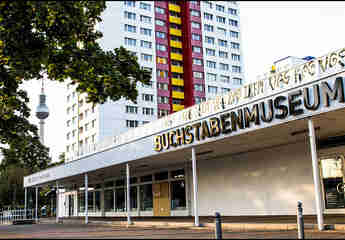
Alexanderplatz (German: Alexanderplatz, Alexander Square) is one of the most famous squares in Berlin. Like Berlin as a whole, it combines the past and the present in the architecture of its buildings. The square is always crowded and noisy; three lines of the Berlin U-Bahn, tram lines, and commuter train lines intersect here. More than 350,000 people change trains here or pass through the square every day, and the entire square is a pedestrian zone[1][2]. In 1805, there was a large market square on this site, which was later named after Russian Emperor Alexander I. Due to rapid population growth during industrialization, Alexander Square became popular among poor people. Pre-war buildings have also been preserved on Alexander Square (Alexanderhaus (Sitz der Bankgesellschaft Berlin) and Berolinahaus). Between 1966 and 1970, the square was built up with new buildings, and its size also increased toward the center of East Berlin.

Flickr, @Medienfuzzi
Alexanderplatz has special significance for travelers from Russia, because its name is directly connected with their homeland. It was here, on October 25, 1805, that Russian Emperor Alexander I the Blessed was ceremonially received, and this square was later named in his honor.
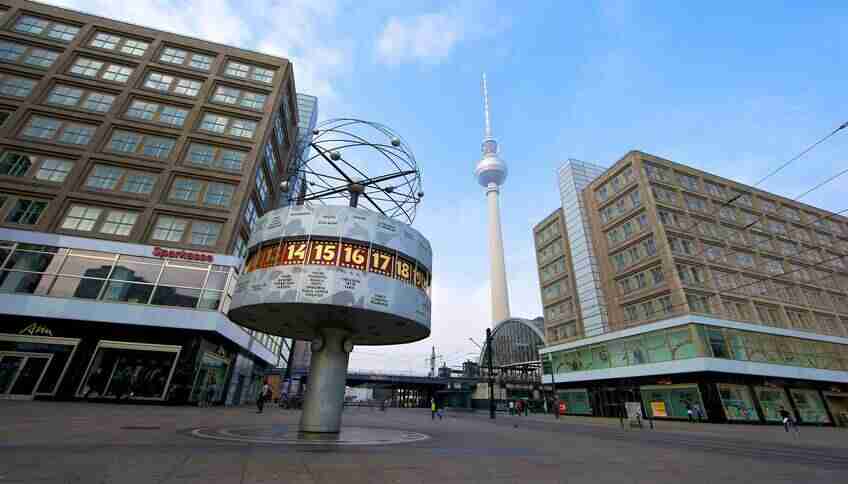
One of the most significant attractions adorning Alexanderplatz is the “World Clock,” or “Urania” - the embodiment of peace and freedom across the entire planet. It appeared in the square in the autumn of 1989, immediately after the fall of the Berlin Wall.
The clock is crowned with a symbolic inscription: “Time will destroy all walls.” This monument, along with the fallen Wall, became a symbol of a new era and the beginning of change. The idea for the “World Clock” belongs to designer Erich John, and it was realized by Hans-Joachim. Interestingly, this monument is unique not only for its appearance, but also for its mechanism - rotating around a huge column, the clock shows the current time in the world's largest cities.
Berlin TV Tower

Flickr, georgechamoun1984
The Berlin TV Tower, 368 m high, is the tallest structure in Germany and, after the Ostankino TV Tower in Moscow (540 m), the Kyiv TV Tower, and the Riga TV Tower, the fourth-tallest TV tower in Europe. It should not be confused with the radio tower in the western part of the city. Plans to build a TV tower in Berlin in the southeast of the city on the Muggelberge hills appeared back in the 1950s, but construction of the tower was suspended because of its proximity to Berlin-Schonefeld Airport. In 1964, SED chairman Walter Ulbricht decided to build the TV tower on Alexanderplatz. Construction work began on August 4, 1965. After the actual cost of the TV tower grew to six times the planned amount and reached 200 million marks, the head of the TV tower construction project and chairman of the German Building Academy, Gerhard Kosel, lost his post in the same 1965.
St. Mary's Church

Flickr, eaglelam89
St. Mary's Church (Marienkirche) (German: St. Marienkirche Berlin) is the oldest still-active church in Berlin, one of the six medieval churches that once stood in the city's historic center. The church is located on Karl-Liebknecht-Straße (German: Karl-Liebknecht-Straße). The first mention of a church with its own parish in Berlin's “New Town” dates back to 1292. A hall church of bright red brick in the style of Brandenburg Brick Gothic was erected on a foundation of cobblestone and granite. The tower, damaged by fires, was reconstructed in the Baroque style in 1663-1666 by Michael Matthias Smids and later in the Neo-Gothic style in 1789-1790 by Carl Gotthard Langhans. In 1893-1895, the church underwent a major restoration by Hermann Blankenstein, and after the Second World War it was restored in 1969-1970.
Neptune Fountain

Flickr, Berlin-bleibt-Berlin.de
The Neptune Fountain (German: Neptunbrunnen) is located in the center of Berlin between Marienkirche and the Red Town Hall. It is one of the oldest and most beautiful fountains in the city. The maximum diameter of the fountain basin made of Swedish granite is 18 meters, the height of the central part to the top of Neptune is 8.50 m, and to the trident - 10 m.
Red Town Hall

Flickr, V.C. Alblas
The Red Town Hall (German: Rotes Rathaus) is a historic building in the center of Berlin, named for its red-brick facade. It was built in 1861-1869 in a semi-Renaissance, semi-Gothic style according to the design of architect H. F. Wesemann. The height of the four-sided tower of the town hall, built in the image and likeness of the towers of Laon Cathedral, is 74 meters. During the Second World War, the building was destroyed; it was restored in 1951-1958 with changes to the interior. On the first floor are the Coat of Arms Hall and the Column Hall, which serve representative functions. After restoration, the Berlin City Representative Assembly and the magistrate of East Berlin of the GDR were housed in the Red Town Hall. Since October 1, 1991, the building has housed the seat of government (the Senate) of the unified state of Berlin. The office of the governing burgomaster (mayor) of the city is also located here.
Nikolaiviertel

Panoramio, TitTornade
Nikolaiviertel (German: Nikolaiviertel - “Nicholas Quarter”) is a historic quarter in Berlin's Mitte district on the eastern bank of the Spree, bounded by the river, Rathausstraße (German: Rathausstraße), Spandauer Straße (German: Spandauer Straße), and Mühlendamm (German: Mühlendamm). At the center of Berlin's oldest residential quarter stands St. Nicholas' Church. In the Middle Ages, trade routes passed through here. Craftsmen and merchants settled where the road crossed the river. Around 1200, a late Romanesque basilica appeared - St. Nicholas' Church. Berlin developed around two centers: Berlin proper - the larger settlement east of the Spree - and Cölln, located directly opposite it on the western bank of the river. The two settlements were connected by the Mühlendamm Bridge. The settlements received town rights by 1230. The first surviving document mentioning Cölln is dated October 28, 1237. The first written mention of Berlin dates to 1244.

Flickr, Gertrud K.
St. Nicholas' Church (German: Nikolaikirche) is the oldest church in Berlin. It is located in the historic St. Nicholas Quarter (Nikolaiviertel). At present, the church is a branch of the Brandenburg Museum within the Berlin City Museum Foundation, where concerts are also regularly held. Nikolaikirche, built in 1220-1230, was a three-aisled cruciform basilica of natural stone and dedicated to St. Nicholas the Wonderworker. In the 13th century, the church was rebuilt into a Gothic hall church. In 1461, the Berlin bakers' guild, which in the Middle Ages belonged to the four wealthy estates, commissioned an altar for the church and undertook to pay an annual rent to the church sexton. The Church of St. Nicholas retained its asymmetrical appearance with one tower until the end of the 19th century. During the major reconstruction of the church in 1876-1878 under the direction of Hermann Blankenstein, the church acquired a Neo-Gothic facade with two towers.