
Campo de' Fiori

Flickr, erburnett
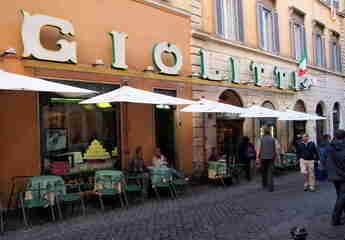
Campo de' Fiori (Campo de' Fiori; lit. ‘field of flowers’) is a rectangular square in the center of Rome, halfway between Piazza Navona and Palazzo Farnese. In the Middle Ages this land belonged to the Orsini family and remained undeveloped until the 15th century. Although Bramante erected the magnificent Palazzo della Cancelleria in this quarter, the development of the square is still disorderly: inns and the houses of market traders are mixed together here (vegetables and fish are still sold on the square today). The statue of Giordano Bruno, installed in 1889 on the spot where the philosopher was burned, reminds visitors that public executions were held at Campo de' Fiori for a long time.
We recommend downloading audio guides to Rome to your smartphone before your trip. These are fascinating stories prepared by a professional guide to Italy, a narrator, and a sound engineer. By listening to them during your walks through the Eternal City, you will discover an incredible number of interesting stories and amazing facts!
Piazza Navona

FLICKR, TOBI_2008
Piazza Navona (Italian Piazza Navona) is a Roman square in the shape of a rectangle elongated from south to north. From the 15th century until 1869 it was the site of the city market. It was built up in the 17th century in the Baroque style. Two churches face the square, including the Church of St. Agnes (1652, architect Girolamo Rainaldi), and several palaces, including Palazzo Pamphilj (built for Innocent X in 1644-50, with frescoes by Pietro da Cortona; now the Brazilian Embassy). Agones (Greek for ‘competition’) were held in the stadium until the 4th century. This word gave the square its name — Navona: in the Middle Ages it was campus agonis or in agone, then n’agone, and finally navone/navona. In the Middle Ages the square was also known as the Circus of Alexander Severus; Ordo Romano and Mirabilia (12th-13th centuries) mention the theater or circus of Alexander.
Pantheon

Flickr, williamcho
The Pantheon (Ancient Greek πάνθειον — a temple or place dedicated to all gods, from Ancient Greek πάντες — all and θεός — god) is the ‘temple of all gods’ in Rome, a monument of centrically planned domed architecture from the flourishing period of Ancient Roman architecture, built in 126 AD under Emperor Hadrian on the site of an earlier Pantheon erected two centuries before by Marcus Vipsanius Agrippa. The Latin inscription on the pediment reads: ‘M. AGRIPPA L F COS TERTIUM FECIT’, which translates as: ‘Marcus Agrippa, son of Lucius, elected consul for the third time, built this.’ It is a great engineering achievement of antiquity. It stands on Piazza della Rotonda. In terms of composition and structural design, the Pantheon is unique in ancient Roman architecture. It is distinguished by the classical clarity and integrity of its interior composition and by the majesty of its artistic image. It is possible that Apollodorus of Damascus took part in the construction of the temple.
Column of Marcus Aurelius

Flickr, grey:wolf
The Column of Marcus Aurelius (Latin Columna Centenaria Divorum Marci et Faustinae, Italian Colonna di Marco Aurelio) is a Doric column located in Rome on the square named after it, Piazza Colonna (Italian Piazza Colonna). It was erected in memory of Marcus Aurelius’s Marcomannic War, and Trajan’s Column served as its prototype. The height of the column is 29.6 m, its pedestal is 10 m. The total height of the monument was 41.95 m, although 3 meters of its base ended up below ground level after the restoration of 1589. According to various sources, the shaft of the column consists of 27 or 28 blocks of Carrara marble 3.7 meters in diameter. Like Trajan’s Column, it is hollow, with a spiral staircase of 190-200 steps inside leading to the top, where a sculpture of Marcus Aurelius stood in antiquity. The stairwell is lit through small slits.
Trevi Fountain

Shutterstock
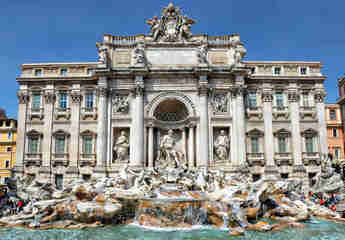
The Trevi Fountain (Italian Fontana di Trevi) is the largest fountain in Rome, 25.9 m high and 19.8 m wide. This Baroque fountain was built in 1732-1762 by the architect Nicola Salvi. It adjoins the facade of Palazzo Poli (Italian Palazzo Poli), whose second floor was rented in the 1830s by Princess Z. A. Volkonskaya. The majestic facade of the palace and the fountain are perceived as a single whole, and so the fountain seems even more grandiose. From the central niche of the palace, Oceanus emerges as if on a chariot, seated on a sea shell pulled by tritons and hippocamps. In the niches on either side of Neptune are allegorical figures, and above them are bas-reliefs. On the right bas-relief, a young girl shows Roman soldiers where the spring is located. An aqueduct was laid from this spring to bring water to Rome, and the aqueduct, like the spring itself, was given the name Acqua Vergine (Acqua means water, Vergine means girl). There is a belief that a person who throws a coin into it will come to Rome once again.
Piazza di Spagna

Flickr, anspics
Piazza di Spagna (Italian Piazza di Spagna) is a square in the center of Rome, in the Campo Marzio district. The square got its name from the Spanish embassy located there. It consists of 2 unequal triangles. In the northern part of the square are the Spanish Steps and the church of Trinita dei Monti; in front of the steps is the Barcaccia fountain in the shape of a boat by Pietro Bernini. In the southern part of the square, since 1620, stands the Palace of Spain (Palazzo di Spagna; Italian Palazzo di Spagna), in front of which rises the Colonna dell’Immacolata — the ‘Column of the Immaculate’, erected in 1854 in honor of the proclamation of the dogma of the Immaculate Conception. Piazza di Spagna is the center of Rome’s fashion district; the most famous Italian fashion brands are represented on Via Condotti, which begins at the square.
Trinita dei Monti

Flickr, Luigi Strano
Trinita dei Monti, also Santissima Trinità al Monte Pincio, is a titular church (since April 13, 1587) in Rome, at the top of the Spanish Steps. Construction of the church began in 1502 at the order and expense of King Louis XII of France and continued until 1585. In 1816 the church suffered serious damage, after which it was substantially rebuilt. The ancient obelisk (a Roman imitation of an Egyptian obelisk) from the Gardens of Sallust was installed here in 1789. The church houses Daniele da Volterra’s masterpiece ‘Descent from the Cross’. The church of Santa Trinita dei Monti is a titular church; since October 21, 2003, the cardinal-priest of the title of Santa Trinita dei Monti has been the French cardinal Philippe Barbarin.
Piazza del Popolo

Flickr, ethan-lin
Piazza del Popolo (Italian Piazza del Popolo — ‘People’s Square’[1]) is a square in Rome from which the streets of Corso (leading to Piazza Venezia), Babuino (to Piazza di Spagna), and Ripetta (to the Mausoleum of Augustus) radiate southward. The angles between the streets are occupied by the very similar-looking propylaea churches of Santa Maria dei Miracoli (1681) and Santa Maria in Montesanto (1679). To the north, meanwhile, the ancient Via Flaminia leads toward Rimini, and for centuries it was along this road that most travelers arrived in Rome. Piazza del Popolo acquired its present form in 1811-22 thanks to architect Giuseppe Valadier. He connected the square to the slope of Pincian Hill with the Napoleonic Stairway, on which the gardens of Villa Borghese stretch out. In the middle of the square rises a 36-meter Egyptian obelisk whose inscriptions praise the deeds of Pharaoh Ramesses II. This obelisk was transferred from Heliopolis to Rome at the whim of Octavian Augustus in 10 BC.