Moldavanka

Flickr, Aleksey Grachev
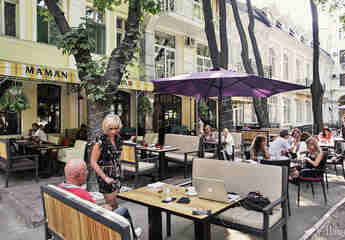
Moldavanka is a historic part of the city of Odessa in the territory of the Malinovsky and Primorsky districts. In the late 1700s, Moldavanka was a separate settlement consisting of two dozen houses, but in 1820 this area became part of the city. It was a working-class suburb of Odessa, where industrial enterprises were located and where their workers lived. Today Moldavanka still remains primarily an industrial district; however, in recent years residential buildings and office centers have been rising on the sites of a number of industrial enterprises. In the center of Moldavanka is Starokonnyi Market — one of the most picturesque corners of Old Odessa (not far from the bus station). Moldavanka became widely known thanks to Isaac Babel’s “Odessa Stories.” In the post-Soviet space, Moldavanka is mostly known from the couplet in Mark Bernes’s song “Scows Full of Mullet”: In the film “The Drayman and the King,” the song “Moldavanka” is heard. The borders of Moldavanka: east — St.
Odessa Film Studio

panoramio.com, White1
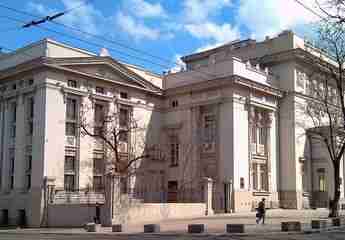
Odessa Film Studio (Ukr. Odeska kinostudiia khudozhnikh filmiv) is a Russian, Soviet, and Ukrainian film studio located in Odessa. One of the oldest film studios of the Russian Empire and the USSR. One of the two centers of film production remaining in Ukraine (the other is in Kyiv).[1] It traces its history back to 1907, when the Myrohraf film atelier was created. It was established as a film studio in 1919 on the basis of private film factories, in 1922 reorganized into the Odessa Film Factory of VUFKU (All-Ukrainian Photo Cinema Administration), in 1929 renamed the Odessa Film Factory “Ukrainfilm,” from 1938 to 1941 — the Odessa Feature Film Studio, during the Great Patriotic War 1941—1945 it was part of the Tashkent Film Studio, and since 1954 it has again operated in Odessa.[2] In 2005 it was reorganized into a CJSC (the state owns the controlling stake). The shareholders of the Odessa Film Studio are the Ukrainian state, represented by the State Property Fund (50 % + 1 share), and LLC “New Film Studio” (50 % - 1 share).

panoramio.com, Igor Belov
The Odessa Sparkling Wine Factory was founded in 1896 as the “Odessa Factory of Henry Roederer.” Although the man after whom the factory was named would more properly be called Henri Roederer — he was the heir to a French winemaking dynasty.
Since 2009, the factory has been part of the “Campari” group of companies. Initially faithful to French traditions, for a long time it produced sparkling wines according to the classic recipe, but in 1952 it moved to a new stage of evolution: champagne began to be made by the tank method, in which the beverage undergoes secondary fermentation in large metal containers.
Nowadays, the factory produces 15 million bottles of champagne every year. Anyone who wants to take a closer look at the process of making this popular sparkling wine can go on a tour of the factory and witness every stage of production — from raw material acceptance to bottling the champagne. Visitors can also look forward to a tasting of more than a dozen varieties of wine.
Victory Park

panoramio.com, Igor Belov
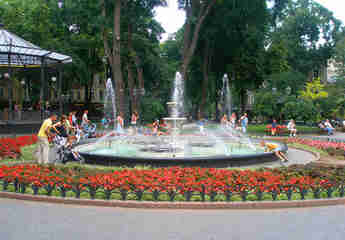
Victory Park is a park-monument of landscape gardening art in the city of Odessa. The author is Odessa landscape architect Maksim Yakovlevich Sereda. In 1967, the project of the first English-style landscape park in the USSR was named the best in the Union and was awarded a VDNKh diploma. In the same year, under the name 'Dendropark named after V.I. Lenin,' it was approved for construction by the Odessa Regional Executive Committee. In 1968, the architectural planning department of GOSSTROY recognized the project as exemplary. It was commissioned in 1971 in unfinished form. Contrary to the recommendation of Gosstroy, construction of the park was carried out without authorial supervision and proper control over the course of construction. It was improved over many years. The total area of the park is currently 48.8 ha. The original area was 50.6 ha — part of the park territory was given over to development. The total length of the reservoirs is 700 m. The total volume of water is 31000 m3. The artificial landscape is represented by hills and ponds, and islands connected to the shore by bridges.
Botanical Garden

cdn.nice-places.com
The Botanical Garden of Odessa is one of the oldest city parks. It was with it that the greening of Odessa began in 1819: the first tree here was planted by Count Alexander Fyodorovich Langeron.
The idea of laying out the garden, however, belonged to the French botanist Karl Desmet. In just a few years, he managed to significantly increase the number of species of shrubs and trees growing in the garden.
Soon after the garden was founded, it was visited by Alexander Sergeyevich Pushkin. And plants were arriving in Odessa from Paris, Budapest, Singapore, Berlin, Palermo, and other corners of the world.
The Botanical Garden rendered a great service to the city — many trees planted on the streets of Odessa originally grew right here.
Today the garden is attached to the biological faculty of Odessa State University named after I.I. Mechnikov, but it is open to everyone. Once here, visitors find themselves in an amazing world made up of several natural zones, where trees from both the tropics and the Siberian taiga grow at the same time. In total, more than three thousand species of plants grow in the botanical garden.

Flickr, Boris Florin
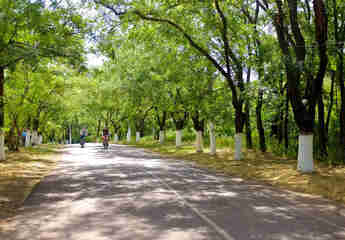
The Health Trail in Odessa is a picturesque road stretching for more than 5 kilometers. It runs along the sea, and along it, in turn, walk, run, and ride bicycles, roller skates, skateboards, and other means of transport many positive, athletic, and cheerful people.
Do you know what terrenkur is? This unusual word refers to therapeutic walking in the fresh air along a specific route. So, in Crimea, near Yalta, special walking routes were laid out for Emperor Nicholas II. And even now the Tsar’s Trail exists there, where the last representative of the Romanov dynasty once strolled in the shade of the trees and admired the sea vistas.
The Odessa Health Trail, unlike the Tsar’s one, is very democratic and accessible to everyone. And the seascapes here are no less captivating.
Odessa residents who lead a healthy lifestyle can be found here practically all year round. Marathons and half-marathons are often organized on the Health Trail, in which everyone can take part.
In recent years, the movement of any transport that pollutes the air with exhaust fumes has been prohibited on the trail. But if you still really want to ride along the Health Trail, you can use the electric car running from Arcadia Beach to Langeron Beach and back.
Arcadia Resort

Flickr, zar_kor
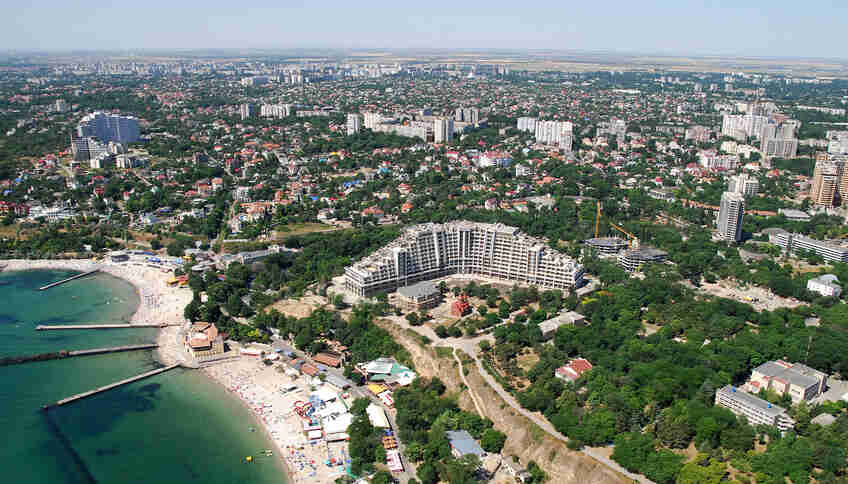
Arcadia is a resort district in the city of Odessa, including the beach of the same name. The district is located in the Primorsky district of the city, on the shore of the Black Sea not far from the 5th — 7th stations of Bolshoi Fontan. The founders of the city chose this particular beach for the resort, because all the beaches of Odessa are reached by steep cliffs and descents that were not easy to go down and, especially, to climb back up, whereas Arcadia is reached by a natural gentle descent (by its origin — a ravine). Residents of Odessa named this district after the mountainous region of Greece in which, in the view of the other Greeks, happiness, peace, tranquility, and simplicity of morals reigned — an idyllic place on earth.

bit.ua
The Odessa club “Ibiza” is the most crowded and popular on the coast. It is located on Genuezskaya Street, in the resort district of Arcadia.
Inside, the two-story building of “Ibiza” resembles a multi-tiered anthill: the walls, partitions, interior decorations, sofas — everything here is snow-white and illuminated by soft neon light, evoking a futuristic landscape.
A table here should be reserved in advance, as there is a chance that on weekends “Ibiza” will be overcrowded, although, strictly speaking, it is not only a club, but also a restaurant and a concert venue.
In summer, world-famous DJs come here to play music in the styles of hip-hop, house, and techno. Every week, famous bands and solo performers appear at “Ibiza.”
The restaurant cuisine is Ukrainian, European, and Japanese, and food can be ordered to go. Free Wi-Fi is available. By the way, for the right to be called the best in Arcadia, “Ibiza” competes with the club “Itaka.”